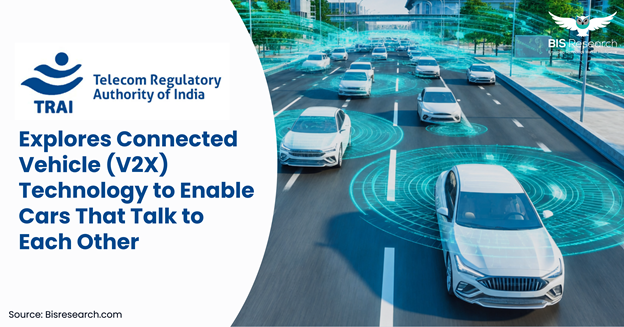
TRAI is examining a regulatory framework for Vehicle-to-Everything communication, or V2X, a technology that allows vehicles to exchange real-time information with other vehicles, traffic signals, roadside infrastructure, telecom networks, and connected devices. The aim is to improve road safety, reduce collision risks, support emergency response, and enable smarter traffic management across Indian roads. As vehicles become more connected, V2X could help create a transport system where vehicles do not operate in isolation but continuously share critical safety and mobility information.
Explore the Automotive V2X Market Before the Your competitors do.
A key benefit of Vehicle-to-Everything or V2X is that it can help vehicles detect risks before they are visible to the driver. For instance, a vehicle approaching a blind curve at high speed can receive an early warning to slow down. At intersections, nearby vehicles can be alerted if another vehicle jumps a red light. In a possible collision situation, the system can support emergency responses such as braking assistance or seatbelt pre-tensioning. Emergency vehicles can also send alerts to surrounding vehicles, helping traffic clear faster and reducing response time during critical situations.
Request a Quote & Unlock Strategic V2X Market Insights Now!
The technology can also improve traffic efficiency. Connected traffic signals can share signal timing information with approaching vehicles, helping drivers adjust speed smoothly and avoid sudden braking. Roadside units can warn vehicles about construction zones, lane closures, congestion, reduced-speed areas, or other road hazards. This can be especially useful in Indian cities, where dense traffic, unpredictable driving behavior, and changing road conditions often increase accident risks and travel delays. By giving drivers timely information, V2X can support smoother movement and better use of road infrastructure.
For India, the regulatory framework will be important because V2X needs reliable communication channels, clear technical standards, and strong coordination among multiple stakeholders. TRAI’s consultation is expected to address issues such as spectrum allocation, communication standards, cybersecurity, data privacy, device certification, infrastructure readiness, and interoperability between vehicles from different manufacturers. Automakers, telecom operators, road agencies, technology providers, and government bodies will need to work together to make deployment practical and scalable.
Download the Complete TOC and Get Ahead of the Connected Mobility Shift
If implemented effectively, V2X could become a key part of India’s intelligent transport system. It can help vehicles anticipate danger, prevent crashes, improve traffic flow, and support faster emergency response. More importantly, it can add a silent but active safety layer to Indian roads, where connected vehicles continuously exchange information to make mobility safer, smarter, and more efficient.