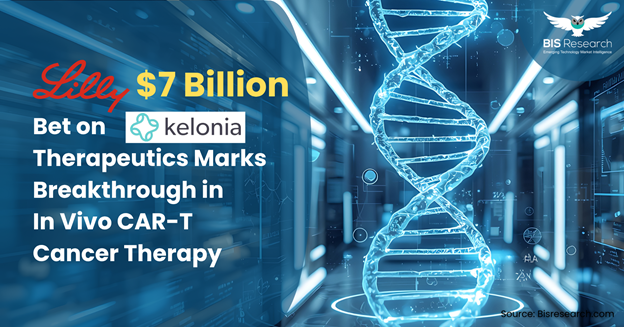
Eli Lilly’s acquisition of Kelonia Therapeutics has quickly emerged as one of the most significant biotech deals of 2026, highlighting the pharmaceutical giant’s aggressive push into next-generation cancer therapies. The deal, valued at $3.25 billion upfront and potentially reaching $7 billion through milestone-based payments, underscores Lilly’s strategy to strengthen its oncology pipeline and compete in the rapidly evolving global cancer drug market, estimated at around $240 billion. The move also reflects a broader industry shift toward innovative cell and gene therapies, particularly in blood cancers such as multiple myeloma.
At the center of the acquisition is Kelonia’s pioneering “in vivo CAR-T” technology, which represents a fundamental departure from traditional CAR-T therapies. Unlike conventional approaches that require extracting, modifying, and reinfusing a patient’s immune cells over several weeks, Kelonia’s platform reprograms T cells directly inside the body. This approach could significantly reduce treatment complexity, improve scalability, and potentially lower costs, while also addressing safety and manufacturing challenges that have limited widespread adoption of existing CAR-T therapies. Early-stage clinical work, including its lead candidate KLN-1010 currently in Phase 1 trials for multiple myeloma, has already generated industry attention for its potential to simplify cancer treatment delivery.
Request sample on CAR-T cell therapy market
The acquisition aligns with Eli Lilly’s broader diversification strategy, particularly as it seeks to balance its heavy reliance on blockbuster diabetes and obesity drugs. Oncology already contributes billions to Lilly’s revenue, but its footprint in blood cancers remains limited, making Kelonia a strategic addition. By integrating Kelonia’s platform, Lilly aims to position itself alongside leading CAR-T developers such as Gilead, Johnson & Johnson, and Novartis, while betting on next-generation “in vivo” solutions that could redefine how cancer is treated.
Download the complete TOC on CAR-T cell therapy now!
Beyond the financial scale of the deal, the underlying science is what makes this development particularly noteworthy. In vivo CAR-T therapies have the potential to eliminate the need for chemotherapy preconditioning, reduce hospital stays, and expand access to advanced cancer treatments globally. While still in early clinical stages, Kelonia’s technology has shown promising initial responses, though long-term safety and durability remain key questions. As the deal progresses toward an expected close in the second half of 2026, it signals growing confidence in a new generation of genetic medicines that could reshape oncology and accelerate the transition toward more accessible, patient-friendly cancer therapies.