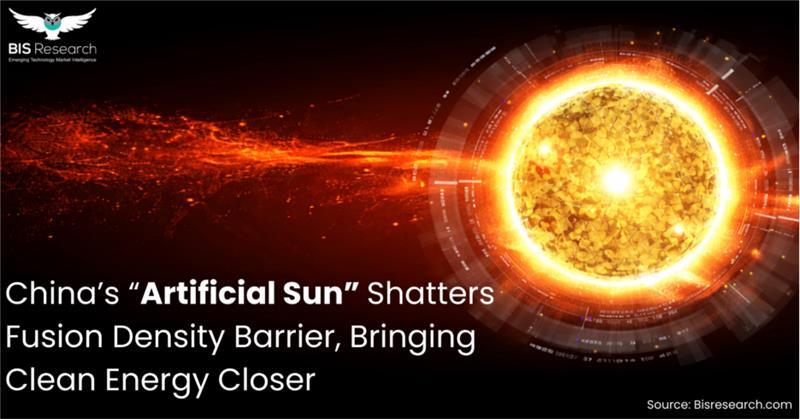
China has reached a historic milestone in nuclear fusion research after its “artificial sun,” the Experimental Advanced Superconducting Tokamak, or EAST, successfully surpassed a long-standing plasma density limit that has constrained fusion experiments for decades. Announced in early 2026, the achievement marks a critical step toward making fusion energy a realistic and scalable clean power source.
The breakthrough was achieved by scientists at the Institute of Plasma Physics under the Chinese Academy of Sciences, working with research partners, at the EAST facility in Hefei, Anhui Province. EAST belongs to the category of magnetic confinement fusion technologies, which use powerful magnetic fields to confine super-hot plasma the same core technology focus highlighted in BIS Research fusion market reports. This alignment places the scientific advance squarely within the broader global fusion development landscape.
Nuclear fusion is widely viewed as the ultimate energy solution because it can generate enormous electricity with no carbon emissions and minimal radioactive waste. However, one of the most persistent challenges has been the plasma density limit, beyond which plasma becomes unstable and fusion reactions collapse. This barrier has slowed progress and increased costs for fusion programs worldwide.
Chinese researchers overcame this obstacle by precisely controlling plasma heating, fuel injection, and plasma-wall interactions. By minimizing impurities and energy losses at the reactor walls, EAST was able to maintain stable plasma at unprecedented densities, entering a confirmed “density-free” regime. From a market relevance standpoint, this progress directly reduces a key technological barrier, potentially accelerating commercial fusion power development an inflection point reflected in BIS Research forecasts of rising investment and demand in the fusion energy market.
The implications of the breakthrough extend beyond physics. BIS Research positions fusion not only as a scientific endeavor but as an emerging commercial energy market, linking experimental successes like EAST to long-term industry growth and commercialization pathways. As governments and private investors seek dependable, carbon-free power sources, such advances strengthen confidence in fusion’s economic viability.
The timing is significant, as energy security, climate targets, and electrification pressures converge globally. Stabilizing higher-density plasma improves reactor efficiency and shortens the path toward deployable fusion systems, reinforcing the business case for utilities, startups, and infrastructure developers.
By clearly addressing who achieved the breakthrough, what was accomplished, where and when it occurred, why it matters, and how it was done, China’s artificial sun experiment marks a turning point. It demonstrates how scientific breakthroughs and market readiness are increasingly converging, bringing fusion energy closer to becoming a transformative pillar of the future global energy system.