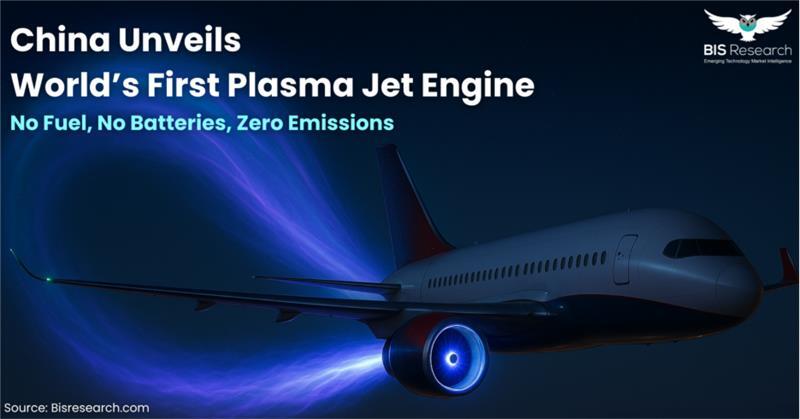
China has introduced a revolutionary plasma jet engine that could reshape the future of aviation. Developed by a research team at Wuhan University, the engine runs without fossil fuels, hydrogen, or batteries marking a major step toward zero-emissions flight.
The technology, led by Professor Jau Tang, uses microwave energy and plasma physics instead of combustion. Unlike traditional jet engines that burn kerosene, this new system compresses atmospheric air and bombards it with 2.45 GHz microwave radiation similar to the frequency used in kitchen microwaves. The radiation strips electrons from air molecules, creating plasma. This ionized gas is then used to produce thrust, effectively powering the engine without any fuel or chemical propellants.
In laboratory testing, the prototype was able to lift a 1-kilogram steel ball vertically. While this is still early-stage, the thrust produced is already comparable to that of smaller commercial jet engines, according to researchers. This suggests that with further development, plasma propulsion could become a viable alternative for short- to medium-range aircraft.
What sets this invention apart is that it sidesteps the challenges faced by hydrogen-powered and battery-electric aircraft. Hydrogen is energy-dense but difficult to store and transport safely. Batteries are heavy and limit flight range. Tang’s design avoids both, relying only on electrical power, which could potentially come from renewable sources like solar or wind.
Plasma, often referred to as the fourth state of matter, has been extensively explored for space propulsion systems, particularly by NASA. However, most plasma thrusters operate in vacuum conditions and generate only minimal thrust. The Wuhan team’s innovation lies in enabling propulsion to function in open air by using microwave ionization to create and sustain the plasma required for lift.
The global space propulsion systems market is witnessing strong momentum, driven by:
Electric and plasma propulsion segments are projected to register the fastest growth rates during the forecast period, supported by rising investments in satellite miniaturization and long-duration space missions. Government-backed space programs across Asia-Pacific, North America, and Europe are further accelerating commercialization.
According to BIS Research, the Global Space Propulsion Systems Market provides an in-depth analysis of next-generation propulsion technologies shaping the future of satellite mobility, deep space missions, and defense space programs. The report delivers comprehensive insights into market size, growth forecasts, technology evolution, competitive benchmarking, and regional investment trends across electric, chemical, and hybrid propulsion systems.
Download Space Propulsion Systems Market Report ToC
How BIS Research Adds Value
The report offers:
This intelligence enables aerospace OEMs, defense contractors, space agencies, investors, and advanced material suppliers to strategically position themselves within the evolving propulsion market.