
bis

Why Supercapacitors Are Powering the Future: Technology, Breakthroughs, and Key Industry Players

04 Dec 2025


Why Supercapacitors Are Powering the Future: Technology, Breakthroughs, and Key Industry Players  

As the world transitions toward electrification; spanning electric vehicles (EVs), renewable energy storage, consumer electronics, and industrial automation, supercapacitors have emerged as one of the most promising energy?storage technologies of the decade. Known for their ultra-fast charging, long cycle life, and high-power density, supercapacitors are reshaping how industries think about energy management. But what exactly makes them special, and why is global investment accelerating? 

What Are Supercapacitors and How Do They Work? 

Unlike traditional batteries that store energy through electrochemical reactions, supercapacitors store energy physically via electrostatic charge. This gives them several advantages: 

  • Rapid charging and discharging (seconds instead of hours) 
  • High power bursts for demanding applications 
  • Long lifespan (over 1 million charge cycles) 
  • Wide temperature tolerance 
  • Near-zero maintenance 

Supercapacitors typically come in three variants: 

  1. Electric Double-Layer Capacitors (EDLCs) – Dominant in the market; use activated carbon electrodes. 
  2. Pseudocapacitors – Incorporate metal oxides or conduct polymers for higher energy density. 
  3. Hybrid Supercapacitors – Combine features of batteries and EDLCs to achieve higher performance. 

Get clarity on the future of supercapacitors 
Download a sample report and set up a call with our team. 
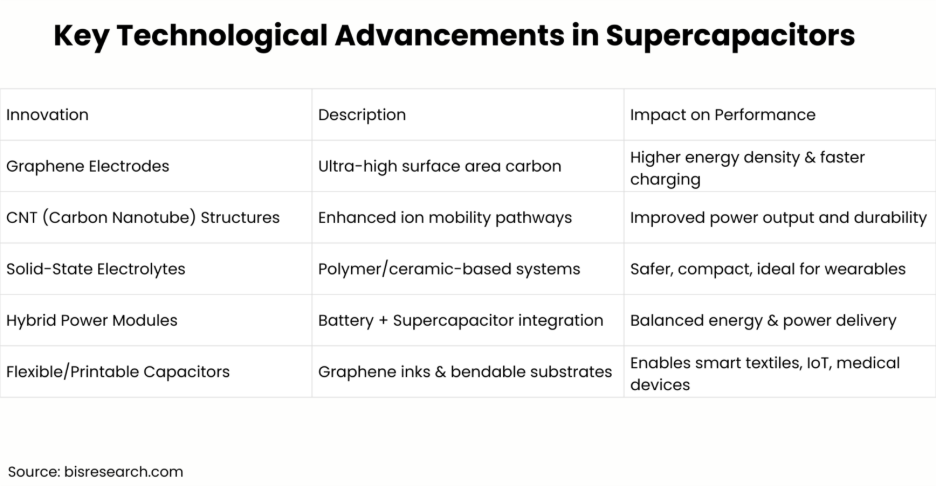

What Technological Advancements Are Transforming Supercapacitors Today? 

1. Nanomaterials Driving Higher Energy Density 

One of the biggest challenges for supercapacitors has been relatively lower energy density compared to lithium-ion batteries. Recent innovations include: 

  • Graphene-based electrodes improve conductivity and storage capacity. 
  • Carbon nanotubes (CNTs) enable more efficient ion transport. 
  • Metal-organic frameworks (MOFs) enhancing surface area for charge accumulation. 

These advancements have doubled the energy density of commercial supercapacitors over the last decade. 

2. Solid-State Supercapacitors 

Solid-state designs replace liquid electrolytes with polymers or ceramic-based materials, improving: 

  • Safety 
  • Stability 
  • Miniaturization 

This is crucial for wearables, medical devices, and next-gen IoT sensors. 

3. Hybrid Battery-Supercapacitor Systems 

To bridge the gap between power and energy, manufacturers are developing integrated systems where: 

  • The battery provides long-term energy 
  • The supercapacitor manages quick bursts of power 

This approach is now widely used in EV braking systems, grid stabilization, and high-power robotics

4. Flexible and Printable Supercapacitors 

Printable and bendable supercapacitors are enabling: 

  • Smart textiles 
  • Next-generation wearables 
  • Autonomous IoT networks 

Companies and universities are exploring printed graphene inks and bendable polymer substrates to create ultra-light, flexible storage systems. 

Where Are Supercapacitors Used Today? 

Supercapacitors are now essential in: 

  • Electric vehicles (regenerative braking, acceleration support) 
  • Solar and wind systems (grid smoothing, backup) 
  • Consumer electronics (fast-charging gadgets) 
  • Industrial automation (power backup for robotics and PLC systems) 
  • Rail transport (energy recuperation in metros and trams) 

China and Europe are leading adoption in public transport, where supercapacitor-powered buses and trams significantly reduce operating emissions. 

Who Are the Key Players Driving Innovation? 

The global supercapacitor landscape includes both established giants and cutting-edge startups: 

Leading Manufacturers 

  • Maxwell Technologies (Tesla) – Pioneer in high-performance industrial supercapacitors. 
  • Skeleton Technologies (EU) – Known for ultracapacitors using patented curved graphene. 
  • CAP-XX (Australia) – Specializes in ultra-thin supercapacitors for compact electronics. 
  • Panasonic – Provides hybrid capacitors and industrial-grade EDLCs. 
  • LS Mtron (South Korea) – Major supplier for transportation and renewable energy. 

Emerging Innovators 

  • Nawa Technologies (France) – Developing carbon nanotube-based ultracapacitors with 10x faster charging. 
  • Eaton – Focused on power backup and grid-stabilization applications. 
  • Urban Electric Power – Innovating hybrid systems blending battery and supercapacitor functionality. 
  • EIC (Electronic Industrial Co.) – Active in automotive-grade supercapacitors across Asia. 

The Road Ahead: What’s Next for Supercapacitors? 

As sustainability mandates tighten and demand for fast, safe, and durable storage grows, supercapacitors are moving into mainstream applications. Future developments will likely focus on: 

  • Achieving battery-level energy density 
  • Lowering manufacturing costs 
  • Expanding flexible, miniaturized designs 
  • Integrating AI-based power management systems 

With breakthroughs in graphene, hybrid chemistries, and solid-state engineering, supercapacitors are poised to become a cornerstone of next-generation energy storage. 

Looking to enter a new market but unsure where to start? At BIS Research, we provide first-hand insights directly from key opinion leaders (KOLs), backed by rigorous primary and secondary research.