
When we think about space missions, our minds naturally jump to rockets, satellites, and futuristic habitats. Rarely do we consider the humble battery yet without it, every spacecraft, rover, telescope, and satellite would instantly go dark. Behind every orbit, launch, and deep-space journey lies a power source engineered to survive in the harshest environment known to science. Welcome to the world of space batteries, the silent engines of the new space race.
A space battery is an energy-storage system designed specifically for spacecraft, satellites, launch vehicles, probes, rovers, and stations operating beyond Earth’s atmosphere.
Unlike standard batteries used on Earth, space batteries must:
• Function in a vacuum
• Endure extreme temperature swings (from –150°C to +120°C)
• Resist radiation exposure
• Last for years sometimes decades
• Deliver reliable power during eclipse periods when solar panels can’t operate
Every critical task in space communications, attitude control, imaging, propulsion support, thermal regulation depends on battery power. If the battery fails, the mission fails. That’s why they are among the most heavily engineered components in any mission design.
The importance of space batteries has skyrocketed due to three major trends:
• The explosion of small satellites and mega-constellations: Companies are launching hundreds of satellites annually for broadband, Earth observation, and defense. Each satellite requires a compact, lightweight, long-life battery system.
• Deep-space exploration: Lunar missions under Artemis, Mars rovers, and planned asteroid mining missions all require high-energy storage capable of operating far from the Sun.
• Commercial space growth: Space tourism, space stations, and in-orbit servicing all demand reliable power systems that can be replaced, recharged, or refurbished in space.
Together, these forces are pushing companies to develop lighter, safer, and more energy-dense batteries than ever before.
Want to explore the insights in detail? Book a Preview and get a guided walkthrough of the Space Battery Market report.
Your phone battery is a consumer product optimized for cost, size, and daily convenience. A space battery is a mission-critical component, and the differences are huge:
Phone batteries last 2–3 years. Space batteries must last 10–15 years, often without maintenance. They undergo extensive radiation hardening and thermal cycling tests.
While smartphones use standard lithium-ion, space missions may use:
• Lithium-ion (dominant today)
• Nickel-hydrogen (for long-life GEO satellites)
• Silver-zinc (high power for launch vehicles)
• Emerging solid-state and lithium-sulfur technologies
Each chemistry is chosen based on mission profile longevity, weight limits, thermal demands, and orbit type.
Every gram counts in space. Batteries are engineered for maximum energy density, outperforming most consumer-grade cells.
Space batteries use intelligent BMS that monitor temperature, charge rate, voltage, and radiation exposure with micro-second precision.
Space-grade batteries must pass ECSS, NASA, and ITAR-related qualification steps far stricter than any consumer electronics test.
The result is a power source engineered more like a spacecraft component than a consumer product.
Download the Complete TOC to view the full structure, chapter breakdown, and coverage of the Space Battery Market report.
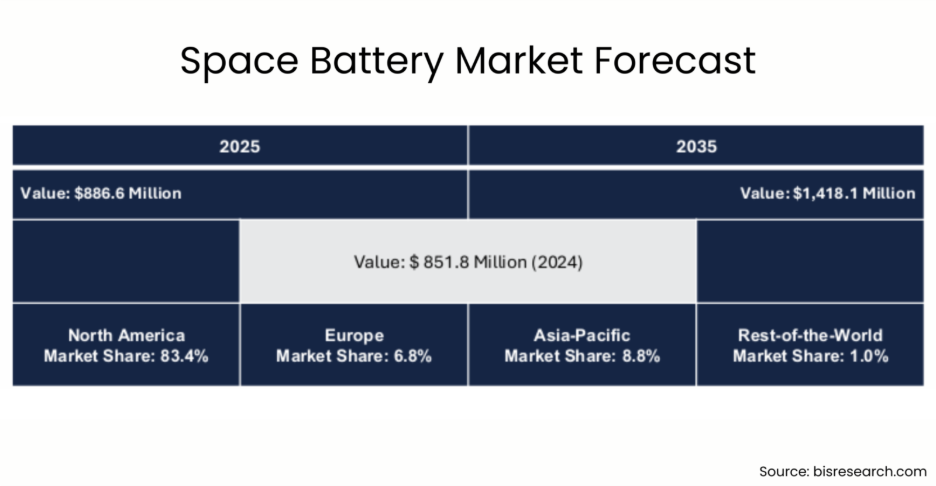
As the space economy expands, the space-battery market is emerging as a high-value niche with strong opportunities for innovation and investment.
Prime satellite manufacturers need lighter and safer batteries, especially for LEO constellations where thousands of satellites must be produced cost-effectively. Suppliers who can scale production, ensure high reliability, and meet global qualification standards are in high demand.
There is huge room for technological disruption:
• Solid-state space batteries
• Radiation-resistant chemistries
• AI-based battery-management systems
• Modular, swappable in-orbit battery packs
Start-ups that crack any of these areas can quickly enter the supply chains of private space companies, defense programs, and satellite operators.
Space batteries fit into a broader mega-trend: the commercialization of space.
Investment opportunities include:
• Satellite manufacturers
• Battery component suppliers
• Companies developing new chemistries
• In-orbit servicing and refueling ecosystem
• Lunar/Mars hardware developers
Interested in evaluating the report before you purchase? Request a Sample Report and get a snapshot of the insights, methodology, and data visuals.”
Space batteries may be small, but they’re powering humanity’s boldest ambitions beyond Earth. As innovation accelerates from solid-state chemistries to AI-driven battery systems, this once-niche market is becoming a major pillar of the global space industry. For suppliers, start-ups, and investors, the opportunity is clear: the next frontier is being electrified, and the race to power it has only just begun.