As the world prepares for the leap beyond 5G, the conversation around 6G connectivity is accelerating. Promising ultra-low latency, massive device connectivity, and seamless global coverage, 6G is expected to redefine how people, machines, and systems communicate. But delivering this vision will require more than terrestrial networks alone. This is where Low Earth Orbit (LEO) satellites emerge as a critical enabler of future connectivity.
Operating at altitudes between 500 and 2,000 kilometers, LEO satellites are uniquely positioned to complement next-generation wireless networks. Their growing role suggests that space-based infrastructure may become the backbone of 6G networks and future digital ecosystems.
While fiber optics, 5G towers, and edge data centers form the foundation of today’s connectivity, they have inherent limitations. Expanding terrestrial infrastructure is expensive, time-consuming, and often impractical in remote or geographically challenging regions.
6G aims to deliver:
• Sub-millisecond latency
• Extreme data rates
• Ubiquitous coverage
• Massive machine-type communications
Achieving these goals solely through ground-based networks is unlikely. Dense urban environments, rural areas, oceans, airspace, and disaster-prone zones require a more flexible and resilient solution. This gap is precisely where LEO satellite communication systems come into play.
Request a sample Report on LEO Market
Unlike traditional geostationary satellites, LEO satellites orbit much closer to Earth, significantly reducing signal travel time. This enables low-latency satellite communication, making LEO constellations compatible with real-time applications envisioned for 6G.
Key advantages include:
• Ultra-low latency connectivity, comparable to terrestrial fiber in some use cases
• Global broadband coverage, including underserved and remote regions
• High network resilience, with thousands of satellites forming redundant mesh networks
• Seamless integration with terrestrial 5G and future 6G infrastructure
As 6G moves toward non-terrestrial networks (NTN), LEO satellites are expected to function as space-based base stations, seamlessly handing off connections between ground, air, and space.
The integration of LEO satellite networks and 6G technology unlocks use cases that were previously unattainable.
• Autonomous transportation: Real-time connectivity for autonomous vehicles, drones, and maritime vessels across borders and oceans
• Smart cities and IoT: Massive IoT deployments supported by satellite-enabled machine-to-machine communication
• Remote healthcare and education: High-speed, reliable internet access in rural and remote areas
• Defense and disaster response: Secure, resilient communication networks during emergencies when terrestrial infrastructure fails
These applications position LEO satellites not just as a supplement, but as a core pillar of future connectivity.
Download the complete TOC on LEO Market
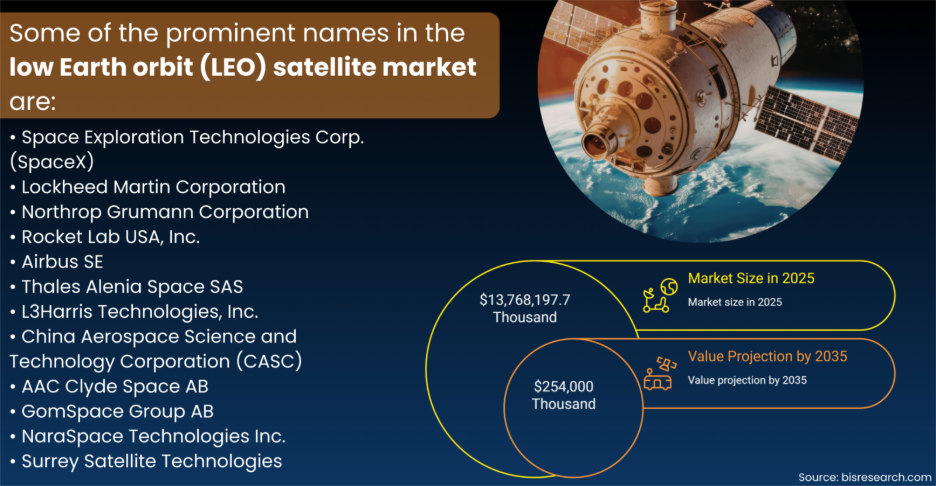
The LEO satellite market is witnessing unprecedented momentum. Major technology companies, aerospace firms, and governments are investing heavily in satellite constellations, ground infrastructure, and advanced payload technologies.
As standards bodies and telecom operators explore 6G network architecture, satellite-terrestrial integration is becoming a central design principle. This convergence is expected to drive long-term demand for LEO satellites across commercial, defense, and enterprise applications.
Despite their promise, LEO satellites face challenges such as orbital congestion, spectrum management, and space sustainability. However, advances in satellite tracking, collision avoidance, and regulatory coordination are helping mitigate these risks, ensuring sustainable growth of space-based networks.
As the world moves toward 6G and beyond, connectivity will no longer be confined to the ground. LEO satellites are set to play a defining role in creating a truly global, resilient, and intelligent communication ecosystem. By bridging coverage gaps and enabling next-generation applications, they are poised to become the backbone of future connectivity.