%20Growth%20Trends%20Across%20Endoscopic%2c%20Surgical%2c%20and%20Outpatient%20Settings.png)
The U.S. gastroenterology landscape is undergoing a measurable shift, driven by rising disease burden, screening expansion, and a structural transition toward outpatient care. An analysis of procedure volumes from 2019 to 2026 highlights three clear trends: steady growth in endoscopic procedures, relative stabilization or selective decline in invasive surgeries, and strong expansion of ambulatory or outpatient settings.
Between 2019 and 2026, total gastroenterology procedure volumes show moderate but consistent growth across most categories. Diagnostic and therapeutic endoscopic procedures dominate the volume landscape, significantly outpacing traditional surgical interventions.
For example, colonoscopy and proctoscopy with biopsy increased from approximately 223,565 procedures in 2019 to 216,631 in 2026, after peaking around 2023–2024. Meanwhile, broader diagnostic and therapeutic colonoscopies in ambulatory settings remained consistently high, hovering around 1.4–1.5 million procedures annually, indicating sustained demand for colorectal cancer screening and surveillance.
This stability reflects the maturity of colonoscopy as a standard of care, supported by screening guidelines and aging demographics.
Schedule a call to explore more about U.S. Gastroenterology Procedure Volumes
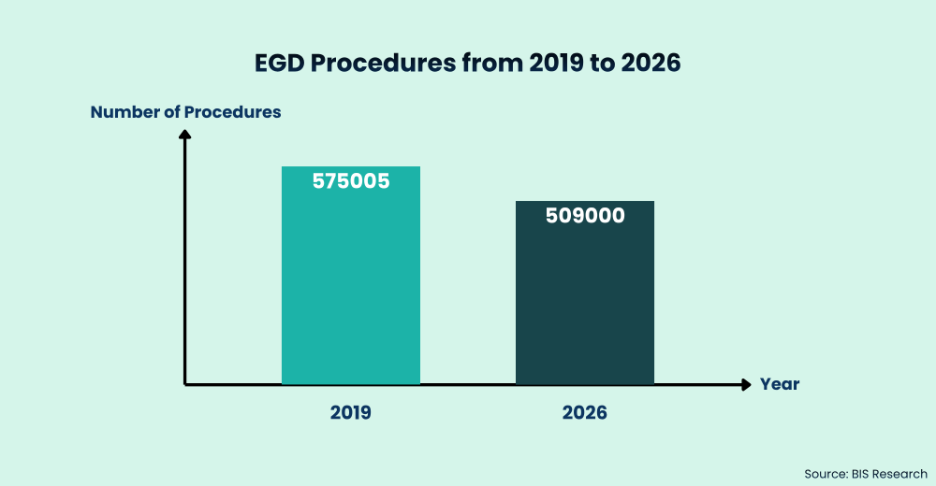
Endoscopic procedures represent the fastest-growing and most resilient segment. Procedures such as:
• Esophagogastroduodenoscopy (EGD) with biopsy increased from 575,005 in 2019 to over 509,000 in 2026, despite a temporary dip during pandemic years
• GI system endoscopic therapeutic procedures maintained strong volumes, reflecting continued clinical reliance
The key drivers include:
• Shift toward minimally invasive diagnostics
• Rising prevalence of gastrointestinal disorders such as GERD and colorectal cancer
• Increased adoption of advanced endoscopic techniques
Endoscopy is increasingly replacing surgical intervention in early-stage disease management, reducing hospital stays and improving patient outcomes.
Surgical volumes present a more nuanced picture. While some procedures remain stable, others show gradual decline or slower growth compared to endoscopy.
For instance:
• Colectomy procedures declined from 295,400 in 2019 to 283,179 in 2026
• Duodenal resection and esophagectomy volumes remain relatively low and stable
However, procedures such as small bowel resection continue to show resilience, reflecting cases where surgical intervention remains essential.
The broader trend suggests:
• A selective reduction in invasive surgeries
• Greater reliance on early detection and non-surgical management
• Improved patient stratification and treatment pathways
The 2020–2021 period shows a noticeable dip across several categories, particularly elective and diagnostic procedures. For example:
• Anorectal repair procedures dropped from 64,790 in 2019 to 59,205 in 2021
• Endoscopy volumes also saw temporary declines
However, the rebound from 2022 onward indicates strong recovery, with deferred procedures and pent-up demand driving volumes back to pre-pandemic levels.
By 2026, the U.S. gastroenterology market is clearly defined by:
• Endoscopy dominance as the primary diagnostic and therapeutic modality
• Selective use of surgery, focused on complex or advanced cases
• Rapid expansion of outpatient care models
Emerging technologies such as AI-assisted endoscopy, capsule diagnostics, and robotic-assisted procedures are expected to further accelerate these trends.
• Healthcare providers should prioritize endoscopic capabilities and outpatient infrastructure
• Medtech companies have strong opportunities in minimally invasive innovation
• Policymakers must support screening programs and ambulatory care expansion
The data signals a clear shift toward efficiency, early intervention, and patient-centric care. Stakeholders who align early with these volume trends will be better positioned to capture long-term value in the evolving gastroenterology market.