As the world accelerates toward electric mobility and renewable energy storage, Lithium Iron Phosphate (LFP) batteries have become one of the fastest-growing chemistries due to their safety, long life cycles, and cost advantages. With this rapid rise comes an equally urgent need for LFP battery recycling, especially as governments push for circular energy ecosystems and sustainable supply chains. The global LFP battery recycling market is now entering a high-growth phase, creating opportunities for several innovative companies.
Below are the key emerging players leading advancements in LFP battery recycling, along with their headquarters, technologies, and notable developments.
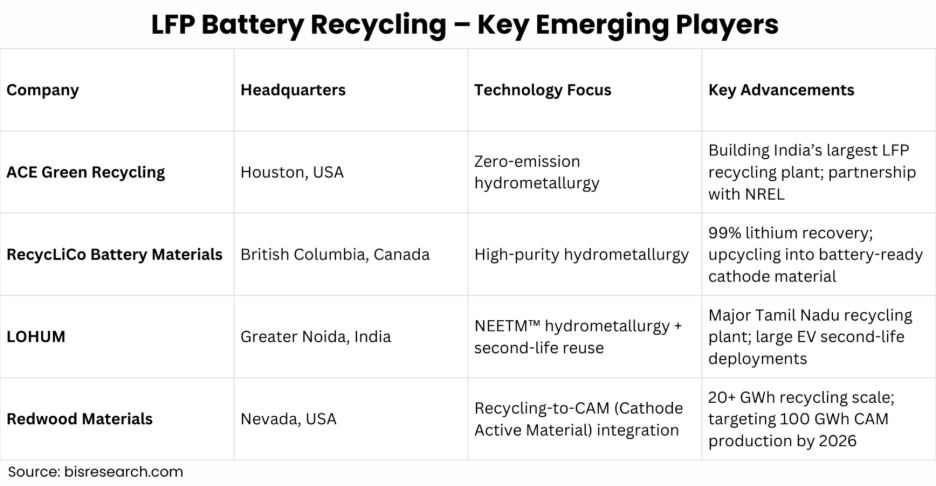
Headquarters: Houston, Texas, USA
Technology Focus: Zero-emission hydrometallurgical recycling, LithiumFirst process
ACE Green Recycling is one of the most rapidly scaling companies in the LFP recycling space. Unlike traditional recyclers that rely on high-heat smelting, ACE uses a cold hydrometallurgical process that eliminates Scope 1 emissions entirely. Its LithiumFirst technology allows efficient recovery of lithium and other valuable materials from LFP cells without using fossil fuel–based furnaces.
The company is building large-scale recycling infrastructure across the US, India, and Southeast Asia. ACE recently announced plans to establish India’s largest LFP recycling facility in Gujarat, designed to process nearly 10,000 metric tons of LFP waste annually. The company is also collaborating with the U.S. National Renewable Energy Laboratory (NREL) to improve recycling efficiency for graphite and LFP-based materials.
Unlock deeper insights into the LFP battery recycling market
Headquarters: British Columbia, Canada
Technology Focus: Hydrometallurgical upcycling, closed-loop cathode material recovery
RecycLiCo Battery Materials is known for its high-purity recovery rates, offering up to 99% extraction efficiency for lithium and other cathode materials. Unlike recyclers that recover mixed materials, RecycLiCo’s process upcycles recovered metals into battery-ready cathode precursor material, enabling true circularity.
For LFP recycling, RecycLiCo has achieved exceptionally high lithium recovery using its proprietary hydrometallurgical process. The company’s new demonstration facility in Delta, British Columbia, integrates recycling operations with in-house labs—positioning it as a technology-driven leader capable of supporting modular recycling plants worldwide.
Ready to discuss your strategic needs?
Schedule a call with our experts today.
Headquarters: Greater Noida, Uttar Pradesh, India
Technology Focus: NEETM™ hydrometallurgy + direct recycling, second-life applications
LOHUM is one of India's fastest-growing lithium-ion recyclers, uniquely positioned because India’s EV ecosystem—especially two-wheelers and three-wheelers—is dominated by LFP batteries. The company’s NEETM™ technology combines hydrometallurgical processes with direct recycling to recover lithium and repurpose battery packs for second-life uses, including solar storage and grid backup.
LOHUM has announced a massive investment to build one of the largest battery recycling plants in Tamil Nadu, reinforcing India’s move toward a localized circular battery economy. With expanding operations in the US and Europe, LOHUM is emerging as a global supplier of sustainably recycled battery materials.
Headquarters: Sparks, Nevada, USA
Technology Focus: Integrated recycling-to-cathode production, large-scale hydrometallurgy
Founded by Tesla co-founder J.B. Straubel, Redwood Materials has become one of the biggest players in lithium-ion recycling, processing more than 20 GWh of batteries annually. While Redwood handles multiple chemistries, its scale and advanced processes make it a crucial player for the LFP recycling surge.
Redwood is vertically integrating recycling with cathode active material (CAM) production, aiming to supply 100 GWh of CAM each year by 2026. Its approach of combining recycling, refining, and manufacturing creates a highly efficient loop that reduces dependency on mined materials. Redwood is also exploring second-life deployment for LFP batteries before final recycling.
LFP is becoming the preferred battery chemistry for affordable EVs, buses, three-wheelers, and grid-scale energy storage. However, unlike NMC or NCA batteries, LFP lacks high-value cobalt and nickel—making recycling more challenging and requiring new cost-effective technologies.
The companies leading this transformation share a common theme:
• ACE focuses on zero-emission modular plants.
• RecycLiCo excels in high-purity hydrometallurgy.
• LOHUM drives second-life innovation in LFP-heavy markets.
• Redwood brings unmatched North American scale.
Together, they are building a circular ecosystem that transforms waste LFP batteries into valuable raw materials, reducing environmental impacts and strengthening global battery supply chains.
Looking to enter a new market but unsure where to start? At BIS Research, we provide first-hand insights directly from key opinion leaders (KOLs), backed by rigorous primary and secondary research.