%20Startups%20Changing%20How%20Businesses%20Think%20About%20Robots.png)
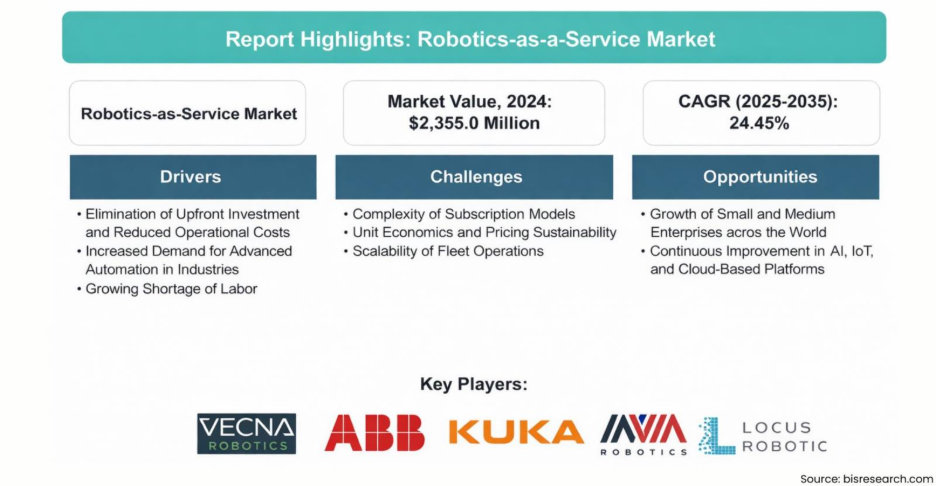
Robotics-as-a-Service (RaaS) is reshaping how enterprises adopt automation by replacing capital-heavy robotics investments with a flexible, subscription-based service model. Instead of purchasing robots outright and managing deployment, integration, and maintenance internally, businesses now pay recurring fees that bundle robot hardware, cloud software, analytics, maintenance, and upgrades into a single, outcome-driven offering.
This shift dramatically lowers the barrier to entry for robotics adoption while allowing organizations to scale automation in line with fluctuating operational demand. More importantly, RaaS aligns robotics with broader digital transformation strategies. Continuous AI-driven optimization, cloud connectivity, and performance-based pricing ensure robots improve over time rather than depreciate like traditional assets.
As labor shortages continue to impact warehousing, logistics, manufacturing, and retail, Robotics-as-a-Service is increasingly viewed as a strategic operating model enabling enterprises to treat robots as a flexible, service-based workforce rather than fixed capital equipment.
Get instant access to a sample featuring key findings, market snapshots, and expert analysis to evaluate the depth and quality of our research- Request Your Sample Report
Below are five RaaS startups that are redefining enterprise automation through innovation, scalability, and real-world deployment success.
Locus Robotics is a market leader in warehouse automation robots delivered through a Robotics-as-a-Service model. The company provides autonomous mobile robots (AMRs) that automate labor-intensive warehouse activities such as order picking, replenishment, putaway, and internal transport.
Its flagship LocusONE platform orchestrates large fleets of robots through cloud-based intelligence and integrates seamlessly with existing warehouse management systems (WMS). This enables rapid deployment, high flexibility, and scalable automation without major infrastructure changes.
• 5+ billion picks milestone: In 2025, Locus Robotics surpassed five billion units picked globally, highlighting the scale and maturity of its RaaS deployments.
• Advanced AI orchestration: The introduction of LocusINTELLIGENCE, combined with expanded AI leadership, strengthens real-time decision-making, predictive analytics, and “physical AI” capabilities across robot fleets.
Fetch Robotics developed cloud-native autonomous mobile robots designed for material transport, batch picking, and inventory movement in warehouses and fulfillment centers. Its platform emphasized rapid deployment and scalability without costly facility redesigns.
Following its acquisition by Zebra Technologies, Fetch’s robotics capabilities were integrated into broader enterprise productivity solutions combining AMRs with wearable devices and data intelligence.
• Zebra Symmetry Fulfillment: Fetch AMRs were incorporated into Zebra’s robot-assisted picking solution, integrating robotics with wearable technology to improve worker productivity.
• Strategic wind-down reflects market complexity: Zebra’s decision to wind down Fetch-based robotics operations in late 2025 highlights the challenges of scaling RaaS within large enterprise portfolios rather than a lack of demand for warehouse robots.
Download the complete TOC now!
inVia Robotics operates as a pure-play Robotics-as-a-Service provider, focusing exclusively on subscription-based automation for e-commerce warehouses, distribution centers, and third-party logistics (3PL) providers.
Its solution combines autonomous mobile robots with cloud-based orchestration software to streamline picking, sorting, and internal movement, enabling customers to adopt automation without heavy upfront capital expenditure.
• Expanded RaaS contracts: inVia has signed multiple long-term automation-as-a-service agreements with major retail and logistics customers across North America and Europe.
• Smarter fleet optimization: AI-driven software upgrades improve real-time task allocation and route planning, delivering measurable throughput gains and improved coordination between robots and human workers.
Owned by Shopify, 6 River Systems (6RS) focuses on collaborative warehouse robots designed to work alongside human associates. Its flagship robot, Chuck, guides workers through optimized picking routes to improve productivity and accuracy.
This human-centric approach, delivered through a RaaS model, enables faster adoption and operational flexibility compared to fully autonomous systems.
• Deeper WMS integrations: 6RS continues enhancing cloud-native integrations with leading warehouse management systems, improving real-time task coordination.
• Proven peak-season scalability: Customers report strong performance during high-demand periods, driven by adaptive prioritization and rapid RaaS-based scaling.
Vecna Robotics delivers AI-driven material handling robots and orchestration software for complex industrial environments. Its platform coordinates both robots and human teams to improve throughput, safety, and workflow efficiency, often through Robotics-as-a-Service subscriptions.
• Strategic partnership with Aptiv: Vecna’s collaboration with Aptiv focuses on developing next-generation AMRs with advanced perception, compute, and safety features.
• Continued funding momentum: Building on its $100 million Series C, Vecna continues expanding its AMR portfolio and intelligent orchestration capabilities.
Book a Preview/schedule a call
These five Robotics-as-a-Service startups demonstrate how RaaS is transforming enterprise automation across warehousing, logistics, and industrial operations. By shifting from ownership to subscription-based robotics, organizations gain scalability, flexibility, and continuous innovation without the risks of traditional automation investments.
As AI-powered robotics, cloud platforms, and outcome-based pricing models mature, Robotics-as-a-Service is emerging as a core operating model for the automated enterprise reshaping how businesses think about robots, labor, and long-term competitiveness.