
The world of surgery is undergoing a profound transformation, marked by the rapid rise of minimally invasive techniques. Once considered cutting-edge, procedures such as laparoscopy, endoscopy, and robotic-assisted surgeries are now setting new standards for patient care across the globe. With robust data-driven insights from BIS Research’s Surgical Procedure Volume Database, industry leaders can clearly see a decisive shift in surgical practice that is reshaping healthcare outcomes, cost structures, and technology investment.
Minimally invasive surgery (MIS) has moved well beyond niche specialty; it is now the new normal across orthopedics, gynecology, urology, cardiology, and more. According to BIS Research, the volume of minimally invasive procedures is outpacing traditional open surgeries year-on-year, driven by hospital demand, patient preference, and a growing body of clinical evidence demonstrating reduced recovery times, lower complication rates, and shorter hospital stays.
This data-driven revolution is not only improving patient outcomes but also redefining operational efficiencies for hospitals and payers globally. Hospitals leveraging MIS report significant reductions in average length of stay—often by several days per procedure—while maintaining or improving surgical success rates. The evidence is clear: hospitals that adopt MIS early tend to see measurable improvements in throughput and financial performance.
Interested in understanding these trends in detail for your organization?
Schedule a Demo | Request a Quote
What’s fueling the global momentum for minimally invasive surgery? Three primary forces stand out:
1. Technology Innovation:
Advancements in surgical robotics, imaging, and instrument design are expanding the complexity and types of procedures that can be performed minimally invasively. For instance, robotic-assisted systems now allow for ultra-precise movements and real-time feedback, even in anatomically challenging or previously inoperable cases.
2. Demographic Shifts:
With aging populations in developed regions and increasing access to care in emerging markets, the need for efficient, lower-risk surgical options is growing. Patients more informed than ever—are actively seeking providers who offer less invasive options, favoring centers of excellence and surgeons with MIS expertise.
3. Economic & Value-Based Care:
Healthcare systems are under mounting pressure to deliver high-value care. MIS is uniquely positioned to support these goals by minimizing complications, readmissions, and recovery time, which collectively reduce the total cost of care while improving patient satisfaction.
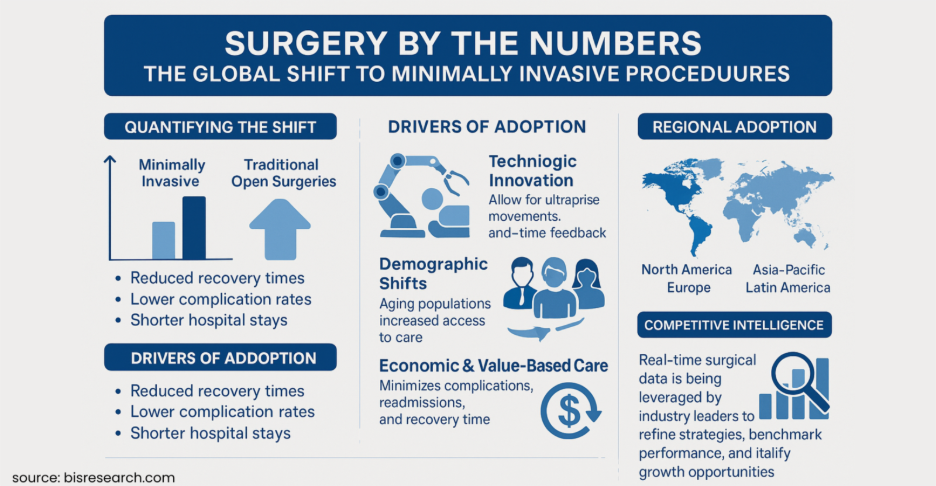
While the shift to MIS is global, adoption rates vary by region and specialty. North America and Europe lead in procedural volume and technology integration, thanks to robust investment in digital health and robotics. However, APAC and Latin America are quickly catching up, as regulatory frameworks improve and training infrastructure expands. Key growth is noted in China and India, where rising middle classes and private investment are accelerating MIS adoption, particularly in urban centers.
Competitive Intelligence:
According to BIS Research, leading device manufacturers and hospital networks are leveraging granular, procedure-level data to identify white space opportunities, refine go-to-market strategies, and benchmark against competitors. Those with the ability to harness real-time surgical data are emerging as market leaders.
Empower your business with actionable surgical procedure volume intelligence.
-Request a Quote now
In a landscape where every percentage point of improvement can mean millions in savings or revenue, data is the ultimate competitive differentiator. Industry leaders are using granular surgical procedure data not just to forecast demand, but to drive investment in new technologies, guide physician training, and shape long-term strategic partnerships.
The best-in-class organizations don’t just track volume they analyze trends across specialties, monitor shifts in payer mix, and assess clinical outcomes at the procedure level. By linking operational, clinical, and financial data, they unlock new pathways to growth and improved patient care.
The global shift toward minimally invasive surgery is more than a technological evolution; it’s a fundamental realignment of patient care and business strategy. Those who harness high-quality, real-time procedure data will not only keep pace but lead in this new era of surgical excellence.
Ready to leverage surgical data for strategic growth?
Schedule a Demo | Request a Quote