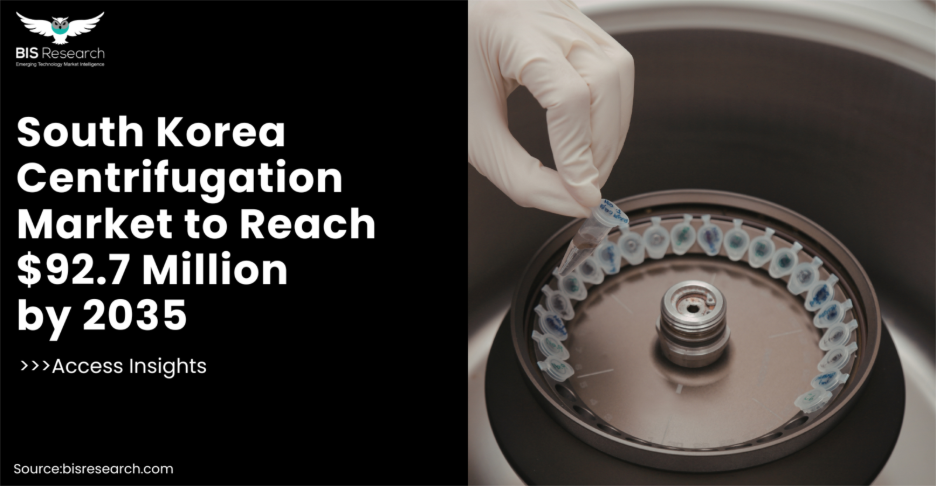
Centrifugation is a critical separation technology widely used across life sciences, pharmaceuticals, biotechnology, diagnostics, chemicals, and industrial processing. By applying centrifugal force, centrifuges separate components based on density, enabling applications such as blood component separation, cell harvesting, protein purification, viral vector processing, vaccine manufacturing, and wastewater treatment.
In South Korea, centrifugation has evolved beyond basic laboratory use into highly automated, GMP-compliant systems integrated into large-scale biomanufacturing workflows. As the country strengthens its position as a global biologics manufacturing hub, centrifuges play a central role in upstream and downstream processes, including cell culture clarification and protein purification.
According to BIS Research, the South Korea centrifugation market was valued at $51.6 million in 2025 and is projected to reach $92.7 million by 2035, growing at a CAGR of 6.04% during the forecast period. This growth reflects sustained demand from biopharmaceutical production, clinical diagnostics, and advanced research ecosystem.
Download the complete TOC and Request Sample Report
• Expansion of biopharmaceutical manufacturing led by Samsung Biologics, Celltrion, and SK Bioscience
• Growth in cell and gene therapy R&D and viral vector production
• Rising clinical diagnostics demand across hospitals, blood banks, and reference laboratories
• Government-backed initiatives such as the K-Bio Pharmaceutical Industry Leap Forward Strategy
• Adoption of automated, closed, and single-use centrifugation systems
• Increasing integration of AI-enabled monitoring and predictive maintenance tools
South Korea’s biotechnology production growth and expanding CDMO infrastructure continue to reinforce demand for high-performance centrifugation systems across research and commercial-scale manufacturing.
• High capital investment required for advanced, GMP-compliant centrifuges
• Dependence on imported premium centrifugation systems
• Intense competition between domestic and global manufacturers
• Pricing pressure in mid- and entry-level equipment segments
• Increasing focus on energy efficiency and sustainability standards
Domestic players such as Hanil Scientific, Daihan Scientific, and GYROZEN are strengthening local capabilities, while global companies including Thermo Fisher Scientific and Danaher continue to dominate high-end, validated systems.
• September 2025: Thermo Fisher Scientific partnered with Dr. Park CDMO to integrate the DynaSpin single-use centrifuge for scalable viral vector manufacturing up to 10,000L batches.
• April 2025: Beckman Coulter Life Sciences launched the OptiMATE Gradient Maker, reducing ultracentrifugation purification times by up to 75%.
• March 2025: Thermo Fisher Scientific introduced Cryofuge, BIOS, and LYNX floor-model centrifuges with GreenCool natural refrigerant technology, offering up to 15% energy savings.
• Equipment
• Accessories
As of 2024, Equipment holds the largest share at 74.44%, driven by:
• Demand for automated and IoT-enabled systems
• GMP and MFDS regulatory compliance requirements
• Expansion of CDMO and biotechnology facilities
• Long lifecycle and capital-intensive infrastructure investments
• Bench-top Centrifuges
• Floor Standing Centrifuges
In 2024, Bench-top Centrifuges dominate due to:
• Space-efficient design for hospital and research labs
• Cost-effectiveness compared to large industrial systems
• Versatility across blood separation, molecular diagnostics, and nucleic acid extraction
• Strong adoption in academic and R&D institutions
• Clinical
• Research
• Biotherapeutic Manufacturing
• Others
In 2024, Research leads the market supported by:
• Strong investment in biotechnology and genomics
• Expansion of regenerative medicine programs
• Continuous centrifuge utilization in universities and research institutes
• Early-stage biologics and biosimilar development workflows
• Hospitals and Diagnostic Labs
• Biotechnology and Pharmaceutical Companies
• Academic and Research Institutes
• Others
Hospitals and Diagnostic Labs dominate due to:
• High-frequency daily usage in routine clinical testing
• Rising chronic and infectious disease testing volumes
• Expansion of molecular diagnostics and PCR testing
• Strict MFDS and international laboratory compliance standards
According to Principal Analyst at BIS Research: “The South Korea centrifugation market is positioned for sustained growth, driven by strong biopharmaceutical R&D, advanced clinical infrastructure, and increasing automation. AI-integrated and robotics-compatible centrifugation systems will continue to enhance precision, throughput, and regulatory compliance. As domestic manufacturing capabilities strengthen and digitalized smart labs expand, the market will remain innovation-focused and competitively dynamic.”
• The market is projected to grow from $51.6 million in 2025 to $92.7 million by 2035
• CAGR during the forecast period is 6.04%
• Agilent Technologies, Inc.
• Bio-Rad Laboratories, Inc.
• Thermo Fisher Scientific, Inc.
• Danaher Corporation
• Corning Incorporated
• Eppendorf SE
• Hanil Scientific Inc.
• DAIHAN SCIENTIFIC CO., LTD.
• GYROZEN Co., Ltd.
• Automated and GMP-compliant centrifuges
• AI-integrated and digitally monitored systems
• Single-use centrifugation platforms for viral vector production
• Bench-top systems for clinical and research labs
• Access granular market segmentation
• Evaluate competitive positioning
• Identify high-growth investment pockets
• Align strategy with regulatory and technological trends