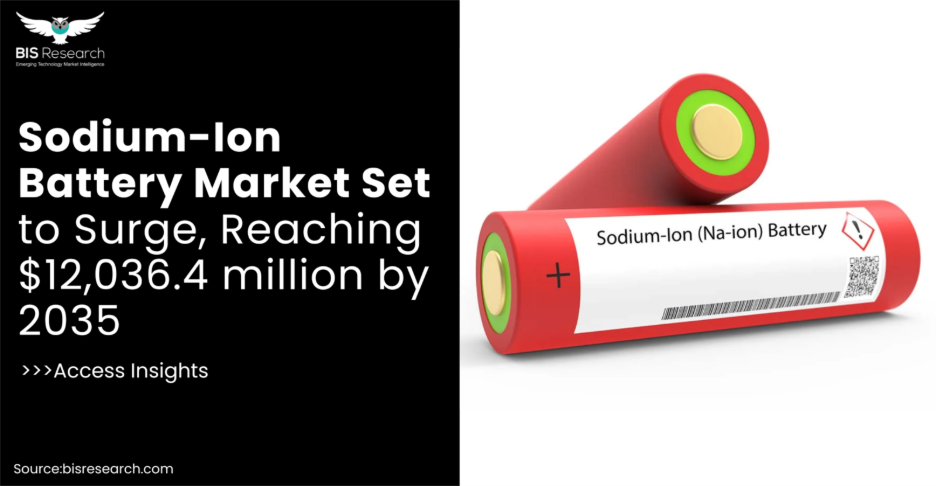
Sodium-ion batteries (SIBs) represent an emerging technology in the world of energy storage, offering an alternative to traditional lithium-ion (Li-ion) batteries. Composed of sodium-based electrode materials, these batteries provide a promising solution for grid-scale energy storage, microgrids, and low-range mobility due to sodium’s abundance and lower cost compared to lithium.
Growing concerns over lithium’s supply constraints, price volatility, and environmental impact have pushed both industry and government to explore sodium-ion solutions. In recent years and ongoing European Union funding have accelerated research and manufacturing. As a result, sodium-ion batteries are gaining traction as a scalable, reliable, and sustainable energy storage option.
According to BIS Research, the sodium-ion battery market was valued at $435.9 million in 2024 and is projected to experience exponential growth, reaching $12,036.4 million by 2035. This expansion highlights the increasing role sodium-ion batteries will play in supporting renewable integration, energy security, and cost-effective electrification worldwide.
[Explore the full TOC and Download report Sample]
• Rising demand for economical, safe, and scalable energy storage solutions for grid and stationary applications
• Advancement in sodium-ion cell chemistry and design, boosting energy density, cycle life, and charging performance
• Growing pressure to diversify beyond lithium-ion technology due to supply, cost, and sustainability concerns
• Government and industrial investments in sodium-ion research, pilot deployments, and large-scale manufacturing
• Expanding use cases in electric mobility, rural microgrids, and renewable energy buffering
• Need for further improvement in energy density and overall battery performance
• Supply chain development and reliable sourcing of electrode materials
• Achieving commercial-scale cost competitiveness with lithium-ion alternatives
• Technical hurdles in optimizing system integration and pack-level design
• Limited commercialization to date, with adoption still ramping from pilot to large-scale production
• April 2025: CATL (Contemporary Amperex Technology) increased its sodium-ion battery output to address surging demand from EV makers seeking affordable options.
• March 2025: Altris AB received funding from Volvo Cars Tech Fund to jointly develop sodium-ion solutions for next-generation EVs and storage, with an emphasis on reducing cost and enhancing sustainability.
• March 2025: Natron Energy and Draslovka partnered to build a new Czech facility for scaling Prussian blue cathode material production—a key enabler for sodium-ion cells.
• March 2024: TIAMAT allied with a European consortium to establish a sodium-ion supply chain, supported by EU green funding.
• July 2024: Datang Group in China launched a 50 MW/100 MWh grid-scale sodium-ion storage project in Qianjiang, highlighting readiness for large installations.
• May 2025: China Southern Power Grid opened a 200 MW hybrid station in Yunnan, pairing sodium-ion and lithium-ion storage for renewable energy balancing.
• Automotive
• Electronics
• Large Scale Stationary Energy Storage
• Industrial
• Others
Sodium-ion batteries are increasingly chosen for grid and large-scale stationary applications due to their cost-effectiveness and safety. With lithium prices remaining uncertain, sodium-ion technology’s abundant raw materials and lower manufacturing cost are making it an attractive option for utilities and renewable integration.
• Non-Aqueous Sodium-Ion Batteries
• Aqueous Sodium-Ion Batteries
• Solid State Sodium-Ion Batteries
• Prismatic
• Cylindrical
• Pouch
• Low Voltage System (12V-60V)
• Medium Voltage System (60V-300V)
• High Voltage System (>300V)
• North America
• Europe
• Asia-Pacific
• Rest-of-the-World
According to Principal Analyst at BIS Research: “The sodium-ion (Na-ion) battery market is fast emerging as a credible and sustainable alternative to lithium-ion technology. While large-scale commercial deployment is still at an early stage, many manufacturers are equipped to shift production to Na-ion cells thanks to their compatibility with existing Li-ion assembly lines. Sodium’s plentiful supply provides strategic advantages, enabling countries to localize battery manufacturing and decrease reliance on lithium supply chains. To unlock sodium-ion’s full potential, sustained investment in R&D, especially in cathode chemistries, and policy support will be vital to shift from promising innovation to mainstream adoption.”
The sodium-ion battery market is forecast to rise from $435.9 million in 2024 to $12,036.4 million by 2035, reflecting a robust CAGR of 37.43% as the technology becomes more commercially viable for grid storage and mobility applications.
Major companies include Aquion Energy (Juline-Titans LLC), Faradion (Reliance Industries Ltd), HiNa Battery Technology, BENAN Energy Technology, AMTE Power, Natron Energy, TIAMAT, Jiangsu Zhongna Energy Technology, CATL, Bluetti Power, Li-FUN Technology, Indi Energy, Altris AB, Farasis Energy, and BYD Company Ltd.
Non-aqueous and aqueous sodium-ion battery chemistries dominate, while solid-state designs and Prussian blue cathode materials are drawing increasing attention for future scalability and performance.
BIS Research offers KOL-based insights, rigorous segmentation, and strategic advisory across software, hardware, and sensing tech domains