The rapid acceleration of artificial intelligence (AI) workloads is fundamentally reshaping the global data center landscape, with GPU demand emerging as the central force behind next-generation infrastructure investments. As enterprises and hyperscalers race to scale AI capabilities, understanding data center GPU demand trends, AI-ready infrastructure, and hyperscale expansion strategies has become mission-critical.
The proliferation of generative AI, machine learning (ML), and high-performance computing (HPC) applications has significantly increased reliance on GPUs. Unlike traditional CPU-based architectures, GPUs enable parallel processing at scale, making them essential for AI training and inference workloads.
This shift has triggered a surge in AI data center demand, with operators designing facilities specifically optimized for GPU density, power efficiency, and advanced cooling systems. As a result, modern data centers are evolving into AI-ready data centers, where infrastructure decisions are tightly aligned with GPU deployment strategies.
Explore BIS MarketIQ to power smarter AI-driven infrastructure decisions
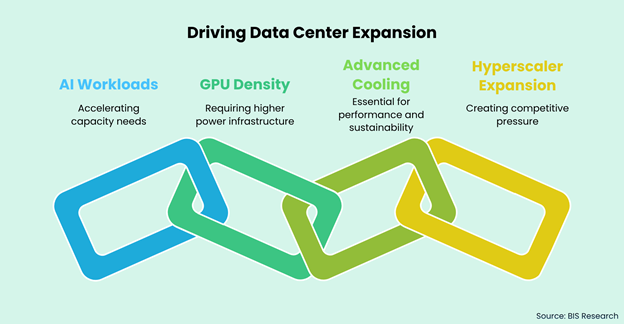
AI-driven workloads are compressing data center expansion timelines. Operators are now building hyperscale data centers with capacities ranging from 250 MW to over 1000 MW to accommodate rising GPU demand.
GPU clusters require significantly higher power densities compared to traditional workloads. This has led to innovations in data center power infrastructure, including high-density racks and enhanced energy distribution systems.
With GPUs generating intense heat, operators are rapidly adopting liquid cooling, hybrid cooling, and immersion technologies. These solutions are critical to maintaining performance and sustainability in AI-driven environments.
Major hyperscalers are aggressively expanding their global footprint to secure GPU supply and capacity. This creates competitive pressure across regions, making real-time data center intelligence essential for strategic planning.
Despite the surge in demand, many operators still rely on fragmented tools such as spreadsheets, disconnected systems, and delayed reporting. This results in:
• Limited visibility into GPU infrastructure trends
• Reactive capacity planning
• Inefficient pricing and yield management
• Increased risk of oversupply or underutilization
These challenges highlight the need for a unified intelligence platform that provides real-time insights into data center GPU deployment, capacity pipelines, and market dynamics.
According to BIS Research, BIS MarketIQ is designed to address these challenges by delivering a decision-ready data center intelligence platform tailored for the AI era.
Request a Quote to unlock tailored data center GPU insights
BIS MarketIQ consolidates commercial, operational, and market data into a single dashboard. Users can track:
• AI density and GPU configurations
• Planned and operational data center campuses
• Capacity additions and deployment timelines
• Cooling architectures and infrastructure choices
The platform provides structured visibility into upcoming data center projects, enabling operators to assess future GPU capacity trends and align investments accordingly.
Instead of managing isolated sites, operators can evaluate performance across entire portfolios, identifying underperforming assets and optimizing GPU utilization.
BIS MarketIQ enables early identification of oversupply pockets, demand shifts, and competitive expansion strategies critical for maintaining pricing discipline and avoiding revenue risks.
The rise in GPU demand is not just a technical shift it is redefining business strategies across the data center ecosystem.
• Operators must optimize capacity planning and utilization
• Investors need visibility into capital deployment and demand hotspots
• EPCs and suppliers must track early-stage builds and technology adoption
• Enterprise teams must align infrastructure strategies with GPU and AI trends
By leveraging real-time intelligence, stakeholders can move from reactive decision-making to proactive, data-driven execution.
The future of data centers will be defined by their ability to support AI workloads efficiently. As GPU demand continues to surge, trends such as edge AI deployment, sustainable data center design, and AI-optimized architectures will gain momentum.
In this rapidly evolving landscape, platforms like BIS MarketIQ play a crucial role in enabling smarter decisions, faster execution, and sustained competitive advantage.