Pharmaceutical dissolution testing plays a critical role in ensuring drug quality, safety, and bioavailability. It evaluates how quickly and effectively an active pharmaceutical ingredient (API) is released from a dosage form under standardized conditions. With increasing regulatory scrutiny and the rise of complex drug formulations, dissolution testing has become a strategic requirement rather than just a compliance step.
In Europe and the Asia-Pacific (APAC) regions, pharmaceutical dissolution markets are undergoing rapid transformation, driven by technological innovation, expanding manufacturing bases, and a growing focus on generics and novel drug delivery systems.
Want deeper insights?
[Download Sample Report Today]
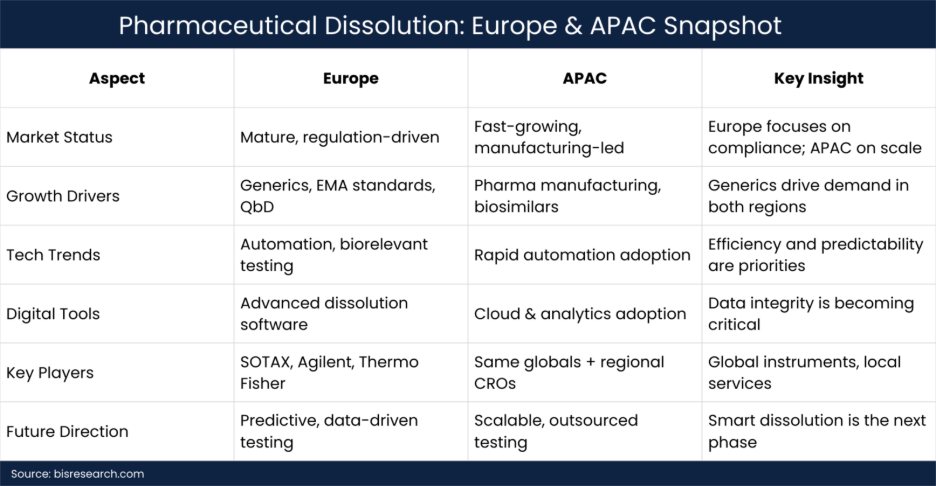
Europe pharmaceutical dissolution market represents a mature yet innovation driven. Growth is largely supported by strict regulatory oversight from the European Medicines Agency (EMA) and national authorities, which emphasize robustness in vitro testing to ensure consistent drug performance.
The region is witnessing strong demand for dissolution testing due to the increasing production of generic drugs, where bioequivalence studies are mandatory. Additionally, the adoption of Quality by Design (QbD) frameworks across European pharmaceutical companies has made dissolution testing integral to formulation development and lifecycle management.
Countries such as Germany, the UK, France, and Italy are leading adopters of automated and biorelevant dissolution systems, particularly for modified-release and controlled-release dosage forms.
Download Sample Report on Europe Pharmaceutical Dissolution Market
Explore the full market potential
schedule a consultation
The APAC pharmaceutical dissolution market is expanding at a faster pace than Europe, fueled by the region’s role as a global manufacturing hub. China, India, Japan, and South Korea are investing heavily in pharmaceutical production, especially generics and biosimilars, which require extensive dissolution testing.
Regulatory bodies in APAC are increasingly aligning with global standards such as ICH and WHO guidelines, pushing manufacturers to adopt advanced dissolution methodologies. Another major driver is the rise of outsourced dissolution testing services, as companies aim to reduce capital expenditure and accelerate time-to-market.
The growing presence of CROs and analytical service providers has made APAC a cost-effective and scalable destination for dissolution testing.
Download Sample Report on APAC Pharmaceutical Dissolution Market
Automation is one of the most significant technology shifts in both Europe and APAC. Automated dissolution systems reduce manual errors, improve repeatability, and enable high-throughput testing. Integration with robotics and auto-sampling has become standard in modern quality control labs.
Biorelevant dissolution testing is increasingly used to simulate real physiological conditions, improving predictions of in vivo drug behavior. This approach is especially valuable for poorly soluble drugs and complex formulations.
Advanced dissolution software platforms now offer real-time data capture, trend analysis, and compliance with digital record standards. Early adoption of AI and machine learning is helping optimize method development and predict formulation performance.
New solutions, such as specialized testing systems for microspheres, nanoparticles, and extended-release formulations, address the growing complexity of modern pharmaceuticals.
Key global players active across Europe and APAC include Agilent Technologies, Thermo Fisher Scientific, SOTAX, and Distek, providing advanced dissolution instruments and analytical platforms. CROs such as Catalent, Almac Group, SGS, and Intertek play a vital role by offering outsourced dissolution testing and regulatory support services.
In APAC, regional service providers and startups are rapidly expanding capabilities through partnerships with global technology suppliers, helping local manufacturers meet international compliance requirements.
High equipment costs, skilled workforce shortages, and method standardization remain key challenges. However, increasing regulatory harmonization, growing demand for generics, and digital transformation are expected to unlock significant opportunities in both regions.
As pharmaceutical formulations become more complex, dissolution testing will continue to evolve as a predictive, data-driven discipline. With automation, biorelevant testing, and digital intelligence at the core, Europe and APAC are well-positioned to lead the next phase of pharmaceutical dissolution innovation.
Looking to enter a new market but unsure where to start? At BIS Research, we provide first-hand insights directly from key opinion leaders (KOLs), backed by rigorous primary and secondary research.