Space batteries are specialized energy storage systems that power satellites, spacecraft, launch vehicles, and space exploration missions when solar energy is unavailable. In Europe’s growing space ecosystem, spanning Earth observation, navigation, defense, and deep-space exploration, battery reliability directly impacts mission lifespan, payload performance, and operational safety.
Unlike terrestrial batteries, space batteries must function in extreme conditions, including vacuum, radiation, large temperature fluctuations, and long eclipse cycles. As Europe accelerates satellite constellation deployment and invests in autonomous space capabilities, demand for high-performance, space-qualified batteries is rising steadily.
Access Europe Space Battery Market
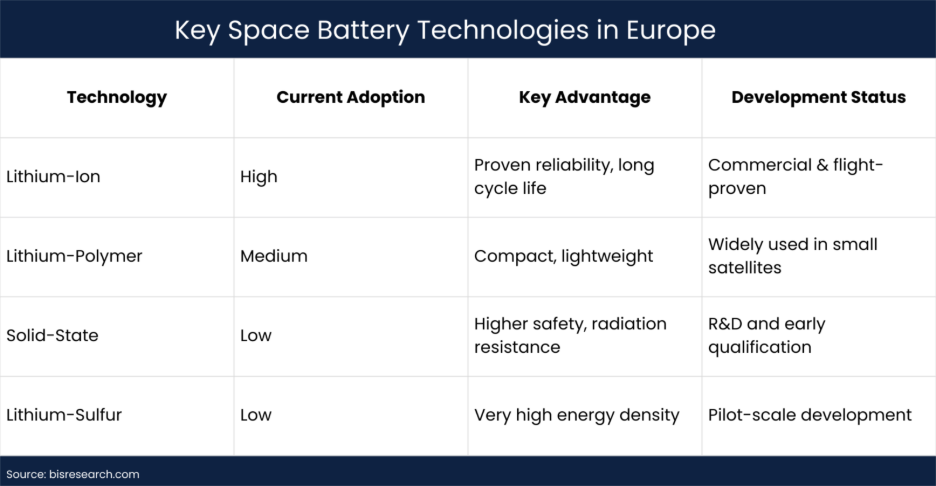
Lithium-ion (Li-ion) batteries remain the dominant technology in Europe’s space programs due to their proven flight heritage, favorable energy density, and predictable cycle life. These batteries are widely used in low Earth orbit (LEO), medium Earth orbit (MEO), and geostationary orbit (GEO) satellites, as well as in launch and exploration missions.
For small satellites and CubeSats, lithium-polymer (Li-poly) batteries are increasingly adopted. These systems offer compact form factors and flexible integration, making them suitable for rapid deployment missions and commercial constellations. While energy density improvements are incremental, reliability and qualification remain the primary purchasing criteria.
Explore the full market potential
Space qualification is a rigorous and time-intensive process. Space batteries must demonstrate consistent performance across thousands of charges–discharge cycles while resisting radiation damage, vibration during launch, and degradation over missions lasting 10–15 years or longer.
Unlike commercial batteries, space batteries prioritize predictability over peak performance. Even small deviations in voltage or capacity to fade can compromise mission-critical systems. This requirement explains why established suppliers with extensive testing infrastructure continue to dominate near-term procurement.
Want deeper insights?
Europe’s space battery ecosystem is shaped by a mix of large aerospace suppliers and specialized battery manufacturers.
Saft (France) is one of the most established players, supplying lithium-ion battery cells and systems for a wide range of European and international space missions. Its vertically integrated capabilities and long flight heritage make it a key partner for ESA programs.
ABSL (UK), part of EnerSys, is another major supplier known for space-grade lithium-ion batteries used in satellites and exploration platforms. The company focuses heavily on safety, redundancy, and long-duration performance.
Airbus Defence and Space also develops and qualifies battery systems internally, particularly for satellites and exploration platforms, supporting Europe’s push toward supply chain resilience.
For the small satellite market, AAC Clyde Space provides standardized CubeSat battery systems, enabling faster mission development cycles for commercial and institutional customers.
While incumbents dominate today’s market, startups and research organizations are driving next-generation battery innovation.
One of the most promising areas is lithium-sulfur (Li-S) batteries, which offer significantly higher theoretical energy density than lithium-ion. Germany-based theion is developing lithium-sulfur batteries using solid-state polymer electrolytes and lithium-metal anodes, targeting mass reduction and improved sustainability—key advantages for space missions.
In parallel, European research institutions, including Fraunhofer institutes, are working on solid-state battery technologies that could improve safety and radiation resistance. However, these technologies remain in the development and qualification phase, with commercial space adoption likely later in the decade.
Europe’s space battery development roadmap focuses on three priorities: higher energy density, enhanced safety, and long-term reliability. Reducing battery mass allows satellites to carry larger payloads or reduce launch costs, while improved safety is critical for crewed missions and high-value assets.
The European Space Agency continues to invest in testing infrastructure and qualification frameworks to accelerate the transition of advanced chemistries from laboratory research to flight-ready systems.
In the near term, space-qualified lithium-ion batteries will continue to dominate Europe’s space missions due to their reliability and proven performance. Over the medium to long term, solid-state and lithium-sulfur technologies could reshape the market if they achieve consistent cycle life and scalable manufacturing.
Ultimately, success in the Europe space battery market will depend not only on chemistry innovation but also on qualification discipline, supply chain readiness, and the ability to meet Europe’s growing demand for autonomous, resilient space infrastructure.
Looking to enter a new market but unsure where to start? At BIS Research, we provide first-hand insights directly from key opinion leaders (KOLs), backed by rigorous primary and secondary research.