Intelligence, Surveillance, and Reconnaissance (ISR) aircraft and drones are undergoing structural transformation. What once revolved around endurance, altitude, and payload capacity is now decisively shaped by software, autonomy, and data fusion. In 2025, ISR advantage no longer comes from owning the most sophisticated aircraft; it comes from how fast intelligence is generated, processed, and acted upon in contested environments.
The strongest reality check for defense planners is this: ISR is no longer a platform problem; it is a technology and systems-integration problem.
Access Intelligence, Surveillance, and Reconnaissance (ISR) Aircraft and Drones Market
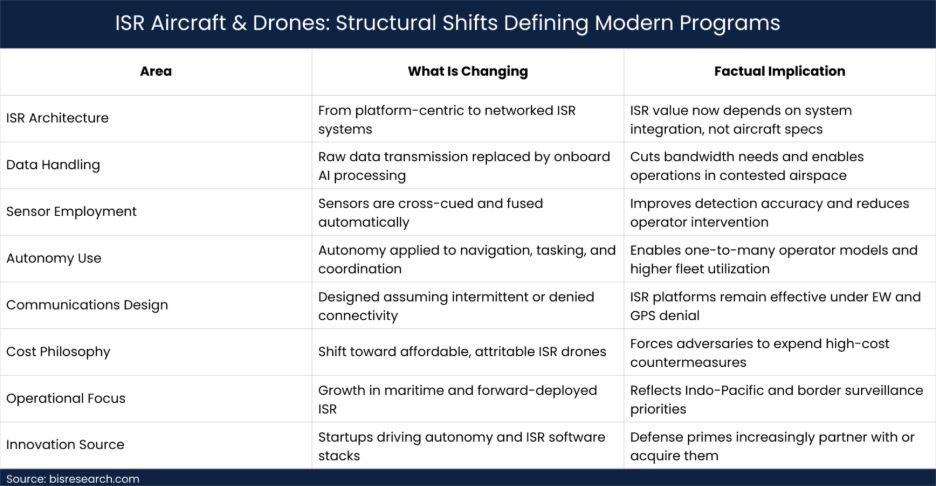
Traditional ISR architectures relied on collecting massive volumes of raw sensor data and transmitting it back to centralized command centers. This model is increasingly fragile. Bandwidth constraints, electronic warfare, and satellite denial make continuous data streaming unreliable.
Modern ISR aircraft and drones are therefore shifting toward edge intelligence, processing data onboard using AI and machine learning. Instead of streaming full-motion video, platforms now transmit actionable insights such as detected targets, anomalies, or change-detection alerts. This reduces data loads, shortens decision cycles, and enables ISR operations even in communications-denied environments.
Explore the full market potential
schedule a consultation
Electro-optical and infrared sensors remain essential, but next-generation ISR depends on multi-intelligence fusion. The real value lies in combining EO/IR, SAR, SIGINT, ELINT, AIS, and open-source intelligence into a unified operational picture.
ISR aircraft and drones are increasingly designed to cross-cue sensors autonomously, allowing one detection event to trigger another sensor or platform. The competitive edge is no longer sensor quality alone, but the fusion engine and software stack that integrates diverse data streams in real time.
Want deeper insights?
[Download Sample Report Today]
Autonomy in ISR is often misunderstood. The biggest gains are not about fully autonomous combat, but about scalability and resilience. Modern ISR concepts emphasize one operator supervising multiple drones, supported by AI-driven mission planning, deconfliction, and target tracking.
This shift enables mass deployment of ISR assets, higher sortie rates, and sustained surveillance under jamming or GPS denial. As conflicts increasingly reward numbers, dispersion, and redundancy, autonomy becomes a force multiplier rather than a novelty.
• NATO ISR modernization: NATO’s Alliance Ground Surveillance (AGS) program and RQ-4D Phoenix operations highlight the continued importance of persistent wide-area ISR, but also signal a move toward forward-deployed, interoperable intelligence sharing.
• Maritime ISR acceleration: Japan’s adoption of the MQ-9B SeaGuardian reflects surging demand for maritime domain awareness, particularly in the Indo-Pacific. Long-endurance drones optimized for ocean surveillance are becoming strategic assets.
• Shift toward affordability and mass: Defense procurement in 2024–2025 shows growing emphasis on lower-cost ISR drones deployed in large numbers, complementing high-end HALE platforms rather than replacing them.
Startups are playing an outsized role in redefining ISR—particularly in autonomy, edge computing, and rapid manufacturing.
• Shield AI has emerged as a leader in autonomy software with its “Hivemind” platform, designed to operate without GPS or communications, critical for ISR in denied environments.
• Palladyne AI reflects the growing crossover between commercial AI and defense ISR, focusing on human-supervised autonomy and scalable software architectures.
• Raphe mPhibr (India) exemplifies ISR localization, combining indigenous drones, swarm capabilities, and domestically developed avionics aligned with national self-reliance strategies.
• Beyond air, ISR is expanding into multi-domain sensing, with defense firms investing in underwater and surface autonomous systems to fuse aerial and maritime intelligence.
1. ISR as an integrated system, not a standalone aircraft
2. Open architectures that allow rapid sensor and software upgrades
3. Cost per actionable insight, not cost per flight hour
4. Multi-domain ISR fusion, especially for maritime security
ISR aircraft and drones are evolving into distributed, software-defined intelligence networks. Endurance and payload still matter, but they are no longer decisive. The future of ISR belongs to those who master edge intelligence, autonomy, and fusion at scale—and who partner with or acquire the startups already building that future.
Looking to enter a new market but unsure where to start? At BIS Research, we provide first-hand insights directly from key opinion leaders (KOLs), backed by rigorous primary and secondary research.