
As Europe accelerates its transition toward decarbonized energy and electrified mobility in late 2025, supercapacitors have shifted from niche components to strategic enablers in advanced energy systems. With unique electrochemical characteristics, ultrafast charge and discharge, high power density, and exceptional cycle life, supercapacitors now play a defining role across electric vehicles (EVs), renewable energy management, industrial power systems, and grid stability architectures. Unlike batteries that rely on internal chemical reactions, supercapacitors store energy through electrostatic charge mechanisms, enabling sub-second energy throughput and unparalleled durability, a trait increasingly indispensable for Europe’s clean energy infrastructure.
Access insight on Europe supercapacitors
At the heart of Europe’s supercapacitor evolution is a wave of breakthroughs in materials engineering, device architecture, and manufacturing scalability. Traditional supercapacitor electrodes leverage high-surface-area carbon structures to maximize ion adsorption, but European research initiatives are pushing beyond these limits. Projects funded under Horizon Europe, including those focused on novel supercapacitor materials are advancing next-generation electrochemical storage by exploring 2D materials, ionic liquid electrolytes, and hybrid architectures that aim to bridge the performance gap between batteries and capacitors.
Download Sample Report to access detailed data, forecasts, technology breakdowns, and competitive analysis.
One of the most prominent research and development consortia is GREENCAP, a multidisciplinary initiative uniting universities, R&D institutes, and industry partners across Italy, Germany, France, Ireland, Estonia, the Netherlands, the United Kingdom, and Ukraine. GREENCAP’s core objective is to produce high-performance, sustainable supercapacitors free from critical raw materials. By exploiting graphene, MXenes, and advanced ionic liquid systems, the project aims to unlock ultra-high voltage stability and performance at industrial relevant scales.
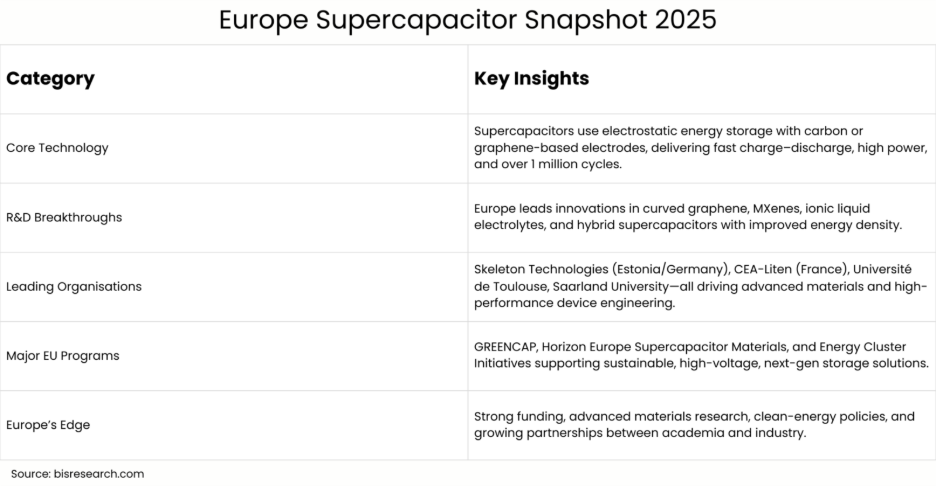
Parallel to this, research published in 2025 underscores the critical role of advanced electrode materials and electrolyte engineering including carbon nanostructures, metal oxides, and redox-active polymers in elevating energy density without compromising the rapid response capabilities that define supercapacitor utility. These scientific strides are foundational in expanding the practical domain of supercapacitors into EV power buffers, renewable grid micro-stabilization, and high-performance industrial electronics.
Schedule a call with our analyst team to explore how these insights can support your strategy and decision-making.
Several European organisations have emerged as formidable innovators, scaling technologies from lab prototypes to real-world systems.
Skeleton Technologies headquartered in Estonia with major research and manufacturing operations in Germany is a leading example of commercialised supercapacitor development. The company’s SkelCap ultracapacitors, distinguished by curved graphene electrodes, deliver significantly improved power density and lower equivalent series resistance compared to conventional cells. Skeleton has forged partnerships with major OEMs and industrial integrators and is actively expanding production capacity with new facilities in Leipzig, positioning itself at the center of Europe’s energy storage supply chain.
Across Europe’s research landscape, academic leaders such as Professor Patrice Simon at Université de Toulouse are advancing a fundamental understanding of electrochemical storage mechanisms. Simon’s work on the synthesis and charge transfer dynamics of supercapacitor materials contributes to analytical frameworks that guide improved cell design and performance optimisation.
Simultaneously, research hubs like Saarland University’s Energy Materials group (led by Volker Presser) are pioneering nanomaterial engineering for eco-efficient electrodes and sustainable energy storage systems, aligning Europe’s scientific advancement with broader environmental and circular economy goals. \
Europe’s supercapacitor ecosystem is not limited to isolated projects. Collaborative networks such as HEDAsupercap and allied consortia bring together a spectrum of stakeholders, from StoRIES and Hyflow to Enercap and MetSupercap, fostering cross-disciplinary co-innovation in materials, design, manufacturing, and system integration. Events like the Innovation & Networking Days in Supercapacitors highlight the strategic convergence of industry, academia, and policy guiding Europe’s energy storage roadmap.
These platforms emphasise not only technological breakthroughs, but also sustainable production practices, life-cycle impact analysis, and workforce development aspects critical for scaling supercapacitor solutions across diverse sectors.
In late 2025, Europe’s supercapacitor sector is no longer purely a research frontier it is a commercial reality shaping energy transition outcome. Advanced supercapacitor systems are already embedded in regenerative braking systems for urban transit, grid voltage stabilization modules for renewable farms, and high-performance power buffers for industrial automation.
The strategic alignment of Europe’s regulatory incentives, research investments, and manufacturing capacity positions the continent to lead not only in supercapacitor innovation but also in defining next-generation energy storage paradigms. As materials science continues to evolve and manufacturing ramps to meet industrial demand, Europe’s trajectory toward a resilient, responsive, and sustainable energy ecosystem will increasingly depend on supercapacitor technologies.