Industrial heating systems rarely attract headlines, yet they sit at the core of global manufacturing. From steam generation and drying to melting and thermal processing, industrial heat enables nearly every major industrial operation. What makes today different is that industrial heating long dependent on fossil fuels is now undergoing one of the most consequential transformations in decades.
Driven by energy volatility, emissions regulations, and industrial electrification goals, industrial heating systems are evolving into high-efficiency, digitally controlled, and low-carbon energy platforms. This shift is redefining how industries think about heat, not as a cost center, but as a strategic lever for resilience and competitiveness.
According to BIS Research, the global industrial heating systems market is projected to grow from $12,688.3 million in 2025 to $19,950.7 million by 2035, registering a CAGR of 4.63% during 2025–2035.
Industrial process heat accounts for a large share of industrial energy demand and emissions, particularly in sectors such as chemicals, food processing, metals, cement, and pulp and paper. Historically, this demand was met almost exclusively by natural gas, coal, or oil-fired boilers and furnaces.
However, three forces are changing the equation:
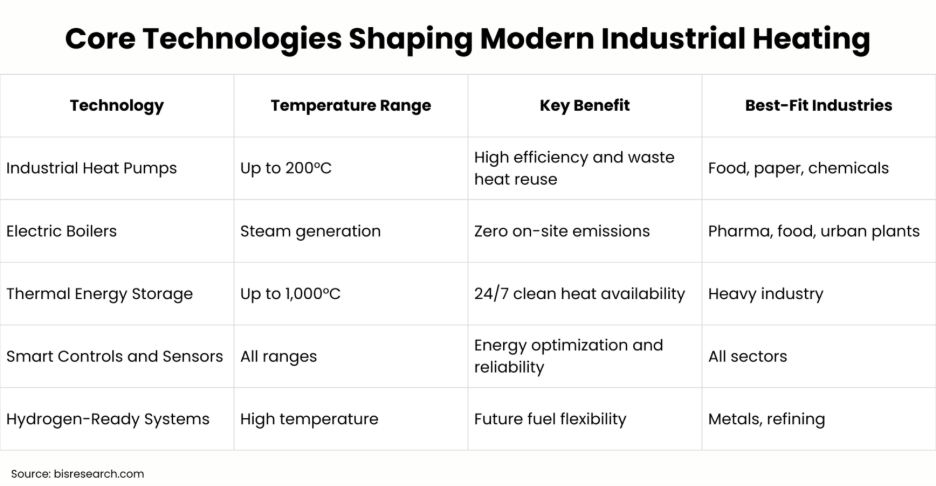
One of the most impactful developments is the rise of industrial heat pumps capable of delivering medium- to high-temperature heat. Unlike conventional systems that generate heat from fuel, heat pumps upgrade waste heat from industrial processes, cooling systems, or exhaust streams.
This approach dramatically improves energy efficiency and reduces operating costs. For industries with large continuous heat demand, such as food and beverage, paper, and chemicals, industrial heat pumps are emerging as one of the fastest-return decarbonization investments.
As electricity grids become cleaner, heat pumps also provide a direct pathway to emissions reduction without compromising reliability.
Steam remains the dominant heat carrier in industry, making electric boilers and resistance-based heating systems increasingly relevant. Electrified steam systems offer precise control, rapid response times, and zero on-site emissions as an advantage in urban and regulated environments.
Rather than replacing entire boiler systems, many plants are deploying electric boilers alongside conventional units, enabling fuel switching based on cost, grid availability, and emissions targets. This hybrid approach improves flexibility while reducing exposure to fuel price volatility.
A critical barrier to electrified heating has been intermittent. Thermal energy storage systems, often referred to as industrial heat batteries, are now solving this challenge by storing energy as heat and releasing it on demand.
These systems allow manufacturers to decouple heat production from real-time electricity supply using low-cost or renewable power when available and delivering steam or process heat continuously. This capability is particularly valuable for energy-intensive, 24/7 industrial operations.
Innovation in industrial heating is increasingly led by startups focused on electrification and efficiency:
These companies are moving rapidly from pilot projects to commercial installations, supported by industrial customers seeking near-term emissions reductions.
Get deeper, tailored insights with a customized report designed around your market, technology focus, and strategic goals.
Established equipment manufacturers are also evolving. Companies such as Babcock & Wilcox, Cleaver-Brooks, Miura, Alfa Laval, and Spirax Sarco are integrating advanced controls, waste heat recovery, and fuel-flexible designs into their systems.
Meanwhile, industrial automation leaders like Honeywell, Emerson, and Schneider Electric are embedding digital intelligence into heating systems, enabling predictive maintenance, real-time optimization, and energy performance tracking.
The future of industrial heating is not about a single technology; it is about system-level optimization. The most effective strategies combine electrification, waste heat recovery, thermal storage, and digital control.
For manufacturers, modernizing industrial heating systems delivers benefits beyond emissions reduction: lower energy costs, improved reliability, regulatory compliance, and long-term operational resilience.
Industrial heating systems are no longer static utilities hidden in boiler rooms. They are becoming intelligent, flexible energy systems that directly influence industrial competitiveness. As technology matures and adoption accelerates, industrial heating will play a central role in shaping a more efficient, resilient, and low-carbon industrial future.
Looking to enter a new market but unsure where to start? At BIS Research, we provide first-hand insights directly from key opinion leaders (KOLs), backed by rigorous primary and secondary research.