Engine oil has come a long way in recent years. As cars get smarter, faster, and more fuel-efficient, the motor oil inside them must keep up. That’s where standards like ILSAC GF-6 and GF-7 lubricants come in. These certifications, developed by the International Lubricant Specification Advisory Committee (ILSAC), define the quality and performance of engine oils used in modern gasoline-powered engines.
So, what’s the difference between ILSAC GF-6 and GF-7 lubricant? Why does it matter for drivers, mechanics, and lubricant brands like Valvoline, Castrol, or TotalEnergies? Let’s break it down.
Explore the Market Impact, Regulatory Timeline, and Growth Forecast for Next-Generation Engine Oils – Explore the Full Market Report
ILSAC GF-6 was introduced in 2020 to meet the needs of modern engines, especially those with turbocharging, direct injection, and stop-start systems. The standard brought two sub-categories: GF-6A and GF-6B. GF-6A is backward-compatible with older engines, while GF-6B is specifically designed for lower-viscosity oils like SAE 0W-16 to improve fuel economy.
GF-6 lubricants introduced stricter requirements for:
This was a significant step forward in advanced engine protection and a response to growing concerns about LSPI, which can damage engines at low speeds in turbocharged setups.
The ILSAC GF-7 standard, currently under development and expected to launch by 2026, will raise the bar even higher. It builds on the success of GF-6 but focuses more on emissions reduction, durability in hybrid powertrains, and improved compatibility with biofuels. As automakers push for lower emissions and better fuel economy, oil standards must evolve to meet stricter regulatory demands.
Key advancements in GF-7 lubricants include:
These updates are not only for performance; they’re crucial for meeting federal fuel economy and emissions targets, especially as more vehicles shift toward hybrid platforms.
Parameter | ILSAC GF-6 | ILSAC GF-7 (Expected) |
|---|---|---|
Launch Timeline | 2020 | Expected 2026 |
Fuel Economy | Improved | Further enhanced |
LSPI Protection | Strong | Advanced & optimized |
Turbocharger Deposits | Controlled | Enhanced protection |
Hybrid Compatibility | Limited focus | High optimization for hybrids |
Biofuel Compatibility | Standard | Improved compatibility |
Volatility Control | Moderate | Lower oil consumption |
Sustainability Focus | Efficiency-driven | Emissions + extended oil life |
Market Readiness | Current fleet | Future vehicle platforms |
From a commercial engine oil market perspective, GF-7 will likely accelerate demand for:
Download the ILSAC GF 6 & GF 7 Market Report ToC
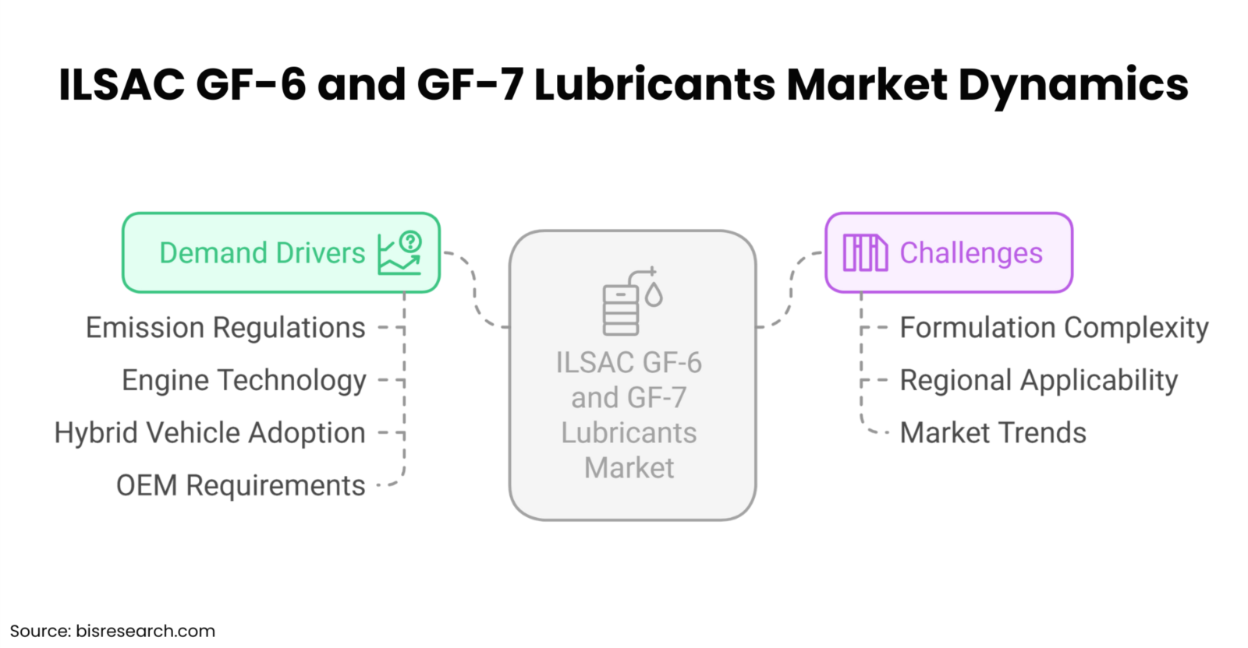
The global automotive lubricants market is undergoing structural transformation due to:
Key Market Drivers
Regional Growth Insights
The transition to GF-7 will directly influence the engine oil additives market, synthetic base oil market, and passenger car motor oil industry forecast.
1) Lubricant Manufacturers
Companies such as Shell, ExxonMobil, TotalEnergies, Valvoline, and Castrol are investing in:
The GF-7 shift presents opportunities for:
2) Additive Suppliers
The engine oil additives market growth will benefit from:
3) OEMs and Automakers
Automakers must align lubrication systems with:
4) Investors & Market Stakeholders
From an investment perspective, the transition signals:
Choosing between ILSAC GF-6 vs GF-7 engine oils is not simply technical—it’s strategic.
As hybrid vehicle platforms expand, GF-7-certified oils will become increasingly important for future engine performance and emissions standards.
Companies Preparing for the GF-7 Shift
Leading lubricant companies are already preparing for:
As per BIS Research, stronger positioning around future-ready, hybrid-optimized lubricants in expected.
The shift from GF-6 to GF-7 will significantly influence:
Organizations planning product development, market entry, or investment strategies should evaluate:
Download ILSAC GF-6 and GF-7 Lubricants Market ToC
Need Tailored Insights for ILSAC GF-6 and GF-7 Lubricants Market Report