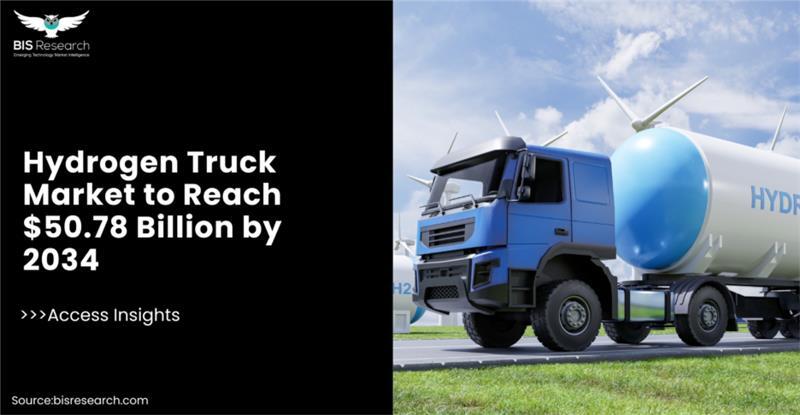
Hydrogen trucks represent a critical solution within the clean transportation ecosystem, focused on replacing traditional diesel-powered trucks with zero-emission hydrogen fuel cell vehicles. These trucks benefit from advances in fuel cell technology, onboard hydrogen storage, and fast refueling enabling heavy-duty and long-haul trucking where battery-electric alternatives face range and payload limitations.
The hydrogen truck market benefits from ongoing R&D to improve fuel cell longevity, lower total cost of ownership, and enable scalable production. Integration with renewable hydrogen sources and hybrid fuel cell-battery systems further enhance operational flexibility. Hydrogen trucks play a key role in helping logistics operators and fleet owners meet global decarbonization targets and stricter sustainability standards.
According to BIS Research, the hydrogen truck market was valued at $3.79 billion in 2024 and is projected to reach $50.78 billion by 2034, expanding at a CAGR of 25.58% during the forecast period.
Explore the full TOC and Download report Sample
Key Drivers:
• Stringent global emission regulations driving zero-emission vehicle adoption
• Government subsidies and tax incentives accelerating hydrogen truck deployment
• Corporate sustainability commitments across logistics and fleet sectors
• Advances in fuel cell stack technology, storage solutions, and refueling speed
• Integration of renewable hydrogen and hybrid powertrains for improved flexibility
Key Challenges:
• High upfront costs of hydrogen fuel cell vehicles compared to diesel trucks
• Limited hydrogen refueling infrastructure, especially outside major freight corridors
• Need for harmonized safety and refueling standards across regions
• Ongoing requirements for R&D investment to extend fuel cell lifespan and reduce costs
• Supply chain development and scaling of hydrogen production capacity
• 2024: Early commercial deployments in the U.S. and Europe validate hydrogen truck technology, driving new manufacturing investments.
• 2023-2025: Major manufacturers partner with hydrogen producers to speed up refueling station rollout across North America, Europe, and Asia-Pacific.
• 2025: Cross-border alliances in Europe and Asia standardize hydrogen refueling protocols, improving interoperability for logistics operators.
• Ongoing: Government incentive programs in Germany, California (U.S.), and China support wider fleet adoption of hydrogen trucks.
By Hydrogen Tank Type
• Type III
• Type IV
By Vehicle Type
• Hydrogen Buses
o Minibuses/Shuttles
o City/Transit Buses
• Hydrogen Trucks
o Medium and Heavy-Duty Trucks
o Liquid Hydrogen Tank Trucks
By Fuel Cell Technology
• Proton Exchange Membrane (PEM) Fuel Cells
• Others (Alkaline Fuels, Direct Methanol Fuel)
By Applications
• Long Haul Trucking
• Heavy-Duty Applications
• Logistics and Freight
• Public Transportation
• Mining Operations
By Region
• North America – U.S., Canada, and Mexico
• Europe – Germany, France, Italy, Spain, U.K., and Rest-of-Europe
• Asia-Pacific – China, Japan, South Korea, India, and Rest-of-Asia-Pacific
• Rest-of-the-World – South America and Middle East and Africa
According to Principal Analyst at BIS Research:
“The hydrogen truck market is on the cusp of significant transformation, driven by advancements in fuel cell technology and increasing regulatory pressure on heavy-duty emissions. Market leaders who focus on scalable manufacturing, infrastructure partnerships, and cost reduction will shape the competitive landscape. Strategic investments in regional infrastructure and harmonized standards will accelerate the hydrogen truck market’s penetration, especially in logistics-heavy corridors.”
The hydrogen truck market is projected to surge from $3.79 billion in 2024 to $50.78 billion by 2034 at a CAGR of 25.58%, propelled by zero-emission regulations and advancing technology.
Key players include Hyundai Motor Company, Daimler Truck AG (Mercedes-Benz Group AG), Nikola Corporation, AB Volvo, Toyota Motor Corporation, Foton International, Yutong Bus Co., Ltd., Solaris Bus & Coach sp. zo.o., Xiamen King Long International Trading Co., Ltd., and Anhui Ankai Automobile Co, Ltd.
Proton Exchange Membrane (PEM) fuel cells lead the market, with high demand for scalable, long-range trucks and hybrid fuel cell-battery systems for logistics and freight.
BIS Research offers KOL-based insights, rigorous segmentation, and strategic advisory across software, hardware, and sensing tech domains
Download Sample Report
Contact Analyst
Download TOC