Precision agriculture is undergoing rapid transformation, and nowhere is this more evident than in precision planting technologies. As global food demand rises and arable land declines, farmers are turning to data-driven planting systems that maximize crop emergence, improve seed-to-soil contact, and reduce input wastage. From high-performance planters to autonomous and aerial systems, precision planting is becoming a cornerstone of sustainable and profitable farming. Here’s a breakdown of the key deployment types shaping the future of modern agriculture.
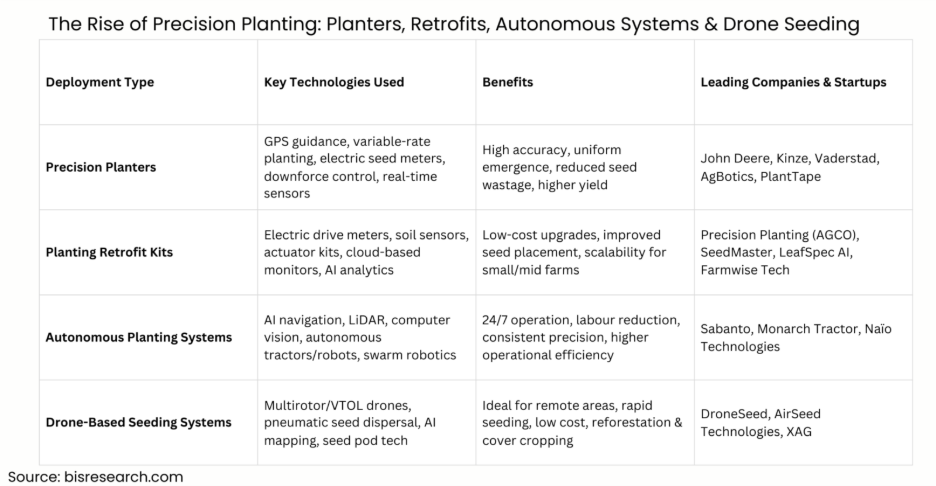
Precision planting advanced machinery designed to deliver seeds at exact spacing, depth, and population rates. Traditional broadcast methods often lead to irregular germination and yield variability. Today’s precision planters integrate:
• Variable-rate planting (VRP)
• High-speed electric seed meters
• Row-by-row control systems
• On-the-go soil sensing
Companies like John Deere, Kinze, and Vaderstad have pioneered smart planters equipped with GPS guidance, real-time feedback loops, and AI-enabled adjustments. These machines reduce seed wastage by up to 10% and improve crop uniformity—critical for maximizing yield potential.
Emerging startups such as AgBotics and PlantTape offer compact and modular planters catering to vegetable, cotton, and specialty crops, demonstrating that precision planting innovation is no longer limited to large-scale row-crop operations.
Not every farmer can afford a new high-tech planter, and that’s where planting retrofit kits come in. These kits upgrade existing equipment with precision components including:
• Electric drive seed meters
• Downforce sensors
• Seed-placement actuators
• Cloud-connected monitors
The affordability of retrofit solutions has made precision planting scalable for small and mid-size farms. Leading innovators like Precision Planting LLC (AGCO) and SeedMaster offer retrofit kits that boost planting accuracy by 20–30% without requiring farmers to purchase an entirely new machine.
New startups such as LeafSpec AI and Farmwise Tech are building sensor kits that integrate seamlessly with retrofitted planting platforms, giving farmers field-level analytics and actionable insights at a fraction of the cost.
Explore the full market potential
schedule a consultation
Autonomous planting systems represent the next big leap in precision agriculture. These robotic or self-driving units carry out planting operations with minimal human intervention. Equipped with:
• AI-driven navigation
• LiDAR and computer vision
• Smart implement control
• Swarm robotics capability
These systems can operate 24/7 with consistent accuracy. Companies such as Naïo Technologies, Monarch Tractor, and Sabanto are leading this segment with autonomous tractors and planting robots capable of covering large areas efficiently.
Autonomy also addresses agri-labour shortages; one of the biggest challenges in global farming. As more startups enter this space with lighter, electric, and autonomous units, the cost of such systems is expected to drop significantly, increasing accessibility for emerging markets.
Want deeper insights?
[Download Sample Report Today]
Drone-based seeding systems are rapidly moving from experimental to commercial use, especially in forestry, covering cropping, land restoration, and hard-to-reach terrains. These systems leverage:
• Multirotor or VTOL drones
• Pneumatic seed dispensers
• AI mapping and prescription algorithms
Companies like DroneSeed, AirSeed Technologies, and XAG are pioneering large-scale aerial seeding platforms that can plant thousands of seed pods per hour, making them ideal for reforestation and regenerative agriculture programs.
Drone seeding reduces planting costs by up to 70% for inaccessible areas and offers high-resolution mapping that supports precision-based replanting strategies. As seed-pod biotechnology and drone payload capacity improve, this segment is expected to become one of the fastest-growing deployment types.
The convergence of AI, robotics, IoT, and aerial systems is pushing precision planting into a new era of automation and intelligence. From retrofit kits democratizing access to drones restoring degraded land, each deployment type plays a unique role in accelerating sustainable agriculture.
As startups continue to innovate and venture funding flows into agri-tech, the precision planting market is poised for robust growth; driven by efficiency, productivity, and the global need for resilient food systems.
Looking to enter a new market but unsure where to start? At BIS Research, we provide first-hand insights directly from key opinion leaders (KOLs), backed by rigorous primary and secondary research.