Indoor Air Quality (IAQ) solutions have become a critical focus area across residential, commercial, and industrial buildings as awareness grows around the health impact of indoor pollutants. With people spending nearly 90 percent of their time indoors, poor indoor air quality is increasingly linked to respiratory diseases, allergies, reduced productivity, and long-term health risks. As a result, IAQ solutions are evolving rapidly, driven by advanced sensing technologies, smart ventilation, air purification systems, and data-driven monitoring.
Today, IAQ is no longer limited to basic filtration. It is emerging as a holistic indoor environmental management system that integrates air quality monitoring, purification, humidity control, and intelligent building automation.
As per BIS Research, the global indoor air quality (IAQ) solutions market is projected to grow from $16.8 billion in 2025 to $29.91 billion by 2035, registering a CAGR of 5.93% during 2025–2035.
Indoor air can be two to five times more polluted than outdoor air, containing particulate matter (PM2.5), volatile organic compounds (VOCs), carbon dioxide, mold spores, and biological contaminants. The COVID-19 pandemic further accelerated IAQ investments by highlighting the role of airborne transmission in enclosed spaces.
Regulatory attention, green building certifications, and corporate wellness initiatives are now pushing building owners to adopt advanced indoor air quality solutions that go beyond compliance and focus on occupant health and comfort.
Want deeper insights?
[Request Sample Report Now]
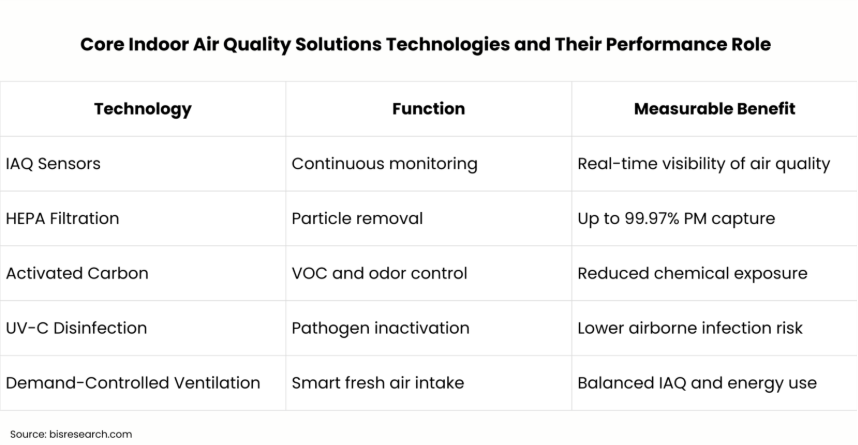
The foundation of modern IAQ solutions lies in real-time air quality monitoring. Advanced sensors can continuously measure CO?, PM2.5, PM10, VOCs, temperature, and humidity. These sensors are increasingly connected via IoT platforms, enabling building managers to track air quality trends and respond proactively.
Recent developments include AI-enabled analytics, which correlate air quality data with occupancy patterns and HVAC performance to optimize ventilation dynamically.
Air purification has evolved significantly from traditional filters. High-efficiency particulate air (HEPA) filters, activated carbon filters, and electrostatic precipitators are widely used to remove fine particles and chemical pollutants.
Newer advancements include UV-C disinfection, bipolar ionization, and photocatalytic oxidation systems, which target airborne pathogens and biological contaminants. These technologies are increasingly integrated into HVAC systems for large buildings and hospitals.
Ventilation plays a crucial role in IAQ. Demand-controlled ventilation systems use CO? and occupancy data to adjust fresh air intake automatically, balancing air quality with energy efficiency. This is particularly important in commercial buildings where excessive ventilation can drive energy costs.
Integration with building management systems allows IAQ solutions to operate as part of a broader smart building ecosystem, optimizing both air quality and operational efficiency.
Explore the full market potential
schedule a consultation
Recent IAQ innovations focus on connectivity, automation, and predictive control. Cloud-based IAQ platforms now provide dashboards, alerts, and compliance reporting for facility managers. AI models are being used to predict air quality deterioration before it impacts occupants, enabling preventive action.
Another major development is the convergence of IAQ and sustainability goals. Energy-efficient filtration, low-pressure-drop filters, and intelligent ventilation systems help maintain healthy air while reducing carbon footprints.
Several established companies are shaping the global IAQ landscape:
• Honeywell offers integrated IAQ solutions combining sensors, filtration, and building automation.
• Daikin and Carrier focus on advanced HVAC systems with built-in air purification and ventilation controls.
• Johnson Controls integrates IAQ monitoring into smart building platforms.
• 3M remains a leader in filtration technologies, including HEPA and advanced filter media.
These companies leverage deep HVAC expertise and global reach to deploy scalable IAQ solutions across sectors.
Startups are accelerating innovation with data-driven and user-centric solutions:
• Awair specializes in smart indoor air quality monitors for homes and offices.
• IQAir focuses on high-performance air purification systems for healthcare and critical environments.
• Kaiterra develops commercial-grade air quality sensors and analytics platforms.
• Airthings offers consumer-friendly IAQ monitoring solutions with cloud connectivity.
These startups emphasize usability, transparency, and real-time insights, making IAQ management more accessible.
Indoor Air Quality solutions are transitioning from optional add-ons to essential building infrastructure. As regulations tighten and occupants demand healthier spaces, IAQ technologies will continue to evolve toward predictive, automated, and integrated systems.
For building owners and facility managers, investing in modern IAQ solutions delivers multiple benefits: healthier occupants, improved productivity, regulatory compliance, and long-term energy efficiency. In the coming years, healthy air will be as fundamental as heating, cooling, and lighting, making IAQ a defining pillar of smart and sustainable buildings.
Get deeper, tailored insights with a customized report designed around your market, technology focus, and strategic goals.