The automotive industry is entering a defining phase where how vehicles are manufactured is becoming just as important as what vehicles are produced. Factory-of-the-future mobility solutions are reshaping automotive manufacturing by integrating digital twins, industrial AI, autonomous logistics, and software-defined automation into a single, intelligent ecosystem. By 2026, these technologies are expected to move from pilot projects to standard operating models across mobility production facilities.
A factory-of-the-future refers to a digitally connected, flexible, and data-driven manufacturing environment designed to support electric vehicles (EVs), autonomous systems, and software-defined vehicles. Unlike traditional automotive plants built for scale and repetition, future mobility factories are optimized for adaptability, enabling manufacturers to handle multiple vehicle platforms, battery configurations, and powertrains on the same line.
This shift is driven by EV complexity, shorter product cycles, and increasing cost pressures, forcing OEMs to rethink rigid production models in favor of smart manufacturing solutions.
As per BIS Research analyst, the factory-of-the-future mobility solutions market was valued at $8,134.8 million in 2024 and is projected to reach $58,681.4 million by 2035, growing at a CAGR of 19.94% during 2025–2035.
Want deeper insights?
[Request Sample Report Now]
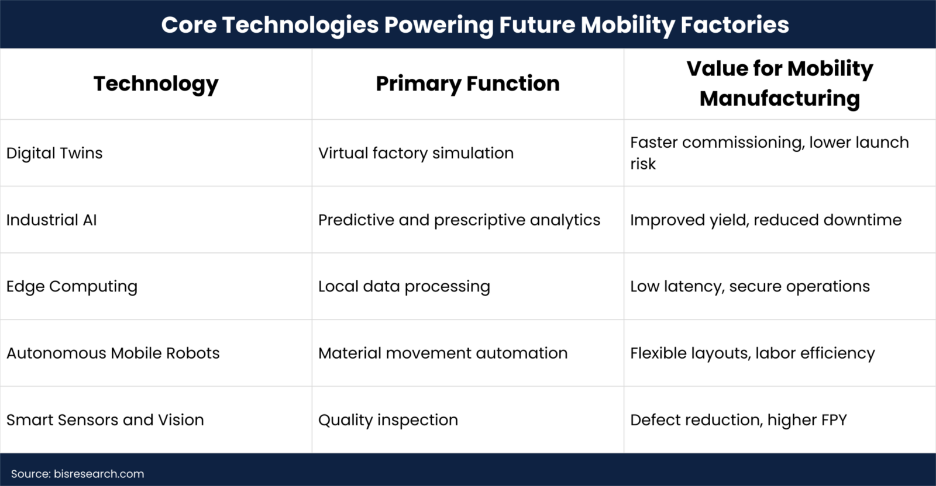
Digital twin technology is becoming the backbone of factory-of-the-future mobility solutions. These virtual replicas of production lines allow manufacturers to simulate workflows, validate automation logic, and identify bottlenecks before physical deployment. For EV and battery manufacturing, digital twins reduce ramp-up risks and significantly shorten time-to-market.
By 2026, digital twins will be widely used for EV battery assembly, power electronics manufacturing, and mixed-model vehicle production, making them essential for scalable mobility manufacturing.
Artificial intelligence is shifting from centralized analytics to real-time, edge-based intelligence on the shop floor. AI-powered vision systems are improving defect detection, predictive maintenance tools are reducing downtime, and AI-driven production scheduling is optimizing throughput in complex EV manufacturing environments.
Edge computing ensures these AI systems operate securely and with low latency, critical for safety-sensitive mobility production processes.
Explore the full market potential
schedule a consultation
Material movement is one of the biggest constraints in modern mobility factories. Factory-of-the-future mobility solutions increasingly rely on Autonomous Mobile Robots (AMRs) for material transport, line-side delivery, and kitting operations. These systems improve operational continuity, reduce dependency on manual labor, and support flexible production layouts.
As EV battery packs and e-drive systems introduce higher part variability, autonomous intralogistics becomes a strategic enabler rather than a support function.
By 2026, the focus of factory-of-the-future solutions will shift from full automation to intelligent flexibility. OEMs are prioritizing modular production lines that can be quickly reconfigured for new vehicle architectures or fluctuating demand.
Another major advancement is the tighter integration of product engineering and manufacturing planning. Software-driven collaboration tools allow manufacturing constraints to be addressed earlier in the vehicle design process, reducing costly late-stage changes.
Sustainability is also becoming central to future mobility factories. Energy-efficient equipment, digital energy management systems, and battery material recycling integration are increasingly embedded into plant operations to reduce carbon footprints and meet regulatory requirements.
Several technology leaders are shaping this evolution:
• Siemens is advancing digital twin platforms, virtual commissioning, and industrial AI for automotive and EV manufacturing.
• NVIDIA provides simulation and AI computing platforms that enable realistic factory digital twins and AI model training.
• Rockwell Automation, along with OTTO Motors, is integrating autonomous robotics into smart manufacturing environments.
• Aptiv is expanding intelligent factory systems and autonomous logistics capabilities to support next-generation mobility production.
These companies are helping OEMs transition from traditional plants to adaptive, software-driven manufacturing ecosystems.
Factory-of-the-future mobility solutions are no longer experimental; they are becoming a competitive necessity. Manufacturers that successfully deploy smart manufacturing technologies, AI-driven automation, and autonomous logistics will benefit from faster launches, higher quality, and lower production costs.
As the mobility industry evolves toward electrification and digitalization, the factory itself is emerging as a strategic differentiator. In the next phase of automotive transformation, the intelligence of the factory will define the success of mobility innovation.
Looking to enter a new market but unsure where to start? At BIS Research, we provide first-hand insights directly from key opinion leaders (KOLs), backed by rigorous primary and secondary research.