Green gigafactories are large-scale electric vehicle (EV) and battery manufacturing facilities powered predominantly by renewable energy sources such as solar, wind, and hydropower. Unlike traditional factories, these facilities are designed to minimize carbon emissions across the entire production lifecycle.
Their importance is tied directly to a critical paradox in the EV industry. While EVs reduce emissions during use, their manufacturing, especially battery production, is energy-intensive. If powered by fossil fuels, this undermines their environmental benefit. Green gigafactories address this gap by aligning production with sustainability goals.
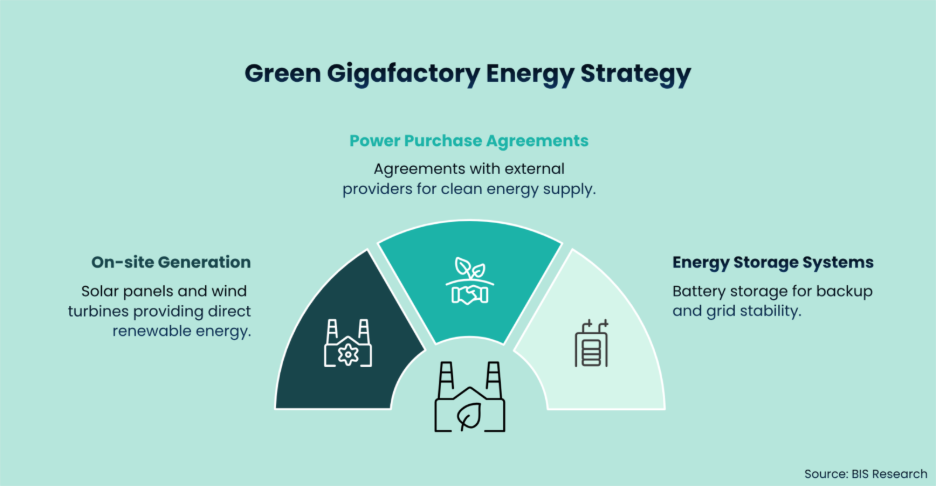
Renewable energy integration in gigafactories typically occurs through three primary approaches:
• On-site generation: Many manufacturers install solar panels or wind turbines within or near factory premises. Tesla’s Gigafactory Nevada, for instance, was designed with plans to run largely on solar energy.
• Power purchase agreements (PPAs): Automakers partner with renewable energy providers to secure long-term clean energy supply.
• Energy storage systems: Battery storage solutions help balance intermittent renewable supply.
This combination creates a more resilient and sustainable energy ecosystem within manufacturing hubs.
Gain a comprehensive view of the EV battery value chain with the Global Electric Vehicle Battery Market Report by BIS Research, which provides insights into market trends, technology advancements, and competitive dynamics.
The shift toward renewable-powered manufacturing is driven by multiple factors:
1. Regulatory pressure: Governments are tightening emissions standards.
2. Cost efficiency over time: Renewable energy reduces long-term operational costs.
3. Investor and consumer expectations: ESG metrics are increasingly influencing decisions.
4. Supply chain decarbonization: OEMs are targeting Scope 3 emissions.
For a deeper understanding of quality assurance in EV batteries, consult the Electric Vehicle Battery Testing, Inspection, and Certification Market report by BIS Research.
Several industry leaders are actively developing renewable-powered manufacturing ecosystems:
1. Tesla: Integrating solar and storage across facilities.
2. Volkswagen Group: Building carbon-neutral battery plants in Europe.
3. Northvolt: Operating on hydropower in Sweden.
4. BYD and CATL: Expanding renewable integration in China.
These companies are scaling EV production while embedding sustainability at the core of operations.
Despite strong momentum, challenges persist:
1. High capital expenditure: Renewable infrastructure requires upfront investment.
2. Energy intermittency: Solar and wind depend on weather conditions.
3. Geographic limitations: Renewable access varies by region.
4. Supply chain alignment: Ensuring supplier decarbonization is complex.
To explore how fast-charging infrastructure is evolving alongside EV adoption, refer to the Electric Vehicle Fast Charging System Market Report by BIS Research.
Policy frameworks are accelerating adoption:
• U.S. Inflation Reduction Act supports clean manufacturing
• EU Green Deal promotes carbon-neutral industry
• China’s renewable policies enable large-scale deployment
These initiatives reduce financial risks and encourage long-term investments.
Green gigafactories are expected to become the standard as EV adoption scales globally. Key emerging trends include:
• Hydrogen-based industrial processes
• AI-driven energy optimization
• Circular manufacturing and battery recycling
Green gigafactories close the gap between clean transportation and clean production. They ensure that EVs deliver environmental benefits not just on the road, but throughout their lifecycle.
As regulatory pressure, technology innovation, and market demand converge, renewable-powered manufacturing will define the next phase of the EV industry.