The global mobility sector is undergoing one of its most profound transformations in decades. What was once a relatively stable industry centered on internal combustion engine (ICE) vehicles is now being reshaped by sustainability mandates and rapid digital innovation. Electrification marked the beginning of this shift, but the journey does not end there. The future of mobility is increasingly defined by a convergence of electric, autonomous, connected, and data-driven systems.
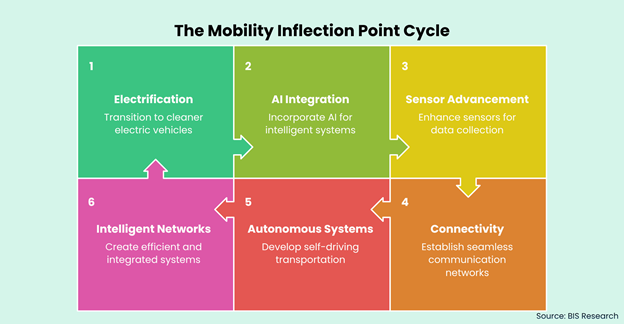
The push toward cleaner transportation has accelerated the transition from ICE vehicles to electric mobility. Governments across major economies are setting net-zero targets, tightening emission norms, and offering incentives to drive EV adoption. However, this is only one part of a broader disruption. The automotive industry is evolving into a technology-driven ecosystem where software, data, and intelligence are as critical as hardware.
This transformation is layered. Electrification is enabling a cleaner foundation, while advancements in artificial intelligence, sensors, and connectivity are paving the way for autonomous and intelligent transportation systems. As a result, mobility is no longer just about moving people or goods. It is about creating integrated, efficient, and intelligent networks.
Electrification continues to dominate the conversation. The EV ecosystem now extends well beyond vehicles to include battery innovation, charging infrastructure, and energy integration. Breakthroughs in battery technologies, including solid-state and sodium-ion batteries, are addressing long-standing challenges related to cost, safety, and resource availability. Meanwhile, the expansion of charging infrastructure remains critical, particularly in emerging markets where deployment gaps still exist.
Autonomous driving is another major pillar. The industry is steadily progressing from advanced driver-assistance systems (ADAS) to higher levels of automation. While fully autonomous vehicles are still in the testing and early deployment phase, Level 2 and Level 3 systems are gaining commercial traction. These systems rely on a combination of sensors, machine learning, and real-time processing to enhance safety and driving efficiency.
Want to know more explore Autonomous Vehicle Simulation Solutions Market
Connectivity is redefining the vehicle experience. Modern vehicles are increasingly becoming software-defined platforms capable of receiving over-the-air updates and enabling digital services. This shift is unlocking new business models for automakers, including subscription-based features and data monetization strategies. At the same time, vehicle-to-everything (V2X) communication is enhancing traffic management and road safety.
In parallel, shared and smart mobility solutions are transforming how transportation is consumed. Ride-hailing, car-sharing, and mobility-as-a-service (MaaS) platforms are reducing reliance on private vehicle ownership, particularly in urban areas. These models are supported by digital platforms that optimize fleet utilization and improve user convenience.
The pace of change is strongly influenced by policy frameworks. Incentives for EV adoption, investments in infrastructure, and regulatory support for autonomous testing are driving market growth. However, policy fragmentation across regions can create uncertainty for global players.
Collaboration has become a defining feature of the industry. Automotive manufacturers are increasingly partnering with technology companies, semiconductor firms, and startups to accelerate innovation. These partnerships are critical for bridging capability gaps, especially in areas such as AI, software development, and advanced electronics.
Despite strong momentum, infrastructure readiness remains a key challenge. The scaling of EV charging networks, grid modernization, and digital infrastructure must keep pace with vehicle adoption. Without this alignment, growth could slow, particularly in high-demand regions.
In a rapidly evolving landscape, informed decision-making is essential. Market intelligence provides the foundation for understanding industry dynamics, identifying growth opportunities, and mitigating risks. Companies need detailed insights into market size, demand forecasts, technology adoption trends, and competitive positioning.
Ecosystem mapping helps stakeholders identify key players, emerging startups, and potential partners. Competitive benchmarking offers clarity on how different companies are positioning themselves across electrification, autonomy, and connectivity. At the same time, regional analysis highlights where investments are most likely to yield returns, based on policy support, infrastructure maturity, and consumer readiness.
Crucially, intelligence enables organizations to prioritize. Not all segments of the mobility market will grow at the same pace. Identifying high-growth niches, whether in battery supply chains, autonomous software, or smart mobility platforms, can provide a significant competitive advantage.
Ready to expand into new markets with confidence? Explore how BIS Research can help you assess opportunities, mitigate risks, and build a winning market entry strategy
Discover BIS Research Market Entry Solutions
BIS Research plays a critical role in helping stakeholders navigate this complexity. By delivering in-depth analysis across the mobility value chain, the firm provides actionable insights into emerging technologies and market trends. Its coverage spans electric vehicles, battery technologies, autonomous systems, and connected mobility ecosystems.
Through detailed segmentation by vehicle type, autonomy level, and geography, BIS Research enables precise decision-making. Its insights support a range of strategic objectives, from market entry and expansion to investment planning and competitive strategy development. For organizations operating in a fast-changing environment, such intelligence is not optional. It is essential.
The future of mobility will be defined by convergence. Electrification, autonomy, connectivity, and data will collectively reshape transportation systems worldwide. The transition is complex, with multiple variables influencing its trajectory.
For industry participants, the ability to anticipate change will be a key differentiator. Those who leverage robust market intelligence will be better equipped to identify opportunities, adapt to disruptions, and lead in the next phase of mobility evolution.