
The medtech industry is undergoing a fundamental shift from standalone medical devices to intelligent, data-driven healthcare systems. This transformation is not just technological; it is redefining how care is delivered, measured, and continuously improved. Today, the real value of medical technology lies not only in devices themselves but in the data they generate and the insights they unlock.
Historically, medical technologies focused on hardware innovation diagnostic imaging systems, surgical instruments, and monitoring equipment. Today, these devices are no longer isolated tools; they are intelligent endpoints within a broader digital health ecosystem.
Modern medtech solutions are embedded with IoMT (Internet of Medical Things) capabilities, enabling continuous data generation across patient touchpoints. This shift allows healthcare providers to move beyond episodic care toward continuous, insight-driven decision-making.
According to BIS Research, the integration of AI, cloud computing, and data analytics into medical technologies is accelerating the transition toward predictive and preventive healthcare models.
Data has become the backbone of next-generation healthcare. From diagnostics to post-operative monitoring, real-time data streams are enabling clinicians to make faster, more accurate decisions.
For example, BIS Research’s surgical procedure volume database provides granular, procedure-level insights across regions and specialties. These datasets allow hospitals and medtech companies to:
• Forecast demand for surgical procedures
• Optimize operating room utilization
• Align product development with real-world clinical needs
Such intelligence transforms raw data into actionable insights, improving both patient outcomes and operational efficiency.
Discover how actionable data can transform your healthcare strategy today.
Request a Quote for the Surgical Procedure Volume Database
One of the most impactful outcomes of data-driven medtech is the rise of precision medicine. By leveraging patient-specific datasets genomics, imaging, and real-time biometrics healthcare providers can tailor treatments with unprecedented accuracy.
BIS Research highlights that advancements in AI-enabled diagnostics and digital health platforms are enabling early disease detection and continuous patient monitoring. Wearables and remote monitoring devices are further extending care beyond hospital settings, reducing readmission rates and improving long-term outcomes.
The operating room is becoming a hub of data intelligence. Surgical robotics, minimally invasive systems, and AI-assisted imaging technologies are generating vast amounts of intraoperative data.
According to BIS Research insights, these innovations are:
• Enhancing surgical precision and reducing complication rates
• Enabling data-driven training and performance benchmarking for surgeons
• Supporting standardized, evidence-based surgical protocols
In addition, integration with procedure volume analytics helps healthcare systems identify high-growth surgical segments and optimize capital investments in advanced surgical technologies.
Medtech data is not only improving patient care but also revolutionizing healthcare operations. Hospitals are increasingly adopting data platforms to monitor key performance indicators such as procedure volumes, patient throughput, and equipment utilization.
This enables:
• Strategic capacity planning based on real-world demand trends
• Improved cost efficiency through resource optimization
• Data-backed procurement and investment decisions
Furthermore, medtech companies are leveraging these insights to refine go-to-market strategies and identify high-growth opportunities across regions and specialties.
Stay ahead with insights that redefine patient-centric care.
Access the Global Patient Engagement Solutions Report
According to BIS Research, North America remains the leading market for data-driven medtech adoption, supported by advanced digital infrastructure and strong investment in healthcare innovation.
Europe is focusing on regulatory-compliant, secure data ecosystems, while Asia-Pacific is emerging as a high-growth region due to increasing healthcare digitization, expanding patient populations, and rising demand for advanced medical technologies.
These regional dynamics underscore the global shift toward data-centric healthcare delivery models.
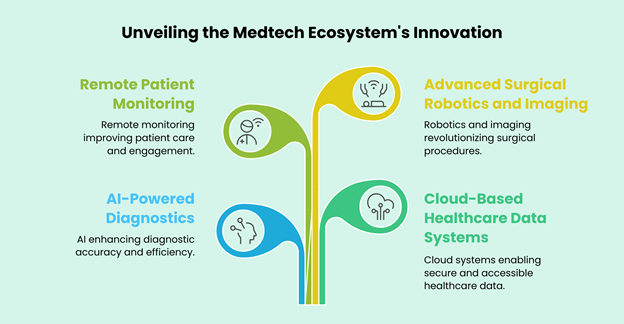
The medtech ecosystem is becoming increasingly collaborative, with traditional device manufacturers partnering with AI firms, cloud providers, and digital health startups.
According to BIS Research, companies are investing in:
• AI-powered diagnostic platforms
• Cloud-based healthcare data systems
• Remote patient monitoring solutions
• Advanced surgical robotics and imaging technologies
This convergence is accelerating innovation and enabling scalable, data-driven healthcare solutions across the value chain.
Despite its potential, the transition to data-driven medtech presents challenges. Data privacy, interoperability between systems, and regulatory compliance remain key concerns.
Healthcare organizations must ensure secure data management while enabling seamless integration across platforms. Addressing these challenges will be critical to unlocking the full potential of medtech data.
The future of medtech lies in fully integrated, intelligent healthcare ecosystems. Emerging trends such as predictive analytics, digital twins, and real-time health monitoring will further enhance clinical decision-making.
According to BIS Research, organizations that effectively leverage data will gain a competitive edge by delivering personalized, efficient, and outcome-driven care.
The transition from devices to data represents a paradigm shift in healthcare. Medtech is no longer defined solely by physical innovations but by its ability to generate, analyze, and act on data.
As healthcare continues to evolve, data-driven medtech will play a central role in improving patient outcomes, optimizing operations, and shaping the future of global healthcare.