What is a Large Satellite Propulsion System and Why Does It Matter?
Large satellite propulsion systems in Europe encompass chemical, electric, cold-gas, and hybrid thrusters that are critical for orbit insertion, station-keeping, attitude control, and deorbiting of heavyweight satellites. These systems are essential for navigation constellations, Earth observation platforms, and high-throughput communication satellites, all of which require precise and sustained maneuverability.
Technological advancements, such as modular hybrid propulsion stages, green chemical systems, and high-thrust electric Hall-effect thrusters, are reshaping the industry. These solutions provide scalable, cost-effective, and sustainable options for European satellite operators. Collaboration between established manufacturers, global aerospace leaders, and organizations like the European Space Agency (ESA) is further accelerating innovation. As operators prioritize propellant efficiency, debris mitigation, and mission flexibility, investments in reusable and next-generation electric propulsion systems continue to grow.
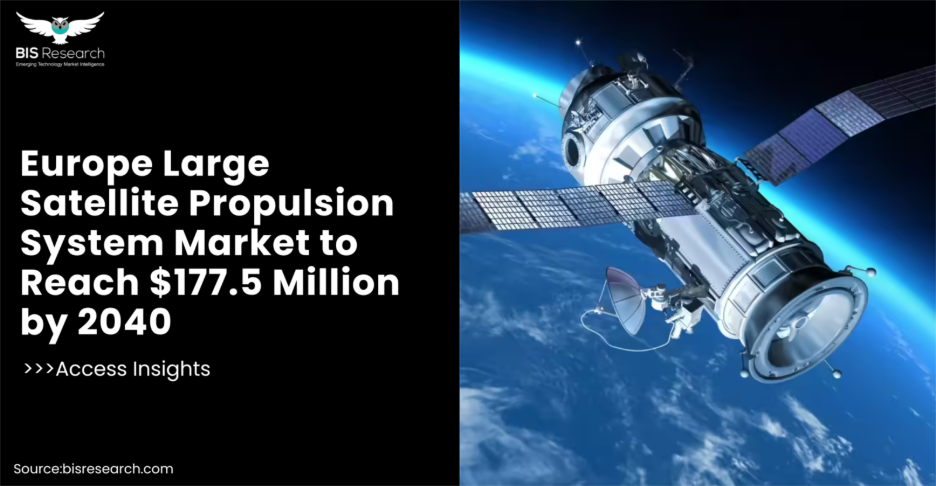
According to BIS Research, the Europe large satellite propulsion system market is projected to reach $177.5 million by 2040, reflecting the rapid transformation driven by technological advancement, private-sector participation, and the increasing performance demands of satellite missions. ?
[Explore the full TOC and Download report Sample]
What’s Driving Growth in the Europe Large Satellite Propulsion System Market?
Key Drivers:
- Strong government investment through ESA and national space programs in propulsion technology innovation.
- Surging demand for high-throughput communication satellites and advanced Earth observation missions.
- Strategic focus on European space autonomy to reduce reliance on non-European systems.
- Growing commercial space activity, driven by NewSpace startups and private aerospace firms.
- Emphasis on propellant efficiency, sustainability, and long mission lifetimes aligned with EU regulations.
What Are the Challenges in the Europe Large Satellite Propulsion System Market?
Key Challenges:
- High costs and technical complexity in developing next-generation propulsion systems.
- Strict compliance requirements with EU safety and debris mitigation regulations.
- Competition from established international propulsion suppliers.
- Supply chain vulnerabilities due to limited raw material and component availability.
What is the Recent Development in Europe Large Satellite Propulsion System Market?
- Adoption of high-thrust electric propulsion systems, including Hall-effect thrusters, for both geostationary and deep-space missions.
- Greater integration of green chemical propellants to satisfy EU sustainability mandates.
- Expansion of European mega-constellation initiatives aimed at broadband connectivity.
- Implementation of modular and hybrid propulsion architectures to boost mission adaptability.
- Increased R&D and manufacturing collaboration among ESA, national agencies, and private aerospace organizations.
Market Segmentation: Where Are Growth Opportunities?
By Subsystem
Chemical Thruster
- Propellant Tank
- Pump
- Fuel and Oxidizer Valve
Electric Thruster
Cold Gas Thruster
- Gas Storage Tank
- Propulsion Chamber/Nozzle
- Pump
Hybrid Thruster
- Propellant Tank
- Propulsion Chamber/Nozzle
- Pump
By Region
Analyst Perspective: What’s Next for Europe’s Large Satellite Propulsion Systems?
According to BIS Research Principal Analyst:
“The large satellite propulsion system market in Europe is evolving rapidly due to sustained government and commercial investments, stringent regulatory frameworks, and increasing performance requirements. Electric and hybrid propulsion solutions—driven by sustainability, efficiency, and mission flexibility—will continue to anchor growth. Strategic partnerships, innovative technology, and adherence to EU space policies position Europe as a key player in next-generation satellite propulsion.”
FAQs About the Europe Large Satellite Propulsion System Market
What is the expected growth outlook?
The market is expected to see steady expansion through 2040, supported by technological advancements and policy-driven demand for efficient, eco-friendly propulsion.
Who are the key leaders in this market?
The landscape includes established European manufacturers, global aerospace giants, ESA, and national agencies, collaborating across innovation, production, and mission delivery.
Which propulsion technologies are most in demand?
Electric propulsion especially Hall-effect thrusters—dominates, with green chemical and hybrid systems gaining traction due to EU sustainability directives.
Want to Make Data-Backed Moves in the European Satellite Propulsion Market?
BIS Research offers KOL-based insights, rigorous segmentation, and strategic advisory across software, hardware, and sensing tech domains
[Download Sample Report]
[Contact Analyst]
[Download TOC]