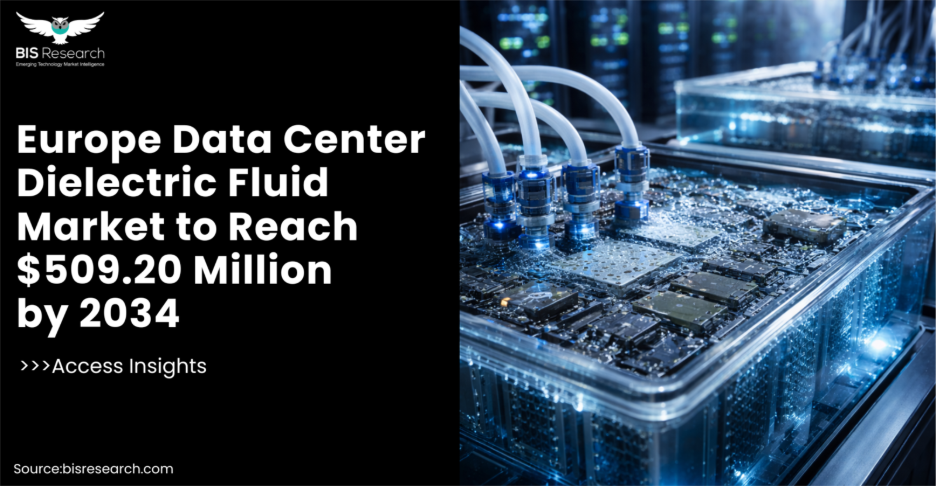
Data center dielectric fluids are non-conductive cooling liquids designed to manage heat in high-density computing environments. These fluids are used in direct immersion cooling systems or circulated through cold plates to efficiently dissipate heat from servers, storage systems, and networking hardware. Unlike traditional air-cooling systems, dielectric fluids significantly improve heat transfer performance while reducing overall energy consumption and power usage effectiveness (PUE).
As Europe accelerates digital transformation, the demand for AI processing, high-performance computing (HPC), cloud services, and 5G infrastructure is intensifying. These workloads generate substantial thermal loads, making advanced cooling solutions essential. Dielectric fluids enable operators to reduce reliance on high-GWP refrigerants, align with strict EU environmental regulations, and achieve climate-conscious operational goals.
According to BIS Research, the Europe data center dielectric fluid market (excluding the U.K.) was valued at $37.99 million in 2024 and is projected to grow at a CAGR of 29.63%, reaching $509.20 million by 2034. This remarkable growth reflects the region’s strong focus on sustainable digital infrastructure and advanced thermal management technologies.
Download the full TOC and Request a Sample report
• Increasing demand for AI, HPC, and 5G workloads requiring high-heat-flux cooling solutions
• Stringent EU regulations such as the Fit for 55 package, Energy Efficiency Directive, and F-Gas rules pushing lower PUE targets
• Rising pressure on operators to reduce carbon emissions and improve sustainability performance
• Government incentives, carbon-credit mechanisms, and green data center certifications encouraging adoption
• Growing adoption of circular economy principles promoting recyclable and regenerative dielectric fluids
• Strategic collaborations between fluid manufacturers, OEMs, and hyperscale operators accelerating deployment
• Significant capital investment required to retrofit traditional air-cooled data centers
• Complex compatibility testing to prevent fluid degradation of electronics, seals, and coatings
• Lack of harmonized pan-European standards for fluid selection, handling, and safety
• Need for specialized workforce training and fluid management protocols
• Limited recycling and reclamation infrastructure for used dielectric fluids
• Growing deployment of single-phase and two-phase immersion cooling fluids for high-density server racks
• Development of biodegradable, low-toxicity, and low-GWP dielectric formulations aligned with REACH and RoHS compliance
• Integration of predictive maintenance analytics, leak detection systems, and real-time dielectric-strength monitoring
• Expansion of modular rack-level immersion chassis for hyperscale and edge computing environments
• Cross-border industry collaborations to standardize fluid technologies and accelerate certification
• Hyperscale
• Colocation
• Enterprise
• Others
• Fluorocarbons
• Mineral Oil
• Synthetic Oil
• Natural Oil
• Water-Glycol Mix
According to a BIS Research Analyst: “The Europe data center dielectric fluid market is positioned for transformative growth as sustainability and performance converge in next-generation data center design. With AI-driven compute density rising rapidly, operators must adopt highly efficient and environmentally responsible cooling technologies. Regulatory alignment, circular-economy initiatives, and technological innovation in low-GWP dielectric formulations will play a central role in shaping Europe’s low-carbon digital future.”
The market is projected to expand at a CAGR of 29.63% from 2024 to 2034, increasing from $37.99 million in 2024 to $509.20 million by 2034.
AI and HPC workloads, EU energy-efficiency mandates, carbon-reduction targets, and government incentives are driving strong demand for dielectric cooling technologies.
Single-phase and two-phase dielectric fluids, along with biodegradable and low-GWP formulations, are witnessing increasing adoption due to regulatory alignment and sustainability goals.
Prominent companies include FUCHS, Submer, Solvay, and Shell.
BIS Research provides expert-driven insights, detailed segmentation, and strategic advisory across digital infrastructure, advanced materials, and sustainable technology markets.