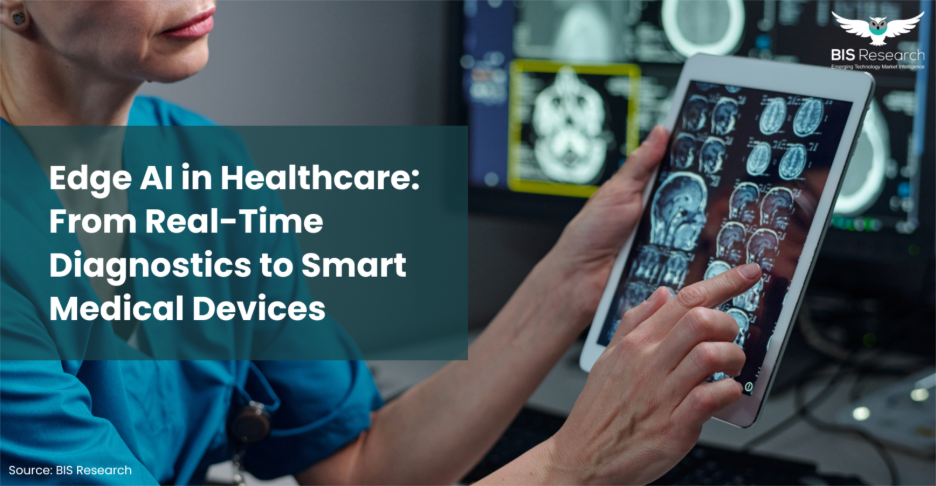
Edge AI is fundamentally reshaping healthcare delivery by embedding intelligence directly into devices rather than relying on centralized cloud systems. This shift enables faster decision-making, reduced latency, and improved patient outcomes. In practical terms, it allows medical devices to process and analyze data instantly, whether in a hospital, clinic, or home setting.
The broader implication is significant. Healthcare is moving from a reactive, hospital-centric model to a proactive, patient-centric ecosystem. Real-time diagnostics, continuous monitoring, and intelligent therapeutic interventions are now possible at the edge, supporting outpatient care and improving accessibility across geographies.
Edge AI addresses critical limitations of traditional healthcare infrastructure. By processing data locally, it minimizes delays, reduces bandwidth dependency, and enhances data privacy. This is particularly relevant for applications such as remote patient monitoring, emergency diagnostics, and chronic disease management.
As a result, healthcare providers can act on insights instantly rather than waiting for cloud-based analysis. This capability is enabling a new generation of smart medical devices and decentralized care models.
Digital therapeutics are emerging as a key application area for Edge AI. These software-driven solutions deliver clinically validated interventions using real-time patient data. Unlike conventional treatments, digital therapeutics can continuously adapt based on patient behavior and physiological inputs.
Edge AI enhances this adaptability by enabling on-device processing. This ensures uninterrupted care delivery even in low-connectivity environments. It also improves patient engagement by delivering immediate feedback and personalized interventions.
The market is gaining traction as healthcare systems seek scalable and cost-efficient solutions. Pharmaceutical companies and insurers are increasingly integrating digital therapeutics into treatment pathways, particularly for chronic conditions such as diabetes, cardiovascular diseases, and mental health disorders.
Explore detailed forecasts, competitive landscape, and technology trends shaping this space.
Request Sample Report on Digital Therapeutics Market
?
Wearable patches represent one of the most visible implementations of Edge AI in healthcare. These devices enable continuous, real-time monitoring of vital parameters such as heart rate, glucose levels, and respiratory activity.
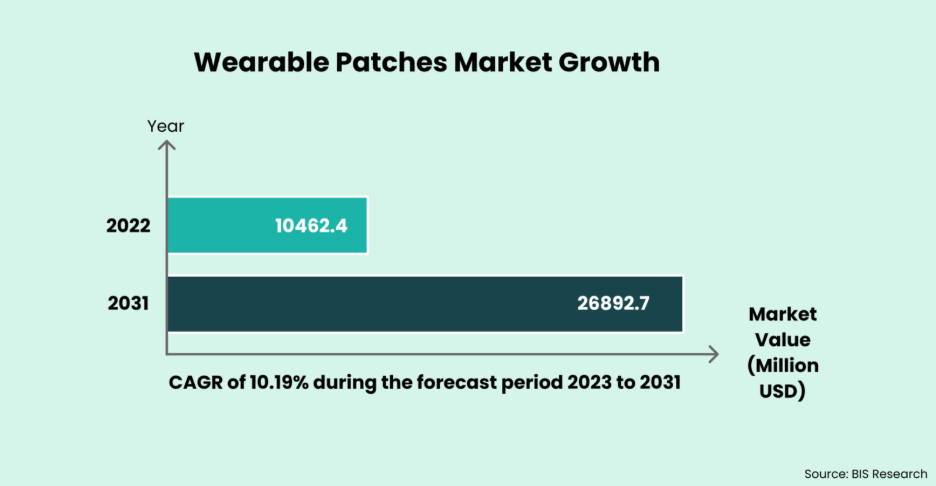
The wearable patches market, according to BIS Research, was valued at $10,462.4 million in 2022 and is projected to reach $26,892.7 million by 2031, growing at a CAGR of 10.19% during the forecast period 2023 to 2031
The growth is driven by rising demand for remote patient monitoring and the increasing prevalence of chronic diseases. Edge AI plays a critical role by processing data directly on the device, enabling instant alerts and predictive insights.
Modern wearable patches are evolving beyond passive monitoring. They now incorporate AI algorithms capable of detecting anomalies and triggering early interventions. This reduces hospital admissions and supports the shift toward outpatient care models.
Access in-depth analysis, growth drivers, and emerging innovations in wearable healthcare technologies.
Request Sample Report on Wearable Patches Market
Ultrasound imaging is undergoing a transformation with the integration of AI and edge computing. Traditionally dependent on skilled radiologists and centralized systems, ultrasound diagnostics can now be performed with real-time AI assistance.
Edge AI enables on-device image analysis, allowing clinicians to receive immediate diagnostic insights. This is particularly valuable in time-sensitive applications such as cardiac assessments, prenatal care, and emergency medicine.
The adoption of AI-powered ultrasound systems is also expanding access to diagnostic services in remote and underserved regions. By reducing reliance on specialized expertise and infrastructure, these solutions are democratizing healthcare delivery.
From a market perspective, the AI in ultrasound imaging segment is witnessing strong growth, driven by increasing demand for faster, more accurate, and accessible diagnostic solutions.
Gain insights into market forecasts, key players, and the future of AI-driven imaging technologies.
Request Sample Report on AI in Ultrasound Imaging Market
As Edge AI adoption increases, the need for robust edge data infrastructure becomes critical. Edge data centers support distributed computing, enabling seamless data processing, storage, and integration across healthcare networks.
This infrastructure ensures scalability and reliability while maintaining data security and compliance. It also supports interoperability between devices, platforms, and healthcare systems, which is essential for delivering cohesive patient care.
Edge AI is not a marginal improvement in healthcare technology. It represents a structural shift toward real-time, decentralized, and patient-centric care. By enabling instant diagnostics, continuous monitoring, and adaptive therapeutics, it is redefining how healthcare is delivered and experienced.
The convergence of digital therapeutics, wearable patches, and AI-powered imaging highlights a clear trajectory. Healthcare is moving closer to the patient, becoming more responsive, accessible, and efficient. As this transition accelerates, Edge AI will remain central to the next generation of smart medical devices and connected care ecosystems.