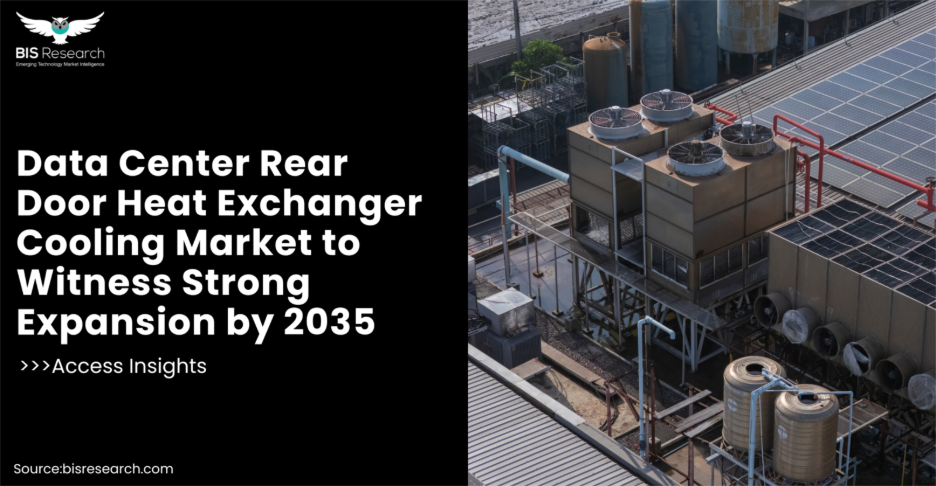
A Data Center Rear Door Heat Exchanger (RDHx) is a liquid-based cooling solution installed at the back of server racks to capture and remove heat directly at the source. Unlike traditional air-cooling systems that rely heavily on CRAC units and large air-handling infrastructure, RDHx systems use chilled liquid circulated through heat exchanger coils mounted on the rack door. This setup absorbs server exhaust heat before it enters the data hall environment.
RDHx solutions are increasingly vital as rack power densities surge due to artificial intelligence (AI), high-performance computing (HPC), blockchain, and advanced analytics workloads. Traditional air cooling often struggles to handle these escalating heat loads efficiently. By contrast, RDHx systems significantly reduce strain on facility-level cooling systems while lowering power usage effectiveness (PUE) and operational energy consumption.
In 2024, demand is largely fueled by hyperscale and colocation operators seeking sustainable ways to manage rising thermal loads. Looking toward 2035, the proliferation of HPC clusters, supercomputers, edge computing nodes, and next-generation 5G/6G infrastructure is expected to accelerate RDHx adoption. As environmental regulations tighten and carbon neutrality becomes a strategic priority, RDHx cooling is poised to become a mainstream solution for modern data centers.
Download the complete TOC and Request Sample Report
Key Drivers:?
Rapid expansion of hyperscale and colocation data centers
• Increasing rack power densities due to AI, HPC, and data-intensive workloads
• Growing focus on reducing PUE and achieving carbon-neutral operations
• Rising electricity costs pushing operators toward energy-efficient liquid cooling
• Advancements in fluid distribution systems and real-time thermal monitoring
• Integration of AI-driven analytics for optimized coolant flow and temperature management
The rise of hyperscale computing and HPC environments is particularly influential. As operators process petabyte-scale datasets and run complex AI models, heat generation intensifies. RDHx systems address this challenge by removing heat at the rack level, ensuring thermal stability without excessive reliance on traditional air-conditioning infrastructure.
North America leads adoption, driven by strong R&D investments and hyperscale expansion in the U.S. Europe follows closely due to sustainability mandates and high energy costs. Asia-Pacific is witnessing rapid growth with extensive data center construction in China, Japan, and India. Meanwhile, Rest-of-the-World regions such as the Middle East, South America, and parts of Africa are emerging as high-potential markets as new facilities adopt advanced cooling solutions from the outset.
According to Principal Analyst at BIS Research:
“The Data Center Rear Door Heat Exchanger cooling market is transitioning from a niche high-density solution to a mainstream thermal management strategy. As AI workloads and hyperscale deployments intensify, liquid-based rack-level cooling will become essential rather than optional. RDHx systems, supported by smart thermal analytics and sustainable design improvements, are set to redefine data center efficiency standards through 2035 and beyond.”
The market is expected to experience strong growth through 2035, driven by AI, HPC, and hyperscale expansion. Increasing sustainability regulations and energy efficiency goals will further accelerate adoption.
Key players include nVent, Legrand (USystems Limited), Motivair, Delta Power Solutions, Boyd Corporation, Vertiv, Rittal, CoolIT, Lenovo, IBM, Stulz, Attom Technology, Nortek Air Solutions, Airedale (Modine), and BEEHE.
Active RDHx systems are gaining traction for high-density environments due to enhanced heat removal capabilities, while passive RDHx solutions remain attractive for facilities seeking cost-effective rack-level liquid cooling.
BIS Research provides expert-driven insights, detailed segmentation, and strategic advisory across data center infrastructure, power management, and advanced cooling technologies.
Book a Preview
Download the complete TOC