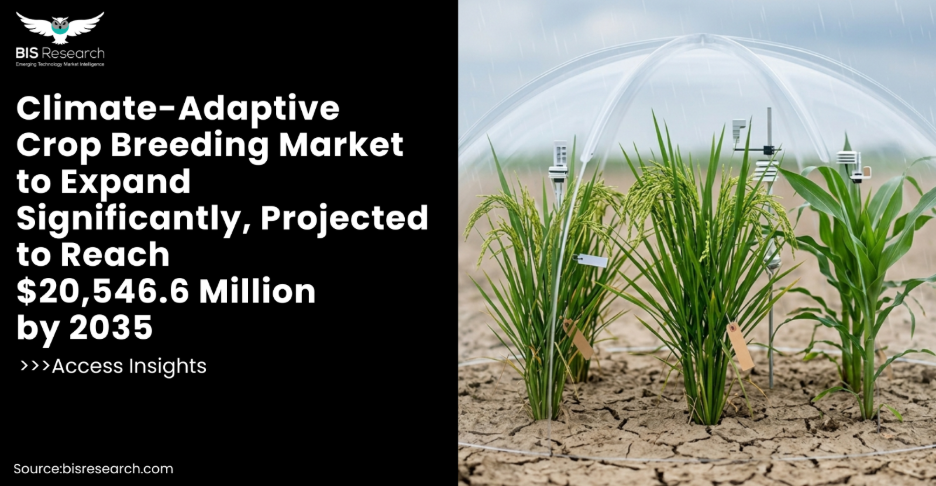
Climate-adaptive crop breeding refers to the development of crop varieties that can withstand environmental stresses such as drought, heat, flooding, and salinity. It integrates advanced technologies including genomics, phenotyping, gene editing, and AI-driven predictive modeling to accelerate the identification and selection of desirable traits.
This approach has become increasingly important as climate change disrupts traditional agricultural cycles, threatening global food security. Conventional breeding methods alone are no longer sufficient to meet rising food demand under volatile climatic conditions. By enabling crops to maintain yield stability, nutritional quality, and resilience, climate-adaptive breeding supports sustainable agriculture and long-term food supply security.
According to BIS Research, the climate-adaptive crop breeding market was valued at $6,751.4 million in 2024 and is projected to reach $20,546.6 million by 2035, growing at a CAGR of 10.46% during the forecast period, highlighting its critical role in future agricultural systems.
Download the complete TOC and Request Sample Report
• Increasing frequency of climate-related disruptions such as droughts, heatwaves, and erratic rainfall
• Rising global demand for food security and stable agricultural output
• Rapid advancements in genomics, gene editing, and AI-driven predictive breeding
• Growing adoption of digital agriculture tools, including remote sensing and high-throughput phenotyping
• Strong government support and funding for sustainable and climate-resilient agriculture initiatives
• High capital requirements and R&D costs for advanced breeding technologies
• Regulatory uncertainty and approval delays for gene-edited and biotech crops
• Lack of infrastructure and technical expertise in emerging economies
• Time-intensive breeding cycles despite technological improvements
• Challenges in integrating large-scale data from digital and genomic platforms
• Farmers and Growers
• Agri-Businesses and Cooperatives
• Research and Academia
• Others
According to Principal Analyst at BIS Research: “The climate-adaptive crop breeding market is set to become a cornerstone of global agriculture as climate variability intensifies. Demand for resilient crop varieties will continue to rise, particularly in staple crops such as cereals. While conventional breeding remains dominant due to regulatory ease and scalability, advanced technologies such as genomics and gene editing are accelerating precision and efficiency. With strong public-private partnerships and increasing investments, this market is expected to play a pivotal role in ensuring sustainable agricultural productivity and global food security.”
The market is projected to grow at a CAGR of 10.46% and reach over $20 billion by 2035, driven by increasing climate risks and technological advancements in crop breeding.
Key players include BASF SE, Bayer AG, Corteva Inc., Syngenta Group, KWS SAAT SE & Co. KGaA, DLF, Inari Agriculture Inc., Limagrain, and Sakata Seed Corporation.
Cereals dominate the market due to their importance in global food security, followed by legumes and horticultural crops.
BIS Research provides expert-driven insights, granular segmentation, and strategic advisory across agriculture, biotechnology, and deep technology domains.