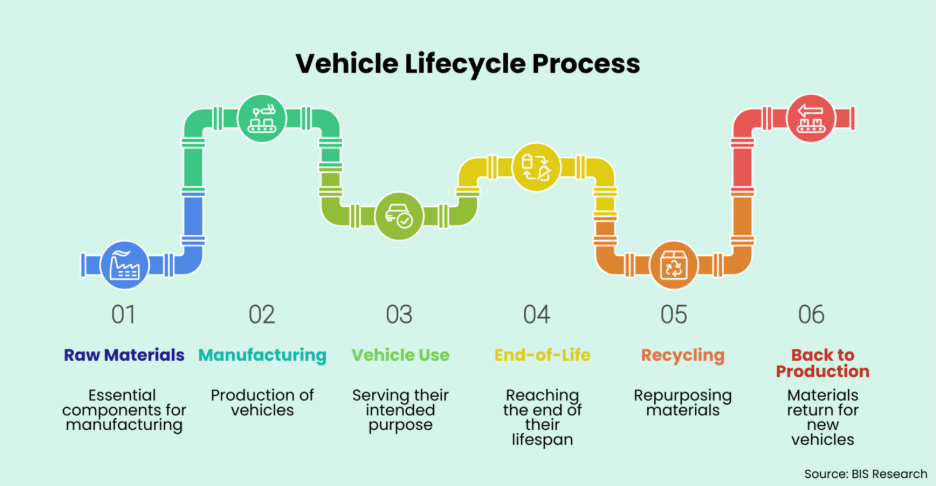
The automotive industry is not just evolving, it is being rebuilt from the ground up. For decades, car manufacturing followed a straightforward logic: extract raw materials, build vehicles, and discard them at end of life. That model is now under pressure. Rising material costs, geopolitical dependencies, and tightening climate regulations are forcing a rethink. In its place, a more resilient system is emerging: automotive circular manufacturing.
At its core, circularity is about keeping materials in use for as long as possible, extracting maximum value from them, and recovering them at the end of their lifecycle. This is not simply an environmental shift. It is a strategic response to supply chain risks and long-term cost pressures.
Request a sample report on Automotive Circular Economy Market
Why Circular Manufacturing Is Gaining Urgency
Automakers today face a complex mix of challenges. Critical minerals like lithium, cobalt, and nickel are concentrated in a few regions, making supply chains vulnerable. At the same time, regulatory frameworks in Europe, the U.S., and parts of Asia are pushing for stricter emissions targets and recycling mandates.
Circular manufacturing addresses both issues simultaneously. By reducing dependence on virgin raw materials and improving resource efficiency, companies can insulate themselves from volatility while aligning with sustainability goals. This is why circularity is increasingly being treated as a core business strategy rather than a compliance requirement.
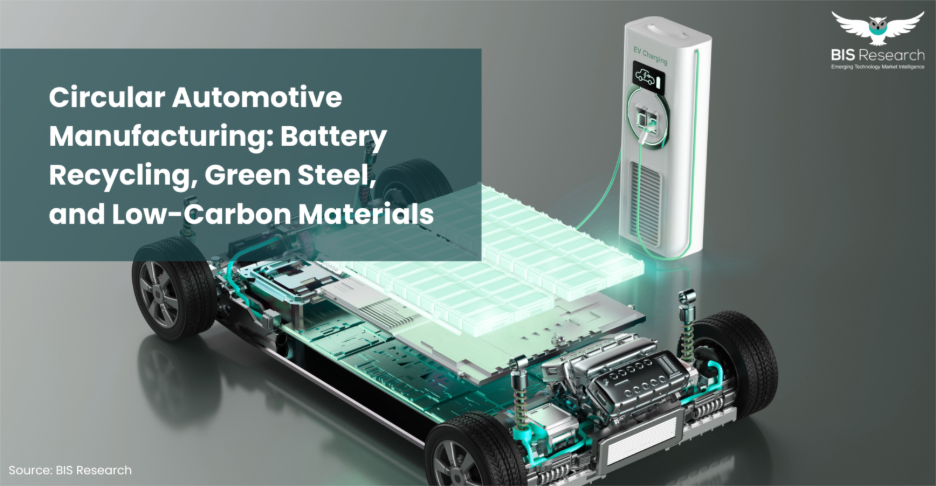
The rapid growth of electric vehicles has brought battery lifecycle management into sharp focus. Lithium-ion batteries are not only expensive but also resource-intensive to produce. Discarding them at end of life is no longer viable.
Battery recycling offers a practical solution. It enables recovery of high-value materials such as lithium, cobalt, and nickel, which can be reintroduced into new batteries. This reduces reliance on mining and creates a more stable and localized supply chain.
Technological progress is accelerating this shift. Hydrometallurgical processes are improving recovery efficiency while reducing environmental impact compared to traditional methods. At the same time, direct recycling techniques aim to preserve battery materials in their usable form, lowering processing costs further.
Major automakers and battery firms are already investing in closed-loop ecosystems. The goal is straightforward: collect used batteries, recover materials, and feed them back into production. Companies like Tesla and Volkswagen are actively building such systems, while specialized players like Redwood Materials and Li-Cycle are scaling recycling infrastructure.
Steel remains one of the most widely used materials in vehicle manufacturing, but it is also one of the most carbon-intensive. Traditional steelmaking relies heavily on coal-based processes, contributing significantly to industrial emissions.
Green steel offers an alternative. Produced using hydrogen-based reduction or renewable-powered electric arc furnaces, it can reduce emissions by up to 90 percent in certain cases. While still in early stages of scale, the momentum is clear.
Automakers are beginning to secure future supplies through partnerships with green steel producers. Companies like BMW and Volkswagen have already entered agreements with firms such as ArcelorMittal and SSAB to integrate low-carbon steel into their vehicles.
This shift is important because material emissions account for a substantial portion of a vehicle’s total lifecycle footprint. Decarbonizing steel has a direct and measurable impact, regardless of whether the vehicle is electric or combustion-based.
Beyond batteries and steel, the industry is exploring a broader portfolio of sustainable materials. Recycled aluminum is gaining traction due to its lower energy requirements compared to primary production. Similarly, recycled plastics are being integrated into interiors and non-structural components.
Bio-based composites are another area of interest. Derived from renewable sources, these materials offer a lower carbon footprint while maintaining performance characteristics. At the same time, lightweight materials are becoming critical, particularly for electric vehicles where reducing weight directly improves driving range.
These innovations are not isolated. They are part of a broader effort to redesign vehicles with circularity in mind, from material selection to end-of-life recovery.
The transition toward a circular automotive economy is being reinforced by multiple forces. Governments are introducing extended producer responsibility frameworks, requiring manufacturers to take accountability for end-of-life vehicles. Consumers are also becoming more conscious of sustainability, influencing purchasing decisions.
From an economic standpoint, material recovery presents clear advantages. Reusing metals and components can significantly reduce production costs over time, especially as raw material prices remain volatile.
However, scaling circularity requires collaboration. Automakers, material suppliers, and recycling firms must work together to build integrated ecosystems. Companies like Umicore in battery recycling and ArcelorMittal in green steel are already key partners in this transition.
Circular manufacturing is no longer a peripheral initiative. It is becoming central to how the automotive industry competes and grows. Companies that move early stand to gain more stable supply chains, lower long-term costs, and stronger alignment with global regulations.
More importantly, circularity provides a pathway to balance two critical objectives: electrification and decarbonization. As the industry accelerates toward a low-carbon future, the ability to reuse, recycle, and rethink materials will define the next generation of automotive leaders.