Breast reconstruction has long been an important step in recovery for many women undergoing mastectomy after breast cancer treatment. For decades, implant-based reconstruction dominated the landscape due to its relatively simple procedure and shorter surgery time. However, a significant shift is now underway. Increasingly, surgeons and patients are turning to autologous breast reconstruction, a technique that uses the patient’s own tissue instead of synthetic implants.
This transition reflects broader changes in surgical preferences, patient awareness, and advancements in reconstructive techniques. Today, autologous reconstruction is gaining global traction as a long-term, natural, and durable solution for breast restoration.
Request a Quote to know more about Autologous Breast Reconstruction Procedure Volume
Autologous breast reconstruction involves transferring tissue typically skin, fat, and sometimes muscle from another part of the patient’s body to recreate the breast mound. Common donor sites include the abdomen, thighs, buttocks, or back.
Some of the most widely performed procedures include:
• DIEP Flap (Deep Inferior Epigastric Perforator) – Uses abdominal fat and skin while preserving muscle.
• TRAM Flap (Transverse Rectus Abdominis Myocutaneous) – Utilizes abdominal tissue and muscle.
• Latissimus Dorsi Flap – Transfers tissue from the upper back.
• SGAP/IGAP Flap – Uses tissue from the buttocks.
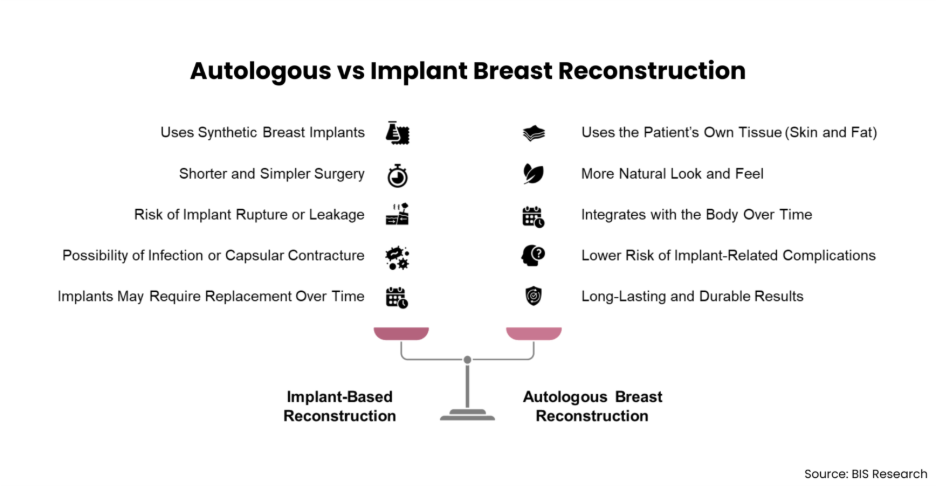
Unlike implants, which may need replacement over time, autologous reconstruction uses living tissue that can integrate with the body, age naturally, and provide long-term results.
Several clinical and patient-driven factors are fueling the growing preference for autologous reconstruction.
One of the most compelling advantages of autologous reconstruction is the natural look and feel. Since the breast is reconstructed using the patient’s own tissue, it behaves more like natural breast tissue compared to implants.
Over time, reconstructed breasts can change with weight fluctuations and aging, creating a more organic aesthetic outcome.
Implant-based reconstruction carries risks such as:
• Capsular contracture
• Implant rupture or leakage
• Infection
• Need for revision surgeries
Autologous reconstruction reduces many of these implant-specific complications, which makes it appealing for patients seeking long-term reliability.
The growth of microsurgical techniques has significantly improved the success rates of tissue-based reconstruction.
Modern procedures like the DIEP flap allow surgeons to transfer tissue while preserving muscle function, reducing donor-site complications and shortening recovery times compared to earlier techniques.
These technological improvements are making autologous reconstruction more accessible across advanced surgical centers worldwide.
Patient education is also playing a key role. Breast cancer patients today have access to more information about reconstruction options, outcomes, and risks.
Healthcare providers, advocacy groups, and digital health resources have helped patients understand that reconstruction options extend beyond implants, empowering them to make more informed decisions about their care.
While clinical interest in autologous breast reconstruction is growing, understanding how quickly these procedures are expanding globally requires accurate and reliable surgical procedure volume data.
Healthcare companies, medical device manufacturers, and hospital systems rely heavily on procedure-level insights to:
• Track adoption trends for reconstructive techniques
• Understand regional variations in surgical practices
• Forecast demand for surgical technologies and devices
• Plan market entry or expansion strategies
Procedure volume data helps transform anecdotal trends into actionable market intelligence.
Adoption of autologous breast reconstruction varies significantly across regions.
• North America and Western Europe lead in procedure volumes due to advanced surgical infrastructure and widespread access to microsurgical expertise.
• Asia-Pacific is witnessing increasing adoption, supported by rising healthcare investments and improved cancer screening programs.
• Emerging markets are gradually expanding reconstructive capabilities as healthcare systems strengthen oncology care pathways.
These regional dynamics highlight why granular procedure data is essential for understanding true market potential.
The shift toward autologous breast reconstruction reflects a broader transformation in patient-centered care. Women increasingly prioritize long-term outcomes, natural aesthetics, and reduced dependency on medical implants.
With continued advancements in surgical techniques, improved training in microsurgery, and expanding awareness among patients, the global volume of autologous reconstruction procedures is expected to steadily grow in the coming years.
For healthcare innovators, device manufacturers, and investors, tracking these procedural trends will be critical for identifying the next wave of opportunities in reconstructive surgery.
For organizations looking to understand global surgical procedure trends, including reconstructive surgeries, BIS Research offers comprehensive procedural insights through its data-driven intelligence platforms.
If you are evaluating market opportunities, product demand, or regional surgical trends, you can request a quote to access the Surgical Procedure Volume Database (SPVD) and gain detailed procedure-level insights across global healthcare markets.
The Surgical Procedure Volume Database (SPVD) by BIS Research provides structured intelligence on surgical procedure volumes across multiple specialties and geographies, helping companies track adoption trends and evaluate real-world demand.
By leveraging detailed procedural datasets, organizations can make more confident decisions across product development, commercialization, and strategic planning.