Manufacturing is no longer defined by assembly lines alone. It is being reshaped by intelligent systems that can sense, learn, and adapt in real time. The transition to Industry 4.0 reflects a deeper shift: from mechanized production to data-driven, autonomous operations. For manufacturers facing pressure to improve efficiency, precision, and scalability, the integration of robotics, artificial intelligence, and connected systems is becoming less of an option and more of a requirement.
Global supply chains have grown more complex, customer expectations more dynamic, and margins tighter. In response, manufacturers are investing in technologies that reduce variability and improve decision-making. Industry 4.0 is not just about automation. It is about embedding intelligence into every layer of production, from machines on the factory floor to enterprise-level planning systems.
This shift is driven by the need for consistent quality, faster time-to-market, and the ability to respond to disruptions. Smart manufacturing systems enable continuous monitoring, predictive insights, and adaptive control, allowing operations to move beyond reactive models.
Several deep-tech innovations are central to this transformation.
Industrial robotics and collaborative robots (cobots) are becoming more flexible and easier to deploy. Unlike traditional robots that operate in isolation, cobots work alongside humans, enhancing productivity without requiring extensive infrastructure changes.
AI-driven automation and predictive analytics are enabling machines to learn from historical and real-time data. This allows manufacturers to anticipate equipment failures, optimize production schedules, and reduce downtime. The shift from rule-based automation to learning systems marks a significant leap in operational intelligence.
Digital twins and simulation technologies provide virtual replicas of physical systems. These models allow manufacturers to test scenarios, optimize processes, and identify inefficiencies before implementing changes in the real world. This reduces risk and accelerates innovation cycles.
IoT-enabled smart factories connect machines, sensors, and systems into a unified network. This connectivity ensures continuous data flow, enabling real-time visibility into operations. It also forms the foundation for advanced analytics and autonomous decision-making.
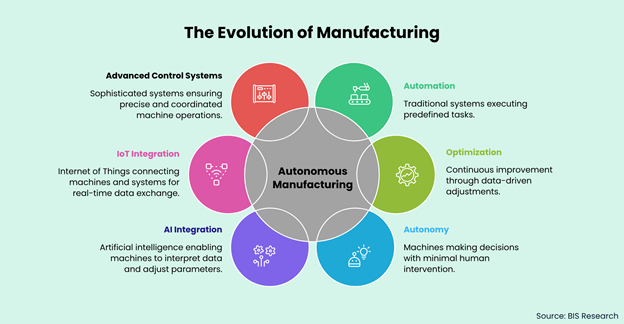
Traditional automation focuses on executing predefined tasks. Autonomous manufacturing, by contrast, is characterized by systems that can make decisions with minimal human intervention. This evolution follows a clear trajectory: automation leads to optimization, which eventually enables autonomy.
In autonomous environments, machines do not just follow instructions. They interpret data, adjust parameters, and coordinate with other systems. For example, a production line can dynamically adjust output based on demand fluctuations or supply constraints. This level of responsiveness is made possible by integrating AI, IoT, and advanced control systems into a cohesive architecture.
The result is a self-optimizing ecosystem where efficiency is continuously improved without constant human oversight.
The impact of smart manufacturing extends beyond operational efficiency. Companies adopting these technologies are reporting measurable gains in productivity, reduced waste, and lower operational costs. More importantly, they are building resilience against market volatility.
However, this transformation also brings workforce challenges. As routine tasks become automated, the demand for advanced technical skills is increasing. Roles are shifting toward system management, data analysis, and strategic oversight. Organizations must invest in upskilling to fully realize the benefits of these technologies.
Scalability is another critical advantage. Smart manufacturing solutions can be adapted across industries, including automotive, electronics, and pharmaceuticals. This flexibility allows companies to standardize processes while maintaining the agility to address sector-specific requirements.
In a rapidly evolving landscape, access to reliable and actionable intelligence is essential. BIS Research plays a critical role in helping organizations navigate this complexity.
Through detailed analysis of robotics adoption, AI integration, and smart factory trends, BIS Research provides a clear view of where the market is heading. Its technology benchmarking helps companies evaluate solutions and identify competitive advantages.
Beyond data, the firm enables strategic decision-making. Whether it is entering new markets, identifying investment opportunities, or understanding emerging technologies, BIS Research supports organizations with insights grounded in deep-tech expertise.
Request a customized report tailored to your industry and expansion plans.
The factory of the future is not a distant concept. It is already taking shape. Autonomous systems, powered by data and intelligence, are redefining how products are designed, manufactured, and delivered.
For businesses, the challenge is not whether to adopt these technologies, but how to do so effectively. Those that combine deep technological capabilities with strong market intelligence will be better positioned to lead in this new era.
Smart manufacturing is no longer just about efficiency. It is about adaptability, resilience, and sustained competitive advantage.