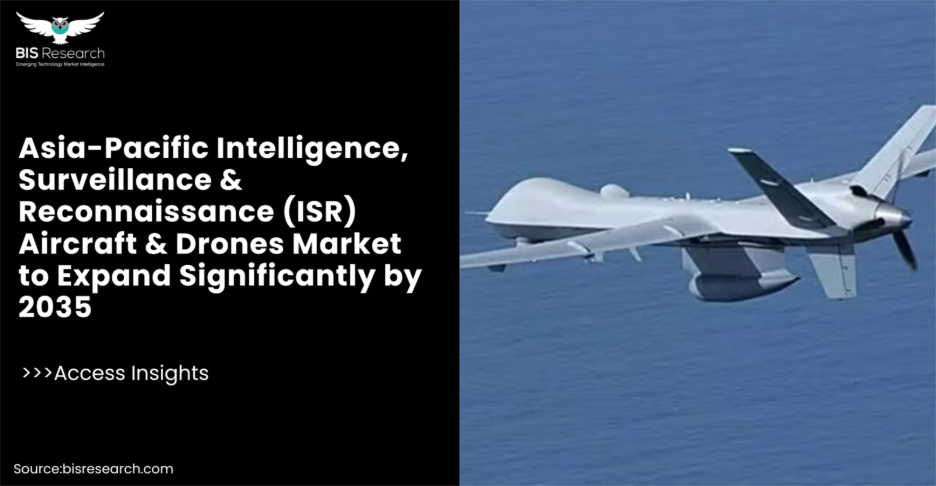
The Asia-Pacific intelligence, surveillance, and reconnaissance (ISR) aircraft and drones market encompasses manned ISR aircraft and unmanned aerial systems equipped with advanced sensors, communication systems, and data analytics tools to collect, process, and deliver real-time intelligence. These platforms support mission-critical activities such as border monitoring, maritime patrol, electronic warfare, airborne early warning, and tactical operations across land, sea, and air domains.
ISR capabilities have become indispensable for Asia-Pacific nations as regional security challenges intensify. Countries such as China, India, Japan, South Korea, and Australia are strengthening their ISR fleets to enhance situational awareness, monitor disputed territories, and respond rapidly to evolving threats. The integration of artificial intelligence (AI), machine learning, and data fusion technologies enables faster target identification, improved decision-making, and autonomous mission execution.
According to BIS Research, the Asia-Pacific ISR aircraft and drones market was valued at $9.65 billion in 2024 and is projected to reach $20.51 billion by 2035, growing at a CAGR of 6.91%, underlining the growing strategic importance of ISR platforms in regional defense and homeland security architectures.
Download the full TOC and book a preview
Key Drivers:
• Rising geopolitical tensions and territorial disputes across the Asia-Pacific region
• Increasing defense budgets and large-scale military modernization initiatives
• Growing demand for continuous, real-time situational awareness across complex environments
• Rapid adoption of unmanned ISR platforms due to cost efficiency and operational flexibility
• Technological advancements in sensors, radar, communications, and data analytics
• Strong government support for domestic defense manufacturing and indigenization programs
Key Challenges:
• Airspace management limitations and regulatory constraints on drone operations
• Cybersecurity risks and vulnerability to electronic warfare and signal jamming
• High acquisition, integration, and lifecycle costs of advanced ISR platforms
• Interoperability challenges among platforms and allied defense forces
• Continued reliance on foreign components and technologies in certain countries
• Ethical, legal, and privacy concerns related to surveillance and intelligence gathering
By Platform
• Military Aircraft
o Fighter Jets
o Special Mission Aircraft
o Missionized Business Jets
o Military Transport Aircraft
• Military Drones
o Medium-Altitude Long Endurance (MALE) Drones
o High-Altitude Long Endurance (HALE) Drones
o Small Drones
o Military Helicopter
By Component Type
• Surveillance System
o Light Detection and Ranging (LiDAR)
o Electro-Optical/Infrared Sensor (EO/IR Sensors)
o Radar
o Others
• Communication System
o SATCOM
o Antenna
o Datalinks
• Signal Intelligence (SIGINT) System
o Electronic Intelligence (ELINT)
o Communication Intelligence (COMINT)
• Software
o Mission Management
o Threat Detection
• Others
By Support Service
• Simulation
• Active Maintenance
• Data Analytics and Post-Processing
By Region
• Asia-Pacific: China, Japan, South Korea, India, Australia, and Rest-of-Asia-Pacific??
According to a Principal Analyst at BIS Research:
“The Asia-Pacific ISR aircraft and drones market is poised for sustained growth as nations prioritize intelligence superiority and real-time situational awareness. Unmanned platforms, particularly MALE and HALE drones, will play a pivotal role due to their endurance, cost advantages, and reduced operational risk. The integration of AI-driven analytics, multi-sensor payloads, and autonomous mission capabilities will further redefine ISR effectiveness across the region. With strong government backing and increasing focus on domestic production, ISR platforms will remain central to APAC’s evolving defense and security strategies.”
The market is expected to grow steadily through 2035, driven by rising defense spending, increasing deployment of unmanned ISR platforms, and the integration of AI-enabled surveillance technologies.
Unmanned aerial systems, particularly MALE and HALE drones, are witnessing strong demand due to their long endurance, operational flexibility, and suitability for persistent surveillance missions.
Key technologies include EO/IR sensors, SAR, SIGINT systems, AI-based data analytics, autonomous mission software, and secure satellite communication systems.
BIS Research delivers in-depth market intelligence, granular segmentation, and strategic advisory services across aerospace, defense, and advanced security technologies.
[Contact Analyst]
[Download the complete TOC]