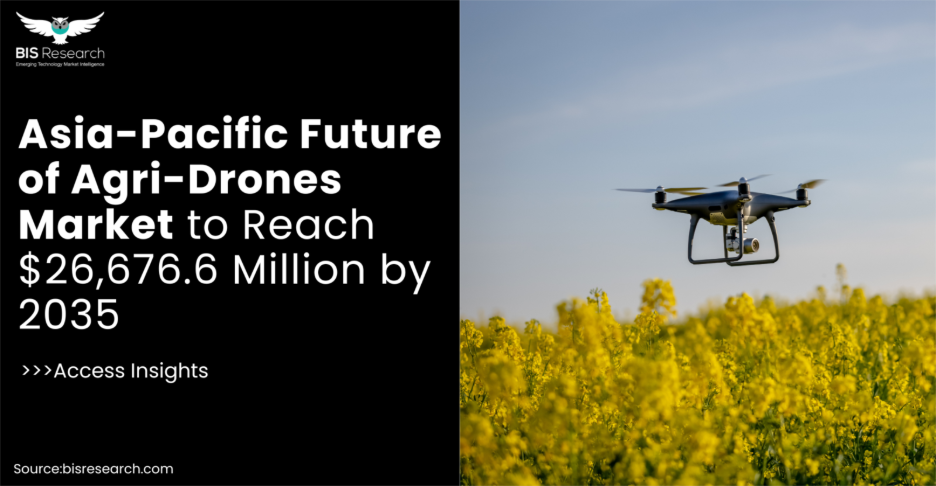
Agri-drones in the Asia-Pacific region refer to unmanned aerial systems designed for crop monitoring, precision spraying, soil analysis, livestock tracking, yield prediction, and overall digital farm management. These drones leverage technologies such as AI, IoT, GPS, multispectral imaging, and data analytics to enable smarter, faster, and more resource-efficient agricultural operations.
With rising food demand, labor shortages, and the push for climate-smart agriculture, agri-drones have become indispensable for improving productivity, reducing input waste, and enhancing sustainability. They offer farmers real-time visibility into crop conditions, automate repetitive field tasks, and support data-backed decision-making for optimal yield outcomes.
According to BIS Research, the Asia-Pacific future of agri-drones market is expected to increase from $1,054.9 million in 2024 to $26,676.6 million by 2035, growing at a CAGR of 34.19% during 2025–2035. This highlights the region’s shift toward modern, digitally enabled agriculture supported by advanced aerial solutions.
Explore the full TOC and Download Report Sample
Key Drivers:
Growing adoption of precision agriculture practices for optimized spraying, crop health monitoring, and soil assessment
Rising food demand and pressure on agricultural productivity across APAC
Advancements in AI, machine learning, IoT, and GPS enhancing drone efficiency and autonomy
Shortage of agricultural labor accelerating drone-based automation
Increasing government incentives, subsidies, and national digital agriculture missions
Strong push toward sustainability and climate-smart farming to reduce environmental impact
Key Challenges:
Varying drone regulations and compliance requirements across Asia-Pacific
High upfront cost of advanced drones and analytics platforms, limiting adoption among small-scale farmers
Requirement for skilled operators and data interpretation specialists
Weak IoT and connectivity infrastructure in several rural regions
Weather-related disruptions affecting drone performance and flight schedules
By Application
• Crop Monitoring/Scouting
• Soil Health Assessment and Carbon Tracking
• Precision Spraying
• Livestock Monitoring
• Insurance and Claim Assessment
• Others
By Drone Type
• Fixed-Wing Drones
• Multi-Rotor Drones
• Single-Rotor Drones
• Hybrid Drones (Fixed + Rotary)
By Payload
• Small Payload (<2 kg)
• Medium Payload (2–20 kg)
• Large Payload (20–50 kg)
• Heavy Payload (>50 kg)
By Region
• Asia-Pacific
According to an industry analyst at BIS Research:
“The Asia-Pacific Agri-drones market is poised for explosive growth as the region accelerates its transition to digitally driven, sustainable farming. Precision spraying, crop monitoring, and autonomous drone fleets will define the future of agriculture in APAC. With strong government push, rapid technological advancement, and increasing need for food security, Agri-drones will become a cornerstone of next-generation agricultural ecosystems.”
The market is projected to grow from $1,054.9 million in 2024 to $26,676.6 million by 2035, registering a CAGR of 34.19%.
Leading companies include:
DJI, XAG Co., Ltd., Yamaha Motor Co., Ltd., Garuda Aerospace Pvt. Ltd., Nileworks Inc., Marut Dronetech Pvt. Ltd., and Suzhou Eavision Robotic Technologies Co., Ltd.
High-resolution imaging drones, precision spraying drones, autonomous systems, and multispectral sensor-equipped drones are witnessing the highest adoption due to their role in precision and climate-smart farming.
Want to Make Data-Backed Moves in the Agri-Drones Market?
BIS Research offers KOL-based insights, rigorous segmentation, and strategic advisory across software, hardware, and sensing tech domains.
[Download Sample Report]
[Contact Analyst]
[Download TOC]