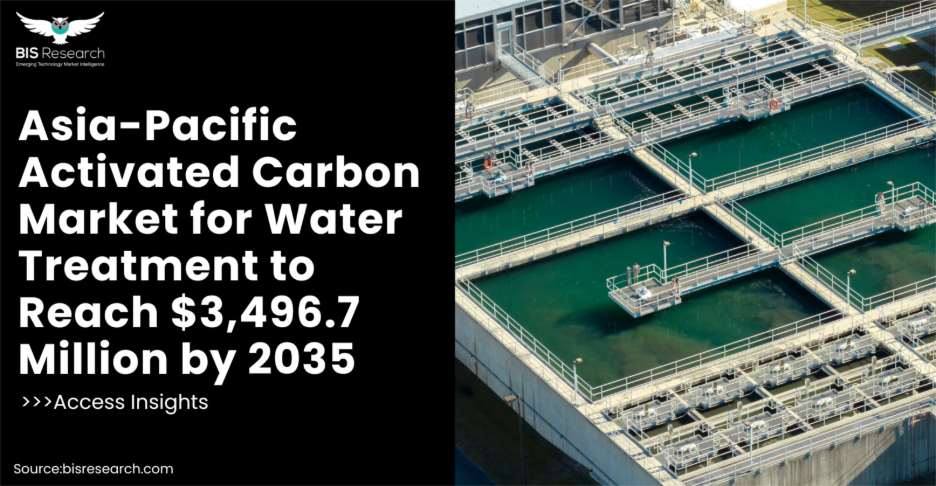
Activated carbon is a highly porous filtration material produced from coal, wood, and coconut shell, and is widely used for removing organic contaminants, pesticides, PFAS, chlorine byproducts, and pharmaceutical residues from water. In APAC, activated carbon plays a critical role in municipal water purification, industrial wastewater treatment, and water recycling programs.
Virgin activated carbon offers high initial adsorption capacity, while reactivated carbon processed using energy-efficient rotary kilns—reduces waste and cost by enabling repeated cycles of use. With APAC countries increasing investment in clean water access and pollution control, activated carbon has become one of the most essential water treatment media.
According to BIS Research, Asia-Pacific activated carbon market for water treatment was valued at $1,149.4 million in 2024 and is projected to reach $3,496.7 million by 2035, growing at a CAGR of 10.57% during 2025–2035.
• Rapid population growth and urbanization raising demand for clean water
• Aging water infrastructure requiring modernization and advanced filtration systems
• Stringent environmental regulations across APAC enforcing higher treatment standards
• Increasing scarcity of freshwater accelerating recycling and reuse of wastewater
• Industrial expansion in sectors such as mining, chemicals, textiles, and pharmaceuticals
• Public health concerns over waterborne diseases and contamination incidents
• High operational and maintenance costs for large-scale activated carbon systems
• Competition from alternative technologies like membranes and advanced oxidation processes
• Dependence on coconut-shell raw material supply, especially from Southeast Asia
• Limited infrastructure and funding in rural or underdeveloped regions
• Regulatory inconsistencies across APAC countries slowing uniform technology adoption
• Municipal Water Treatment
• Food and Beverages
• Pharmaceutical and Medical
• Mining and Metal Recovery
• Chemical Industry
• Textile Industry
• Others
• Liquid-Phase Adsorption
• Gas-Phase Adsorption
• Powdered Activated Carbon (PAC)
• Granular Activated Carbon (GAC)
• Others
• Asia-Pacific
Explore the Full TOC and Download Report Sample >>
The APAC activated carbon market is entering a technologically transformative phase. Utilities and industries are adopting optimized pore-structure carbons, bio-based feedstocks, and closed-loop regeneration systems to meet tightening environmental standards while controlling operating costs. Digital monitoring tools are being integrated with activated carbon systems to extend breakthrough cycles and improve performance predictability.
As water scarcity intensifies and regulatory pressure increases, APAC will continue investing heavily in activated carbon filtration technologies. Innovations in low-energy activation, high-porosity carbon materials, and carbon regeneration will reinforce the region’s leadership in sustainable water treatment solutions.
-BIS Research Analyst Team
The market is expected to grow at a CAGR of 10.57% from 2025 to 2035.
Municipal water treatment leads due to rising urban populations and regulatory mandates.
Granular Activated Carbon (GAC) for continuous municipal filtration; PAC for rapid-response contamination control.
Water scarcity, regulatory pressure, industrial expansion, and the need for advanced purification solutions.
BIS Research offers KOL-based insights, rigorous segmentation, and strategic advisory across software, hardware, and sensing tech domains.