Antibody discovery is a critical engine of modern drug development, powering therapies for cancer, autoimmune diseases, and infectious disorders. For decades, discovery relied on traditional laboratory-based technologies that delivered reliable results but required long timelines and high costs. Today, AI in antibody discovery is emerging as a powerful technological layer, transforming how antibodies are designed, optimized, and selected.
Rather than replacing classical approaches, AI is reshaping antibody discovery by accelerating innovation, improving success rates, and expanding what is scientifically possible.
Traditional antibody discovery relies on experimental platforms such as hybridoma technology, phage display, yeast display, and single B-cell cloning. These techniques use biological systems to generate antibodies and then screen them for binding and functionality.
Over the years, technology improvements have focused on automation, high-throughput screening, and microfluidics, allowing researchers to test larger antibody libraries with greater precision. Companies such as Charles River Laboratories, Abzena, and Evotec play key roles by providing discovery services and optimized screening platforms for biotech and pharma companies.
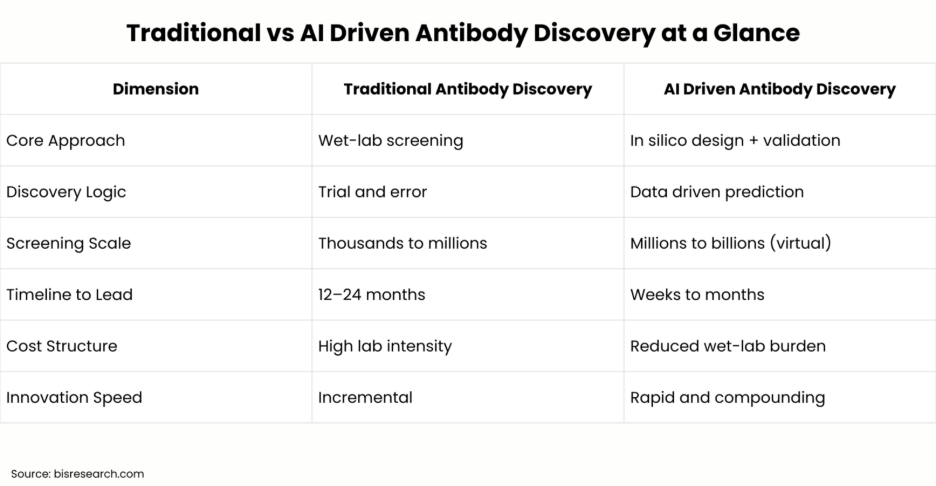
Despite these advances, traditional discovery remains sequential and resource intensive. From immunization to lead candidate selection, timelines typically span 12 to 24 months, and exploration of antibody diversity is constrained by physical library sizes.
Key limitations: even with automation, traditional technologies struggle to scale speed and diversity without escalating cost.
Want deeper insights on Antibody Discovery Market?
[Request Sample Report Now]
AI-driven antibody discovery introduces machine learning, deep learning, and computational protein design into early-stage R&D. These platforms analyze massive datasets of antibody sequences, structures, and experimental outcomes to predict which antibodies are most likely to succeed.
Recent advances in protein language models, structural prediction algorithms, and cloud computing enable AI systems to design novel antibodies, predict binding affinity, and optimize developability factors such as stability and manufacturability all before wet-lab validation.
AI can reduce early discovery timelines from years to months or even weeks, allowing researchers to focus on laboratory resources only on the most promising candidates.
Want deeper insights on AI in Antibody Discovery Market?
[Request Sample Report Now]
Several established players and startups are shaping this transformation:
• Schrödinger (USA) combines physics-based modeling with AI to support antibody structure prediction and optimization.
• Exscientia (UK) applies AI-driven design across biologics and small molecules, accelerating candidate selection.
• Insilico Medicine (USA/Hong Kong) integrates generative AI with biological modeling for drug discovery, including antibodies.
• Generate Biomedicines (USA) focuses on generative AI designing novel proteins and therapeutic antibodies.
• Absci (USA) combines AI with synthetic biology to design antibodies and rapidly express them in engineered systems.
• DeepMind’s AlphaFold technology has also indirectly influenced antibody discovery by dramatically improving protein structure prediction.
These companies represent a shift from screening-based discovery to design-based discovery.
Explore the full market potential
schedule a consultation
Traditional antibody discovery technologies evolve incrementally through better instrumentation and automation. AI-driven discovery, however, improves rapidly as models learn from expanding datasets, enabling faster iteration, broader sequence exploration, and multi-parameter optimization.
AI can simultaneously optimize binding, specificity, stability, and manufacturability—something traditional workflows handle sequentially. However, AI predictions still require experimental validation, reinforcing the importance of wet-lab technologies.
The most impactful development is the rise of hybrid discovery models, where AI designs and prioritizes candidates and traditional laboratories to validate and refine them. This approach is already being adopted by leading pharmaceutical companies to address:
• Difficult biological targets
• Bispecific and multispecific antibodies
• Rapid-response therapeutic programs
Traditional antibody discovery offers biological reliability and regulatory familiarity. AI in antibody discovery delivers speed, scale, and intelligent design. The future of biologics R&D lies in integrating both technologies, enabling faster innovation while maintaining scientific rigor.
Organizations that successfully combine AI platforms with experimental expertise will define the next generation of antibody-based therapeutics.
Get deeper, tailored insights with a customized report designed around your market, technology focus, and strategic goals.