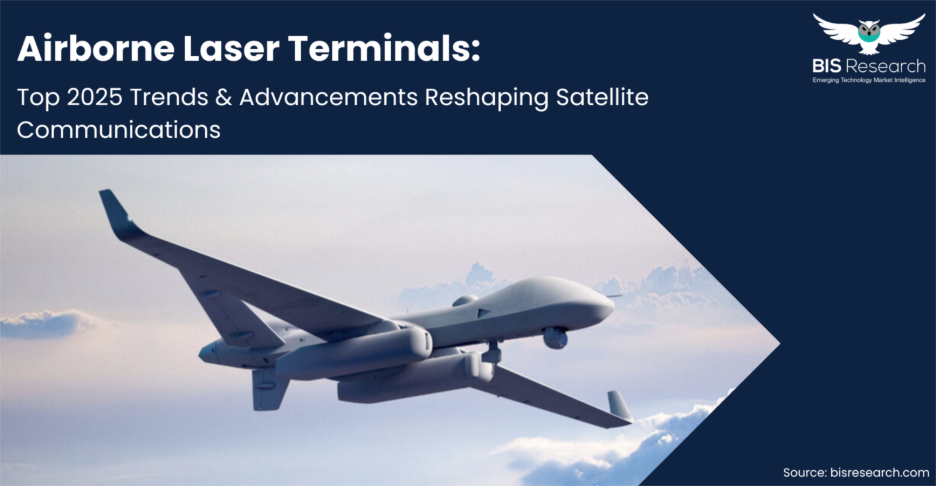
Airborne Laser Terminals (ALTs) are advanced communication devices that leverage laser technology to transmit data at exceptionally high speeds between satellites, aircraft, drones, and ground stations. Unlike traditional radio frequency systems, ALTs utilize optical signals, which enable greater bandwidth, lower latency, and enhanced data security for a wide range of mission-critical communications.
With their ability to deliver fast, secure, and highly reliable connectivity, Airborne Laser Terminals have become a foundational technology for modern communications in commercial aviation, defense networks, and scientific research. As industries seek more efficient and robust data transmission solutions, airborne laser terminals are playing a pivotal role in connecting remote platforms, supporting next-generation applications, and meeting the growing demand for seamless global connectivity.
As global demand for high-speed data transmission, secure communications, and resilient connectivity continues to surge, airborne laser terminals are revolutionizing how we connect across the globe. ALTs are enabling seamless communications for everything from 5G/6G and IoT networks to next-generation Earth observation and military defense.
Know Exactly What You’ll Get Before You Buy, Download the Full Report Table of Contents
1. Ultra-High-Speed, Secure Data Transmission
Laser communication terminals are now delivering multi-gigabit-per-second speeds vastly outperforming traditional radio frequency (RF) systems. This breakthrough means faster internet, real-time video, and rapid data relay for both airborne and satellite platforms. Cybersecurity is also stronger thanks to laser’s inherent resistance to jamming and eavesdropping.
2. Satellite Constellations Enabling Global Coverage
In 2025, networks of satellites and high-altitude drones equipped with airborne laser terminals provide global, always-on coverage. This ensures fast, reliable communication for aviation, maritime, defense, remote monitoring, and even rural internet services.
3. Miniaturization and Affordability
Advances in photonics and materials science have reduced the size and cost of ALTs, making them viable for a wide range of uses from commercial aircraft to small drones and CubeSats. This democratizes access to laser communication for more industries.
Request a sample report to preview market forecasts, key trends, and strategic insights on Airborne Laser Terminals.
1. Quantum-Secure Laser Communications
A major leap forward has been the integration of Quantum Key Distribution (QKD) with laser terminals, creating unhackable communication links for sensitive government and defense data. QKD payloads on satellites such as EAGLE-1 represent this trend.
2. AI-Driven Performance Optimization
Artificial Intelligence (AI) now enhances ALT tracking, alignment, and atmospheric compensation. AI ensures stable laser links even on fast-moving planes and through turbulent weather reducing signal loss and interruptions.
3. Interoperability & Open Standards
New international standards for laser terminals allow different manufacturers’ systems to work together. This interoperability is crucial for building large, hybrid networks that serve both commercial and military users.
4. Dual-Use Applications: Commercial Meets Defense
Technology originally developed for military use is now being adopted by airlines, telecom operators, Earth observation companies, and emergency services—broadening the impact and use cases for airborne laser terminals.
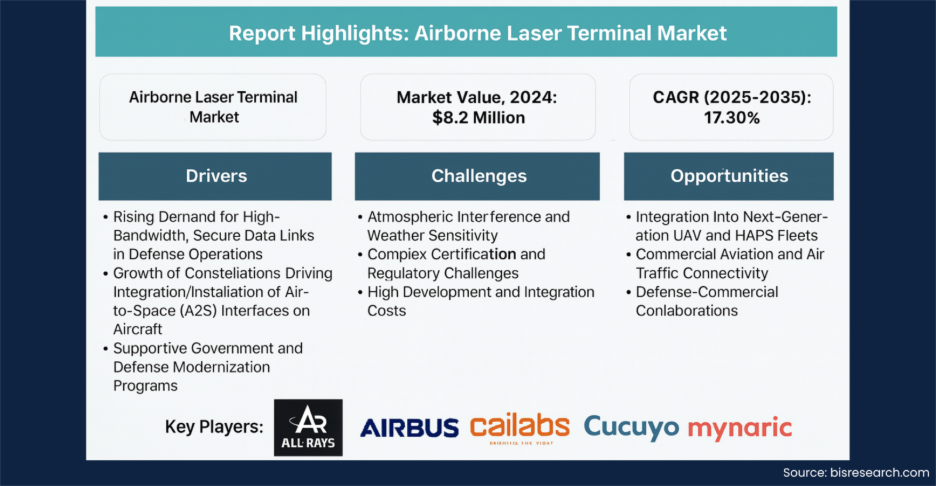
Despite rapid advancements, ALT deployment must address:
Continuous innovation and industry collaboration are critical for overcoming these obstacles and unlocking the full potential of airborne laser terminals.
Q: What are the benefits of airborne laser communication?
A: Key benefits include ultra-high data speeds, enhanced security, low latency, and immunity to RF interference.
By 2026, airborne laser terminals are set to become a core component of global communication infrastructure, delivering high-speed, secure, and resilient connectivity across air, space, and ground. From enabling smart defense networks to powering next-generation broadband and scientific missions, ALTs are at the heart of the future of communications.
Whether you’re evaluating defense-grade laser communications, satellite broadband investments, or next-gen aerospace technologies, our research equips you with actionable insights not just data.