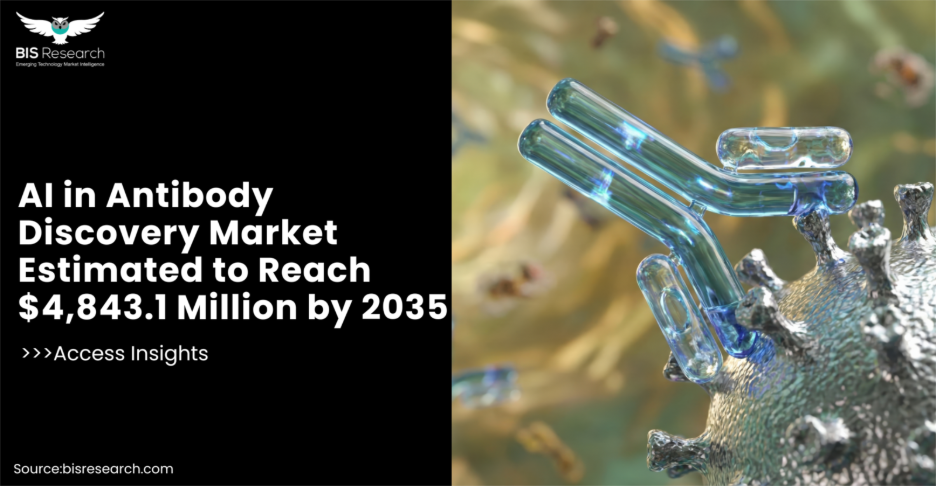
AI in antibody discovery refers to the application of artificial intelligence technologies such as deep learning, generative AI, and antibody-specific large language models (LLMs) to accelerate and optimize the identification, design, and optimization of therapeutic antibodies. These technologies address key limitations of conventional discovery approaches, which are often slow, expensive, and characterized by high attrition rates.
By enabling predictive modelling of antibody structure, binding affinity, and immunogenicity, AI-driven platforms significantly shorten discovery timelines and improve candidate success rates. Integration of AI with wet-lab experimentation allows iterative design–test–optimize cycles with minimal human intervention, transforming antibody discovery into a more efficient, data-driven, and scalable process.
According to BIS Research, the global AI in antibody discovery market was valued at $410.4 million in 2024 and is projected to reach $4,843.1 million by 2035, growing at a CAGR of 24.76% during 2025–2035.
Access Insights on AI in Antibody Discovery Market
• High Attrition Rates and Costs of Traditional Antibody Discovery Methods
• Advancements in Deep Learning, Generative AI, and Antibody-Specific LLMs
• Integration of AI Platforms with Wet-Lab Experimentation
• Rising Demand for Precision and Personalized Antibody Therapeutics
• Strategic Collaborations between AI Startups and Biopharma Companies
• Expansion of Multi-Omics and Cloud-Based Discovery Platforms
• Limited Availability of High-Quality, Curated Training Datasets
• Validation Gaps Requiring Experimental Confirmation of AI Outputs
• Integration Complexity between Computational and Experimental Workflows
• Regulatory Uncertainty around AI-Designed Therapeutics
[Download Complete TOC or Request Sample Report]
• Structure Prediction
• Epitope/Paratope Prediction
• De Novo Antibody Design
• Affinity Maturation & Optimization
• Others
• AI Software Platforms
• Cloud-Based Solutions
• On-Premise AI Tools
• Consulting & Integration Services
• Target Identification
• Lead Antibody Discovery
• Lead Optimization
• Others
• Pharmaceutical, Biotechnology, and Platform Developing Companies
• Academic and Research Institutes
• Others
• Contract Research Organizations (CROs)
• North America
• Europe
• Asia-Pacific
• Rest-of-the-World
The global AI in antibody discovery market is in a rapid expansion phase, driven by the urgent need to improve efficiency, reduce costs, and lower failure rates in biologics development. AI is evolving from a supportive analytics tool into a core discovery engine, capable of generating and optimizing antibody candidates with increasing autonomy.
Over the next decade, antibody-specific LLMs, generative design models, and closed-loop AI–wet lab platforms will become standard infrastructure across leading biopharma organizations. While challenges remain around data quality, validation, and regulatory acceptance, continued investment, partnerships, and platform maturation are expected to move the market toward early maturity. AI-enabled antibody discovery is poised to redefine how biologics are designed, validated, and brought to the clinic.
-BIS Research Analyst Team
The market was valued at $410.4 million in 2024 and is projected to reach $4,843.1 million by 2035, growing at a CAGR of 24.76% from 2025 to 2035.
Structure prediction leads the market due to its critical role in modelling antibody folding, stability, and binding interactions.
AI has the greatest impact on target identification, structure prediction, de novo antibody design, and affinity optimization.
Pharmaceutical and biotechnology companies are the largest adopters, followed by CROs and academic research institutes.
BIS Research offers KOL-based insights, rigorous segmentation, and strategic advisory across software, hardware, and sensing tech domains.
Get deeper, tailored insights with a customized report designed around your market, technology focus, and strategic goals.