The future of grid stability will be defined by how effectively electric vehicle charging is managed, and AI-driven optimization is not just part of the solution, it is the solution.
As EV adoption accelerates globally, the real challenge is no longer electrification itself, but the strain it places on existing grid infrastructure. Without intelligent coordination, EV charging introduces unpredictable demand spikes that traditional grids are not designed to handle. In this context, AI is emerging as the central mechanism that will determine whether EV growth destabilizes or strengthens the grid.
The instability risk associated with EVs does not stem from insufficient generation alone, but from poorly managed demand. Charging behavior is inherently clustered, particularly during evening hours, creating sharp peaks that stress transformers, distribution networks, and overall grid capacity.
If unmanaged, this leads to:
• Peak load congestion
• Accelerated infrastructure wear
• Higher grid reinforcement costs
• Increased electricity prices
This is precisely where AI-driven optimization becomes essential. It shifts grid operations from reactive response to predictive control.
AI-driven EV charging optimization directly addresses the instability problem by transforming charging from a random load into a coordinated system.
Through real-time data analysis and predictive modeling, AI enables:
• Load forecasting to anticipate demand spikes
• Smart scheduling to distribute charging over time
• Dynamic pricing to influence user behavior
• Automated control at both charger and network levels
This ensures that charging demand is aligned with grid capacity rather than overwhelming it. In effect, AI does not just reduce grid stress, it actively stabilizes the system.
The role of the EV Charging Management Software Platform Market is central to this transformation. These platforms act as the control layer that connects chargers, users, utilities, and grid operators.
AI-powered software platforms enable:
• Continuous monitoring of charging networks
• Predictive analytics for demand management
• Automated load redistribution across the grid
• Integration with renewable energy sources
Grid stability in the EV era depends less on hardware expansion and more on how effectively this software intelligence is deployed.
request sample report on EV Charging Management Software Platform Market
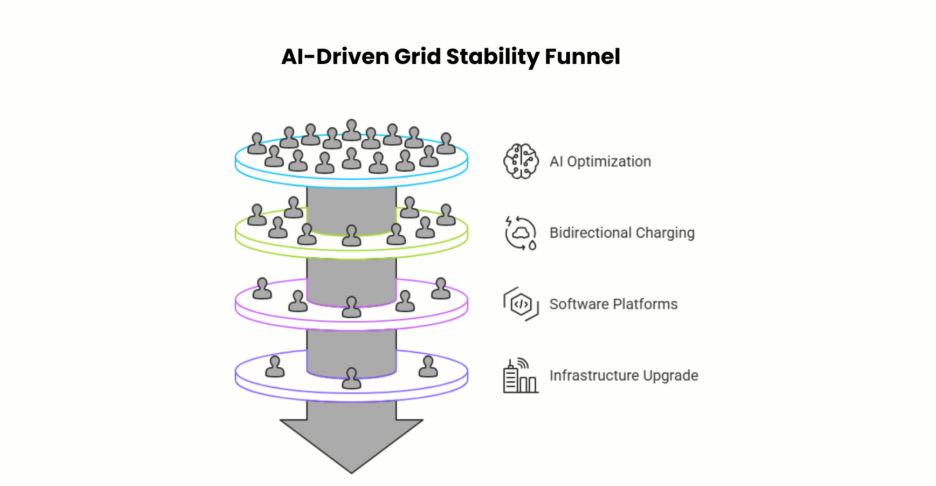
AI-driven optimization does not stop at managing demand. It extends to redefining EVs as active participants in grid stability.
The Bidirectional EV Charger Market introduces Vehicle-to-Grid (V2G) capabilities, allowing EVs to return stored energy to the grid. This transforms EVs into distributed energy assets.
AI is critical in this context because it determines:
• When to charge and when to discharge
• How to balance grid needs with user requirements
• How to optimize economic returns without degrading battery health
With AI coordination, EV fleets can function as a virtual power plant, stabilizing frequency and reducing peak load pressure.
To know more Request a sample report on Bidirectional EV Charger Market
The Electric Vehicle Charging System Market continues to expand rapidly, with deployments of AC chargers, DC fast chargers, and large-scale charging hubs.
However, infrastructure growth alone does not ensure grid stability. In fact, unmanaged expansion can intensify demand volatility.
AI ensures that infrastructure contributes to stability by enabling:
• Grid-aware site selection
• Load-sensitive charging distribution
• Integration with storage and renewable systems
This ensures that scaling charging networks does not translate into uncontrolled grid stress.
Download the complete TOC on Electric Vehicle Charging System Market
The future of grid stability lies in the convergence of three elements:
• Intelligent software platforms
• Bidirectional energy flow
• Scalable charging infrastructure
AI acts as the coordinating layer that synchronizes these components. The result is a grid that can dynamically adapt to demand, redistribute energy, and maintain stability without manual intervention.
AI-driven EV charging optimization is not an enhancement to grid systems, it is a prerequisite for their survival in an electrified future.
As EV adoption scales, grids must evolve into intelligent, adaptive networks. The integration of AI across software platforms, bidirectional charging systems, and physical infrastructure will determine whether EVs become a liability or an asset.
The direction is clear. With AI at the core, EV charging will not destabilize the grid. It will become one of its strongest stabilizing forces.