
As global threats grow more sophisticated and competition with peer adversaries intensifies, the United States military is reshaping its defense strategy across multiple fronts. From strategic deterrence and multi-domain battle networks to advanced missile defense and international partnerships, the next phase of planning reflects a fusion of innovation, industrial capacity, and policy adaptation.
This transformation also fuels recurring global debates such as How strong is the USA military? and Who is the no. 1 Army in the world? While such rankings depend on criteria, the scale of U.S. armed forces modernization, technological superiority, and global operational reach consistently position the country at the top tier of military power.
According to BIS Research, the U.S. Military Market was valued at $69.18 billion in 2024 and is projected to grow at a CAGR of 3.03%, reaching $80.85 billion by 2030. Analysts frequently ask: How big is the U.S. military market in 2026? Current projections indicate it will remain the largest globally, supported by modernization and procurement priorities.
Below are the six forces powering this transformation each grounded in official data and expert analysis.
Protecting the U.S. homeland from missile threats remains a top priority. The Golden Dome for America, launched under Executive Order 14186 in 2025, is a next-generation integrated air and missile defense system designed to counter ballistic, cruise, and hypersonic threats. It marks a strategic shift toward proactive protection of critical infrastructure and major military bases.
A Congressional Research Service defense primer notes that Congress has allocated tens of billions of dollars for initial Golden Dome efforts, highlighting the scale of U.S. missile defense modernization.
The Department of Defense has emphasized Golden Dome’s reliance on space-based sensors and integrated kill chains to address evolving aerial threats. These investments align with broader U.S. R&D priorities in hypersonics, early warning systems, and advanced intercept technologies.
Industry leaders are actively positioning to support the architecture, underscoring the continued strength and competitiveness of the U.S. military-industrial base.
Modern combat demands seamless data sharing and rapid decision-making across air, land, sea, space, and cyber domains connecting the Army, Navy, Air Force, Marine Corps, and Space Force.
To enable this integration, the Department of Defense launched the Joint All-Domain Command and Control (JADC2) initiative, aimed at unifying sensor networks and accelerating decision cycles across the U.S. military.
JADC2 is a key driver of growth in the U.S. military technology market, particularly in AI-powered analytics, resilient communications, ISR systems, network-centric warfare platforms, digital battle management systems, and secure data infrastructure.
Download the complete Table of Contents to explore the full market structure and insights.
Air dominance remains a central pillar of U.S. military strategy. The F-35 Lightning II Joint Strike Fighter program the Department of Defense’s largest procurement effort within the U.S. Department of Defense market continues to modernize the tactical fleet with stealth, sensor fusion, and interoperability.
According to Congressional Research Service (CRS) analysis, the U.S. plans to procure thousands of F-35 aircraft, supported by multinational partnerships and allied demand. Ongoing F-35 production contracts valued at approximately $24.3 billion covering 296 aircraft in Lots 18 and 19 illustrate sustained Pentagon procurement momentum through deliveries scheduled into 2028 and beyond.
Maintaining a robust strategic deterrent is a bedrock of U.S. defense policy and a defining factor when assessing How strong is the USA military? The Columbia-class submarine program tasked with delivering the next generation of ballistic missile submarines remains a cornerstone of nuclear triad modernization under ongoing U.S. armed forces modernization efforts.
Recent appropriations highlight sustained funding for Columbia-class submarines, long-range strike platforms, and strategic capabilities within the broader U.S. military market.
Global security challenges demand stronger international collaboration. The Pacific Deterrence Initiative (PDI), backed by over $40 billion in congressional authorizations, enhances U.S. military posture, infrastructure, and readiness in the Indo-Pacific to counter expanding anti-access/area-denial strategies.
Partnerships like AUKUS between the United States, the United Kingdom, and Australia further strengthen defense integration through cooperation in advanced submarines, autonomous systems, cyber capabilities, and emerging technologies.
Together, these initiatives highlight a key driver of growth in the U.S. defense industry: deeper allied collaboration, shared R&D, and coordinated procurement strategies.
Request your free sample report to access key data, forecasts, and strategic analysis.
Behind these strategic forces lies the strength of the U.S. military-industrial base a core engine of the U.S. defense market and the broader defense industry.
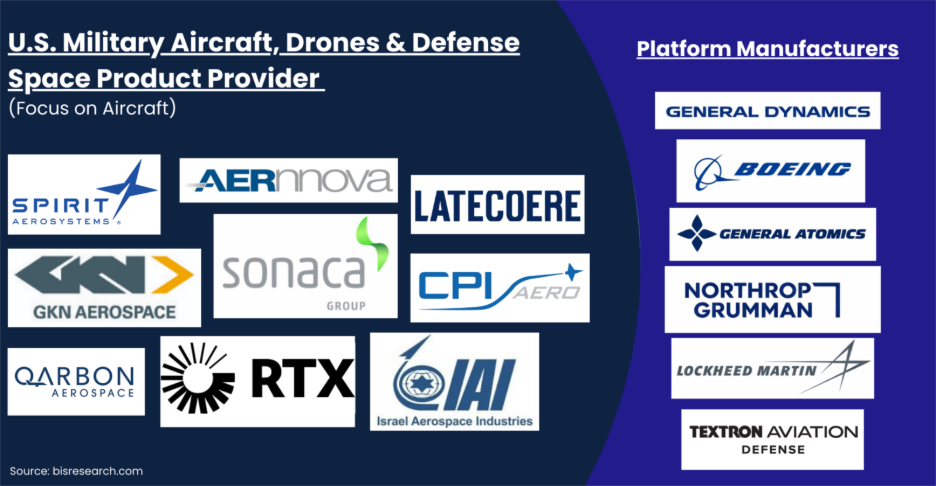
Legacy primes such as Lockheed Martin, RTX (Raytheon Technologies), Northrop Grumman, Boeing Defense, and General Dynamics dominate federal contracts. When examining the top defense contractors in the U.S., these firms consistently lead in revenue, advanced platform production, and global exports.
DoD agencies obligate tens of billions of dollars annually across the Air Force, Army, Navy, and Missile Defense Agency, underscoring the scale of U.S. defense procurement.
Alongside DARPA and service modernization commands, this ecosystem fuels innovation in AI, hypersonics, autonomy, and resilient networks supporting long-term U.S. defense industry growth projections.
Book an analyst preview to discuss customized insights and market opportunities.
The next phase of U.S. defense strategy is not simply about procurement it is about integration, innovation, and global partnership across the entire United States military framework. From missile defense and joint command networks to advanced platforms and strategic deterrence, these six forces define the trajectory of the U.S. military market and the wider U.S. defense market.
As modernization accelerates and investment continues across the U.S. military technology market, policy direction, industrial capacity, and alliance structures will shape the future of American defense leadership well into the next decade.