
A quick peek into the report
Smart Thermostat Market Overview
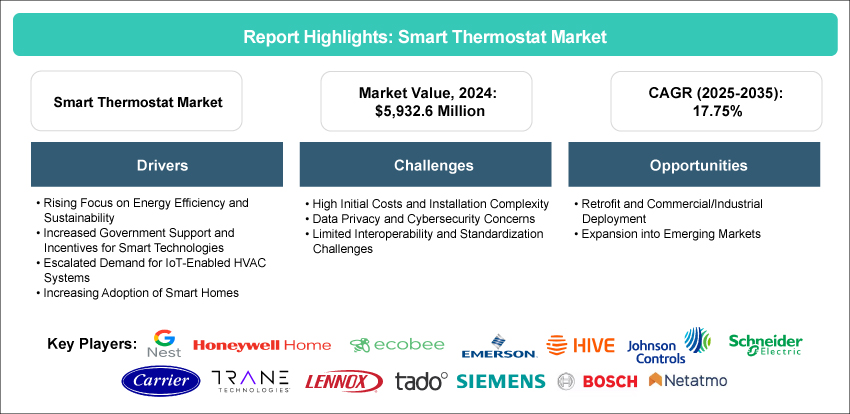
The global smart thermostat market is projected to grow from $7,249.6 million in 2025 to $37,134.9 million by 2035, representing a strong CAGR of 17.75%. This growth has been driven by the rapid adoption of connected home technologies, the expansion of smart home ecosystems, and increasing regulatory pressure to improve building energy efficiency. Advancements in HVAC automation, falling sensor and connectivity costs, and heightened consumer focus on energy savings are further accelerating market momentum. As residential and commercial users seek to manage utility costs and reduce carbon emissions, smart thermostats are becoming a central component of modern, data-driven HVAC systems.
Wi-Fi–enabled and learning thermostats are expected to dominate the technology mix due to their ability to optimize temperature control using occupancy data, weather intelligence, and adaptive machine-learning algorithms. Deeper integration with voice assistants, home energy management platforms, and utility demand response programs is also propelling adoption, particularly as utilities pursue flexible load-management strategies to reduce peak demand. However, the market continues to face challenges, including interoperability gaps across connected devices, cybersecurity risks, higher upfront costs for advanced solutions, and installation limitations in older buildings.
Supported by rising building electrification, stringent energy-efficiency standards, and increased participation from HVAC OEMs, utilities, and service providers, the smart thermostat market is positioned for sustained and robust expansion. As a key interface for comfort management, energy optimization, and grid-responsive operations, the smart thermostat will play a pivotal role in the evolution of next-generation intelligent building infrastructure.
Market Introduction
The study conducted by BIS Research positions the smart thermostat market as a key enabler of intelligent, connected, and energy-efficient building environments. Smart thermostats are rapidly evolving into advanced control platforms that deliver real-time HVAC optimization, adaptive comfort management, and data-driven energy efficiency across residential, commercial, and small enterprise settings. These systems are becoming increasingly essential as buildings face growing demands for energy conservation, carbon reduction, and integration with broader smart home and smart building ecosystems.
With advancements in IoT connectivity, AI-enabled occupancy sensing, predictive temperature control, and seamless integration with voice assistants and building management platforms, smart thermostats are becoming more autonomous, user-centric, and interoperable. Their software-defined architecture allows for rapid configuration across diverse HVAC systems, ranging from central air conditioning to heat pumps and zone-based climate systems, unlocking new value streams for consumers, utilities, and service providers. Enhanced analytics and cloud-based interfaces further enable remote monitoring, grid-interactive control, and participation in demand-response programs.
The market is expected to experience strong growth over the next decade, driven by rising energy-efficiency regulations, accelerating smart home adoption, increased focus on building electrification, and expanding utility-led initiatives to improve load flexibility. As buildings transition toward more intelligent, automated, and data-driven operations, smart thermostats will play a foundational role in enabling comfort, efficiency, and grid-responsive functionality at scale.
Industrial Impact
The smart thermostat market has been delivering significant industrial impact, transforming the HVAC, building automation, and energy management sectors through advancements in connected devices, adaptive intelligence, and real-time environmental control. Smart thermostat, integrating sensors, learning algorithms, and IoT connectivity, enables more efficient temperature regulation, reduced energy consumption, and enhanced user comfort across residential, commercial, and light industrial environments. By serving as an intelligent interface between occupants, HVAC equipment, and building energy management systems, a smart thermostat significantly improves system efficiency and operational visibility.
The integration of next-generation occupancy detection, AI-driven predictive control, and automated demand-response capabilities is accelerating the shift toward modular, scalable, and software-driven HVAC ecosystems. These advancements enhance energy flexibility, reduce peak load demands, and allow utilities to coordinate grid-responsive behavior without requiring major infrastructure upgrades. Additionally, deployments across smart homes, commercial buildings, multi-unit residences, and utility-led energy-efficiency programs are fostering deeper collaboration among HVAC manufacturers, smart home technology providers, energy retailers, utilities, and building automation vendors.
As industries prioritize energy efficiency, building electrification, carbon reduction, and digital transformation, the smart thermostat market is expected to play a central role in enabling more responsive, efficient, and data-driven building operations. The surrounding ecosystem is expanding rapidly, supported by stringent efficiency standards, accelerated adoption of connected HVAC solutions, and increasing investment in AI-enabled building technologies. Collectively, these trends position smart thermostats as a foundational component of next-generation intelligent building infrastructure.
Market Segmentation:
Segmentation 1: by Application
• Residential
• Commercial
• Industrial
Residential Segment to Dominate the Smart Thermostat Market (by Application)
The residential segment is projected to lead the smart thermostat market by application, driven by the rapid expansion of smart home ecosystems, rising consumer focus on energy savings, and growing adoption of Wi-Fi–enabled and learning thermostats. Households are increasingly integrating smart thermostats with connected HVAC systems, voice assistants, home energy management platforms, and utility demand-response programs. With features such as occupancy sensing, geofencing, adaptive scheduling, and real-time energy insights, residential deployments provide the largest installed base and the fastest volume-driven growth. These devices also play a fundamental role in supporting home electrification and efficiency upgrades.
The commercial segment is expected to follow, emerging as one of the most dynamic growth areas due to the increasing digitization of commercial buildings and widespread adoption of building automation and energy management systems. Office complexes, retail outlets, hospitality properties, educational institutions, and healthcare facilities are leveraging smart thermostats to optimize HVAC performance, enhance occupant comfort, lower operational costs, and comply with stricter energy-efficiency regulations. Commercial environments offer strong scalability, particularly when integrated with centralized building management systems, advanced analytics, and multi-zone climate control strategies.
The industrial segment, while smaller in comparison, is set to experience steady growth as facilities begin adopting smart thermostats to improve environmental monitoring, streamline HVAC energy use, and support broader digital transformation initiatives. Manufacturing plants, warehouses, and light industrial units are using smart thermostats to maintain equipment-safe temperature ranges, enhance worker comfort, and reduce peak-load HVAC consumption. Integration with industrial automation platforms and energy-efficiency programs further strengthens the value proposition.
Together, these application segments are driving the evolution of the smart thermostat market toward more connected, efficient, and intelligence-driven HVAC management, supporting improved user comfort, reduced energy costs, and enhanced building-level sustainability.
Segmentation 2: by Product Type
• Standalone
• Connected
• Learning
Connected Thermostats to Maintain Dominance in the Smart Thermostat Market (by Product Type)
Connected thermostats are projected to remain the dominant product segment in the global smart thermostat market, maintaining the largest share through 2035. This continued leadership is supported by widespread adoption of Wi-Fi–enabled HVAC control, integration with smart home ecosystems, and increasing deployment through utility energy-efficiency and demand-response programs. Connected thermostats offer seamless app-based control, remote monitoring, integration with voice assistants, and compatibility with diverse HVAC systems, making them the preferred choice for both consumers and service providers.
Connected devices continue to lead adoption across North America, Europe, and Asia-Pacific, where smart home penetration, building electrification programs, and regulatory focus on energy efficiency are accelerating demand. Their ability to provide real-time control, automate temperature settings, and support grid-responsive load management ensures sustained dominance through the forecast period.
In contrast, the learning thermostat segment is projected to grow rapidly in the coming years. Growth is fueled by AI-enabled capabilities such as adaptive scheduling, occupancy detection, energy-use prediction, and dynamic optimization. As algorithms become more sophisticated and user-friendly, learning thermostats are gaining traction among tech-forward homeowners and commercial users seeking deeper automation and higher energy savings.
The standalone thermostat segment is expected to rise steadily. These devices appeal to cost-sensitive consumers and facilities requiring basic programmability without advanced connectivity features. While standalone units play an important role in budget-driven or retrofit applications, their growth will remain comparatively moderate due to rising demand for connected and intelligent HVAC solutions.
While learning and standalone thermostats will contribute to overall market expansion, connected thermostats are expected to remain the highest-value segment. Their strong integration capabilities, widespread compatibility, and ability to support smart home ecosystems and utility programs ensure that connected thermostats will retain a leading role in shaping the evolution of intelligent, efficient, and automated building environments through 2035.
Segmentation 3: by Technology/Connectivity
• Wired Networking
• Wireless Networking
Segmentation 4: by Region
• North America: U.S., Canada, Mexico
• Europe: Germany, France, U.K., Spain, Italy, and Rest-of-Europe
• Asia-Pacific: China, Japan, South Korea, India, Australia, and Rest-of-Asia-Pacific
• Rest-of-the-World: South America and the Middle East and Africa
North America is expected to maintain its leading position in the global smart thermostat market, holding the highest market value throughout the forecast period. This leadership is driven by high smart home penetration, strong adoption of connected HVAC systems, and stringent building energy-efficiency standards across the U.S. and Canada. Widespread use of Wi-Fi–enabled thermostats, integration with home automation platforms, and extensive utility-driven energy-efficiency and demand-response programs further reinforce North America’s dominance.
Deepening electrification of buildings, large-scale deployment of AMI infrastructure, and regulatory emphasis on reducing HVAC-related emissions continue to stimulate market expansion. North America remains the most advanced ecosystem for smart thermostats, supported by high consumer awareness, strong OEM presence, and favorable rebate programs from utilities and state energy agencies.
The Asia-Pacific region is projected to be the fastest-growing smart thermostat market globally. Growth is fueled by rapid urbanization, increasing residential and commercial construction, and rising adoption of smart home technologies across China, Japan, South Korea, India, and Australia. Government initiatives promoting energy-efficient buildings and digital infrastructure are accelerating adoption. Increasing electricity demand, expanding middle-class households, and growing interest in connected HVAC systems are driving rapid integration of smart thermostats across both residential and commercial properties. APAC’s strong momentum in smart city development, digital building technologies, and IoT-enabled HVAC solutions positions the region as the most transformative and high-growth market globally.
Europe represents one of the most mature and technologically advanced smart thermostat markets. Growth is driven by stringent EU regulations targeting building energy efficiency, widespread smart meter adoption, and increasing electrification of heating, including heat pumps. Countries such as Germany, the U.K., the Netherlands, France, and the Nordics are leading the adoption of smart thermostats through strong policy support, high awareness of energy savings, and integration with advanced building automation systems. Europe’s emphasis on reducing heating-related emissions and enhancing building performance continues to drive steady and sustained market growth.
Demand: Drivers, Limitations, and Opportunities
Market Demand Drivers: Rising Focus on Energy Efficiency and Sustainability
The smart thermostat market has been experiencing strong demand growth, driven by the increasing emphasis on energy efficiency, sustainability, and reduced operational costs across residential, commercial, and industrial sectors. Heating and cooling represent some of the most energy-intensive processes in buildings, and smart thermostats provide a practical solution to optimize HVAC energy use. By automatically adjusting temperature settings based on occupancy patterns, schedules, and external weather conditions, these devices help users reduce utility bills while lowering carbon footprints. As governments and regulatory agencies introduce stricter energy-efficiency standards, smart thermostats are becoming essential tools in achieving sustainability goals globally.
Regulatory and incentive frameworks are accelerating adoption. For instance, in January 2025, the U.S. Department of Energy updated its energy-efficiency guidelines, strongly recommending smart thermostats to meet carbon-reduction targets. Similarly, the European Union’s Green Deal emphasizes the role of smart home technologies, including smart thermostats, in reducing energy consumption across residential and commercial buildings. State-level programs in the U.S., such as those in California and New York, offer tax credits and rebates for energy-efficient devices, making smart thermostats more accessible and cost-effective for consumers and businesses alike.
The commercial and industrial sectors are also driving demand, with many organizations implementing smart thermostats as part of broader energy-management strategies. Large corporations and industrial facilities leverage these devices to reduce operational costs, meet regulatory compliance, and improve energy efficiency. As governments continue to encourage energy-efficient technologies, smart thermostats are expected to see widespread adoption, supporting both consumer and large-scale energy-saving initiatives.
Market Challenges: Data Privacy and Cybersecurity Concerns
Escalating cybersecurity and data privacy risks remain significant restraints on smart thermostat adoption across all sectors. As networked devices, smart thermostats collect sensitive occupancy, schedule, and usage data while communicating with cloud platforms and executing remote commands, making them potential targets for cyberattacks. Concerns include unauthorized temperature manipulation, device bricking, data exfiltration, and exploitation as entry points into broader home or enterprise networks.
These risks are compounded by heterogeneous device fleets, inconsistent patching practices, and long product lifecycles. High-profile vulnerabilities underscore the potential impact; for instance, in October 2023, Bosch addressed a firmware flaw (CVE-2023-49722) in its BCC100 smart-thermostat line that could have allowed attackers to replace device firmware and access internal networks. Similarly, in July 2025, the U.S. Cybersecurity and Infrastructure Security Agency (CISA) issued alerts regarding critical vulnerabilities in industrial and commercial Wi-Fi thermostats from Honeywell, Medtronic, Mitsubishi, LG, and Network Thermostat, highlighting the exposure of Internet-connected units in operational environments.
Until baseline security measures, including secure boot, signed firmware, hardware roots of trust, rapid patch deployment, and robust lifecycle support, become universal, cybersecurity concerns will continue to slow procurement cycles, push buyers toward vetted devices and managed services, and, in some cases, delay smart thermostat rollouts.
Market Opportunities: Retrofit and Commercial/Industrial Deployment
The retrofit market represents a major growth opportunity for smart thermostats, particularly in commercial and industrial buildings with legacy HVAC systems. Upgrading to a smart thermostat allows businesses to optimize energy use, reduce operational costs, and integrate HVAC systems with broader building management platforms without a complete system overhaul. This is particularly relevant in regions with evolving energy regulations that require improved efficiency.
Notable initiatives illustrate this potential. For instance, in March 2025, Honeywell’s commercial retrofit program installed smart thermostats in over 1,000 retail locations across the U.S., aiming to reduce energy costs by 20% over five years. Similarly, Siemens launched a retrofit program in May 2025, deploying smart thermostats across 300 commercial properties in the U.K., projecting a 15% reduction in energy consumption. These examples demonstrate how existing infrastructure can be modernized cost-effectively.
Emerging markets such as Asia-Pacific and Latin America offer additional opportunities, driven by rapid urbanization, rising disposable incomes, and growing regulatory emphasis on energy efficiency. Smart thermostats designed for easy installation, wireless connectivity, and flexible integration are well-positioned to capture market share in these regions. As urban development continues and energy-efficiency goals become more pressing, retrofit and new-building deployments of smart thermostats will be key drivers of global market growth.
Analyst View
According to Dhrubajyoti Narayan, Principal Analyst at BIS Research, “The smart thermostat market is positioned for sustained and accelerated growth, driven by rising demand for energy efficiency, increasing adoption of connected home technologies, and regulatory momentum toward building electrification and carbon reduction. Leading players are expanding their footprint through strategic partnerships with HVAC manufacturers, utilities, and smart home technology providers, as well as deploying advanced AI-enabled thermostat solutions across residential, commercial, and industrial segments. Notable developments include large-scale residential rollouts in North America, commercial retrofit programs in Europe, and accelerated smart building adoption in the Asia-Pacific region, each reinforcing the global smart thermostat ecosystem.
Strategic collaborations are becoming key differentiators, as manufacturers, utilities, and service providers work together to integrate smart thermostats into energy management platforms, demand-response programs, and building automation systems. Examples include utility-backed residential deployment initiatives, commercial HVAC integrations with an AI-based learning thermostat, and large-scale industrial projects targeting optimized energy use and peak-demand reduction.
While mergers, acquisitions, and new product launches remain selective, they are highly targeted and impactful. Advances in AI-driven climate control, device interoperability, and IoT-based monitoring are enabling smarter, more autonomous, and commercially viable HVAC solutions. Simultaneously, policy initiatives and incentive programs are accelerating adoption and market monetization. As these trends converge, the smart thermostat market is evolving into a highly integrated, intelligent building solution, offering significant opportunities for both established HVAC providers and new entrants in the connected home and energy-efficiency sectors.”
Smart Thermostat Market - A Global and Regional Analysis
Focus on Application, Product, and Regional Analysis - Analysis and Forecast, 2025-2035
Frequently Asked Questions
The smart thermostat market focuses on intelligent, networked temperature control devices that optimize heating, ventilation, and air-conditioning (HVAC) systems across residential, commercial, and industrial applications.
Core smart thermostat technologies include:
• AI-driven learning algorithms for predictive temperature control
• IoT-enabled connectivity for remote monitoring and automation
• Integration with building management systems and smart home platforms
• Voice-assistant compatibility (Amazon Alexa, Google Assistant, etc.)
• Energy usage analytics and reporting
• Automated demand-response participation
These technologies allow real-time HVAC optimization, energy savings, improved user comfort, and participation in utility-driven energy-efficiency and demand-response programs.
The market has been expanding rapidly due to the following drivers:
1. Rising Focus on Energy Efficiency and Sustainability – Consumers and businesses are increasingly prioritizing solutions that reduce energy consumption and carbon footprint.
2. Increased Government Support and Incentives for Smart Technologies – Policies and rebates in key regions encourage the adoption of energy-efficient devices, including smart thermostats.
3. Escalated Demand for IoT-Enabled HVAC Systems – IoT connectivity enables remote monitoring, automation, and integration with building management systems.
4. Increasing Adoption of Smart Homes – Rising consumer interest in connected-home technologies drives demand for smart thermostats that enhance comfort and efficiency.
These drivers position the smart thermostat market at the center of the global clean energy transition.
Key challenges affecting adoption include:
• High Initial Costs and Installation Complexity – Premium devices and professional installation may discourage first-time buyers or commercial retrofits.
• Data Privacy and Cybersecurity Concerns – Networked thermostats collect usage and occupancy data, creating potential risks for unauthorized access.
• Limited Interoperability and Standardization Challenges – Differences across brands and platforms can complicate integration with legacy HVAC systems and smart-home ecosystems.
Overcoming these challenges requires secure device architecture, standardization, and simplified installation processes.
Addressing these challenges requires harmonized policies, secure communication systems, and robust standardization.
Smart thermostats contribute to sustainability by:
• Optimizing HVAC energy usage based on occupancy and weather conditions
• Reducing peak energy demand through automated control
• Supporting energy-saving initiatives in residential, commercial, and industrial environments
By enabling intelligent heating and cooling, smart thermostats help achieve measurable energy savings while supporting broader environmental objectives.
The smart thermostat market is projected to grow strongly, reaching $37.1 billion by 2035, driven by energy-efficiency mandates, connected-home adoption, and supportive regulations.
This report is valuable for:
• Smart thermostat manufacturers and IoT solution providers
• Utilities and energy service companies (ESCOs)
• Commercial and industrial building managers
• Software developers and analytics firms
• Policymakers, regulators, and energy planners
• Investors and clean-tech strategists
It provides actionable insights on market opportunities, competitive landscape, technology trends, and adoption strategies shaping the future of intelligent temperature control solutions.