
Published Year: 2025
Very Low Earth Orbit (VLEO) Satellite Market - A Global and Regional Analysis: Focus on Type, Applic
...

Focus on Application, Product, and Regional Analysis - Analysis and Forecast, 2025-2035
Delivery Time: 1 Working Day
Get ISO Certified Research, Customization, Data Extraction, and Value-Added Services with All BIS Research Reports
BIS Research provides a comprehensive report library with unlimited access to data, insights, and market intelligence through Subscription.
Get Subscription Know More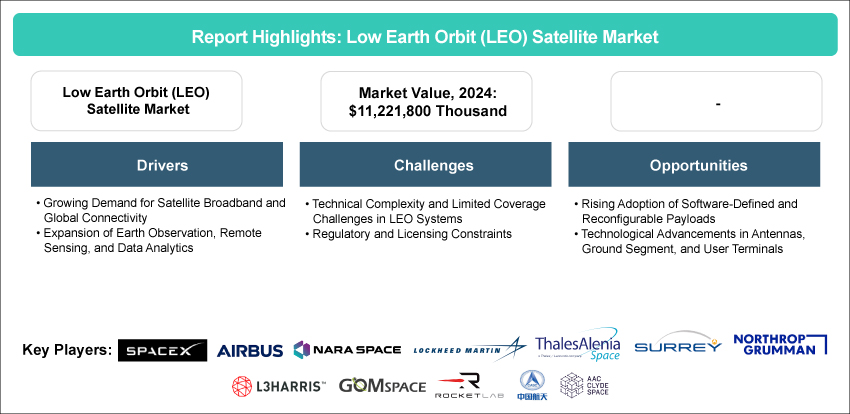
The low Earth orbit (LEO) satellite market was valued at $11,221,800 thousand in 2024 and is projected to reach $254,000 thousand by 2035. The LEO satellite market has been primarily driven by the accelerating demand for low-latency, high-throughput global connectivity that terrestrial networks alone cannot economically deliver. Traditional geostationary systems introduce a latency of ~600 milliseconds, whereas LEO networks typically operate below 40-50 milliseconds, making them viable for cloud computing, real-time collaboration, and latency-sensitive applications. A second major driver is the sharp decline in launch and manufacturing costs; launch costs per kilogram to LEO have fallen by roughly 85-95% over the past two decades, while small satellites now represent over 70% of annual satellite launches, enabling constellation-scale economics. Additionally, the rapid expansion of data-intensive industries, including IoT, autonomous systems, precision agriculture, and Earth observation, requires high revisit rates and persistent coverage that LEO constellations uniquely provide. Government and defense demand further accelerates the market, as distributed LEO architectures offer greater resilience and redundancy compared to single high-value satellites. Together, these drivers act like a reinforcing flywheel; lower costs enable larger constellations, larger constellations improve performance and coverage, and improved performance unlocks new commercial and institutional use cases, sustaining long-term market growth.
Introduction of LEO Satellite
The study conducted by BIS Research highlights that the low Earth orbit (LEO) satellite market represents one of the fastest-evolving segments of the global space economy. Operating at altitudes between 160 km and 2,000 km above Earth, LEO satellites enable high-speed data transmission, frequent Earth coverage, and low signal latency. These characteristics position LEO systems as critical infrastructure for modern digital services, ranging from broadband connectivity to real-time Earth observation. From a strategic standpoint, LEO innovation increasingly resembles a platform play; once orbital infrastructure is established, competitive advantage shifts to how efficiently data flows through the network and how seamlessly services integrate with terrestrial 5G/6G, cloud, and edge ecosystems.
Market Introduction
The low Earth orbit (LEO) satellite market has been emerging as a transformative segment of the global space and telecommunications industry, driven by the need for high-speed, low-latency, and globally accessible data services. Operating at altitudes between approximately 160 km and 2,000 km, LEO satellites enable faster signal transmission and higher revisit rates compared to traditional orbital systems, making them well-suited for applications such as broadband connectivity, Earth observation, and real-time data analytics. Industry momentum is supported by structural cost reductions, with launch costs per kilogram declining by nearly 90% over the past two decades and small satellites accounting for more than 70% of annual satellite deployments. Technological advancements, including software-defined payloads, laser inter-satellite links capable of exceeding 100 Gbps, and cloud-integrated ground infrastructure, are allowing LEO constellations to function like dense digital networks rather than isolated space assets. Much like an express transit system layered over existing roads, LEO satellite networks shorten the distance between data source and user, creating a scalable orbital infrastructure that is reshaping how connectivity and geospatial intelligence are delivered worldwide.
Industrial Impact
LEO satellites are already reshaping multiple industries because they turn space into high-frequency, low-latency infrastructure rather than occasional, “boutique” missions. The biggest industrial impact is in connectivity-dependent sectors; LEO broadband typically delivers tens of milliseconds of latency (Speedtest/Ookla reporting shows median Starlink latency often in the ~38–45 ms range across measured regions), which enables cloud apps, voice/video, and real-time coordination in places where fiber is impractical.
Market Segmentation
Segmentation 1: by Application
• Communication
• Earth Observation and Remote Sensing
• Navigation and Positioning
• Others
Communication to Dominate the Low Earth Orbit (LEO) Satellite Market (by Application)
In the low Earth orbit (LEO) satellite market, the communication segment is expected to dominate the market because it is the only application category that scales simultaneously on constellation size, recurring subscription revenue, and mass-market demand. First, the largest LEO deployments are being built primarily for broadband and direct connectivity, with mega-constellation analyses showing broadband connectivity as a strong proxy for where LEO capacity and capital are concentrated.
Segmentation 2: by End User
• Commercial
• Government and Military
Commercial to Dominate the Low Earth Orbit (LEO) Satellite Market (by End User)
Commercial end users are expected to dominate the low Earth orbit (LEO) satellite market because they generate the greatest repeatable demand and recurring revenue across broadband, mobility, and enterprise connectivity use cases that scale with every additional user terminal, aircraft, vessel, or remote site connected. A clear signal is the real-world expansion of LEO broadband platforms; reporting in late 2025 cites Starlink serving ~8 million users across 150+ markets, and upstream suppliers (like STMicroelectronics) publicly tie multi-billion component volumes to growing commercial terminal demand evidence of a large, expanding commercial base pulling the ecosystem (satellite production, launches, ground gateways, terminals) toward consumer and enterprise connectivity at scale.
Segmentation 3: by Satellite Type
• Small Satellites (Less than 500 Kg)
• Medium Satellites (500 to 1,000 Kg)
• Large Satellites (Above 1,000 Kg)
Medium Satellites to Dominate the Low Earth Orbit (LEO) Satellite Market (by Satellite Type)
Medium satellites (500 to 1,000 kg) are playing an increasingly important role in the low Earth orbit (LEO) satellite market due to their balanced capabilities and cost-effectiveness. These satellites offer greater payload capacity and more advanced functionalities compared to small satellites, making them suitable for a wide range of applications, including communication, Earth observation, and scientific research. The growing demand for enhanced satellite services, such as high-resolution imaging and reliable communication, is driving the adoption of medium satellites. Additionally, the reduction in launch costs and the ability to support multiple missions are accelerating the growth of this segment. Medium satellites are contributing to the expansion of the LEO satellite market by bridging the gap between smaller and larger satellite types, enabling more complex and scalable solutions for various industries.
Segmentation 4: by Region
• North America: U.S., Canada
• Europe: Germany, U.K., France, and Rest-of-Europe
• Asia-Pacific: China, Japan, India, South Korea, and Rest-of-Asia-Pacific
• Rest-of-the-World: South America and the Middle East and Africa
North America is widely expected to lead the low Earth orbit (LEO) satellite market because it combines the strongest commercial scale, launch cadence, and institutional demand in one region. The U.S. hosts and funds many of the ecosystem’s growth engines, mega-constellation operators, and their supply chains, while global deployment trends are being shaped by satellite broadband constellations dominated by major players such as SpaceX (U.S.) (with OneWeb as another large operator) and the broader surge in LEO broadband rollouts.
Demand - Drivers, Limitations, and Opportunities
Market Demand Drivers: Growing Demand for Satellite Broadband and Global Connectivity
The escalating demand for seamless, global connectivity is a pivotal catalyst propelling the expansion of the low Earth orbit (LEO) satellite market, by enabling transformative applications that terrestrial networks are ill-equipped to support. A primary impetus is the imperative to provide robust connectivity for remote and mobile assets, exemplified by the maritime industry. By the close of 2024, LEO solutions such as Starlink connected over 75,000 vessels, empowering leading shipping enterprises like Maersk to execute sophisticated digital fleet management initiatives and convert ships into fully equipped "floating offices." This compelling need for operational reliability has prompted even historically cost-conscious maritime stakeholders to embrace LEO technologies. Furthermore, the market has been underpinned by the essential demand for resilient communications infrastructure that sustains performance amid terrestrial network disruptions. For example, in the wake of Hurricanes Helene and Milton in 2024, organizations including Help.NGO and Intelsat swiftly implemented hybrid GEO-LEO satellite deployments to reinstate vital communications for search, rescue, and coordination operations mere hours after impact. Comparable satellite interventions were mobilized during the 2023 Maui wildfires and the 2025 Cyclone Alfred in Australia, affirming the technology's efficacy in extreme environmental challenges.
Market Challenges: Technical Complexity and Limited Coverage Challenges in LEO Systems
The low Earth orbit (LEO) satellite market is expanding rapidly, offering promising solutions for global communication, internet services, and Earth observation. However, one of the key challenges faced by this market is the technical complexity associated with LEO systems. Operating at altitudes ranging from 160 to 2,000 kilometres, these satellites must navigate a host of technical obstacles, including frequent orbital adjustments and maintaining a stable connection with ground stations. This requires the integration of cutting-edge technologies such as high-throughput communication systems, advanced propulsion mechanisms, and precise orbit control. Moreover, the need for frequent satellite launches and the continuous maintenance of satellite fleets adds to both operational costs and technical risks.
In addition to technical complexity, limited coverage is another significant challenge in LEO systems. Due to their proximity to Earth, LEO satellites have a smaller coverage footprint compared to geostationary satellites. As a result, they can only cover a portion of the Earth's surface at any given time, requiring a constellation of satellites to ensure continuous and global coverage. This necessitates the deployment of large, complex constellations that need to be regularly replenished to maintain operational capacity. The challenge of coordinating such constellations, along with ensuring seamless handovers between satellites, becomes a critical factor in delivering uninterrupted services. The combination of high technical demands and limited coverage capabilities makes LEO satellite systems cost-intensive and difficult to scale. For companies operating in this sector, overcoming these challenges is essential to achieving long-term profitability and delivering reliable global connectivity, especially in remote or underserved regions.
Market Opportunities: Rising Adoption of Software-Defined and Reconfigurable Payloads
The rising adoption of software-defined and reconfigurable payloads presents a significant opportunity in the low Earth orbit (LEO) satellite market. These advanced payloads offer enhanced flexibility and operational efficiency by allowing satellite functions to be reprogrammed or reconfigured in orbit. Unlike traditional payloads, which are fixed in their functionality, software-defined payloads can adapt to changing mission requirements, enabling operators to optimize satellite performance based on real-time needs.
This adaptability allows for the efficient management of satellite resources and the ability to provide a variety of services without the need for new hardware or satellite launches. As a result, satellite operators can offer more dynamic services, such as customized communication channels, data transmission optimization, and improved bandwidth management. This flexibility also reduces the need for frequent satellite upgrades or replacements, lowering operational costs and extending the lifecycle of the satellite fleet.
Additionally, the growing demand for high-throughput communication, global connectivity, and Earth observation data in diverse sectors, such as telecommunications, defense, and environmental monitoring, creates a strong market opportunity. Software-defined payloads can meet these diverse needs efficiently, making them a compelling choice for companies looking to stay competitive in the rapidly evolving low Earth orbit (LEO) satellite market. As the industry continues to embrace this technology, the potential for cost savings, innovation, and scalability becomes increasingly attractive.
Analyst View
According to Dhrubajyoti Narayan, Principal Analyst at BIS Research, “the low Earth orbit (LEO) satellite market is entering a consolidation and optimization phase where commercial viability matters more than launch volume alone. The initial focus on rapid constellation deployment is giving way to network efficiency, service quality, and sustainable revenue models, particularly in broadband and mobility services that generate recurring cash flows. Analysts observe that direct-to-device connectivity, software-defined payloads, and laser inter-satellite links are expanding the addressable market while improving capacity utilization across constellations. At the same time, increasing orbital congestion and regulatory scrutiny are becoming structural cost and risk factors, influencing licensing timelines and operational strategies. Overall, the prevailing analyst view is that long-term market leadership will favor operators that treat LEO constellations as telecom-grade infrastructure, optimizing cost per delivered gigabit and reliability, rather than those competing solely on satellite count.”
Focus on Application, Product, and Regional Analysis - Analysis and Forecast, 2025-2035
Ans: The low Earth orbit (LEO) satellite market refers to the global commercial and institutional ecosystem involved in the design, manufacturing, launch, deployment, operation, and commercialization of satellites operating at altitudes of approximately 160 km to 2,000 km above the Earth’s surface, along with the services enabled by these systems. This market includes upstream components such as satellite platforms, payloads, propulsion, and launch services, midstream activities such as constellation deployment and network management, and downstream applications including broadband communication, Earth observation, remote sensing, navigation support, research, and defense services. Characterized by large satellite constellations, low-latency performance (typically under 50 milliseconds), and declining cost per satellite and per kilogram launched, the LEO satellite market functions as a rapidly expanding layer of global digital infrastructure, supporting scalable, high-frequency data connectivity and near-real-time geospatial intelligence across commercial, government, and military end users.
Ans: The low Earth orbit (LEO) satellite market presents several high-impact business opportunities driven by its ability to deliver low-latency, scalable, and globally accessible services that terrestrial networks cannot economically replicate. The most significant opportunity lies in commercial broadband and mobility connectivity, including residential internet, aviation, maritime, and land mobility, where recurring subscription models and high usage intensity support long-term revenue growth. With LEO networks capable of sub-50-millisecond latency, enterprises in energy, mining, logistics, and construction also represent a strong opportunity, using satellite connectivity to digitize remote operations and reduce asset downtime.
Ans: To strengthen their market position in the low Earth orbit (LEO) satellite market industry, existing players have been adopting several strategic initiatives:
• Strategic Partnerships and Collaborations: Strategic partnerships and collaborations have become a central strategy for LEO satellite market players seeking to accelerate scale, reduce risk, and strengthen competitive positioning.
• Investment in Research and Development: Investment in research and development (R&D) is a core strategy LEO satellite players use to defend and expand market share, because performance advantages in LEO are increasingly created through continuous innovation rather than one-time hardware upgrades.
• Geographical Expansion: Firms are entering new markets to capitalize on regional demand for sustainable materials, thereby broadening their global footprint.
• Sustainable Product Development: Sustainable product development is emerging as a critical strategic focus for LEO satellite market players as constellation sizes grow and regulatory scrutiny intensifies. Companies are increasingly designing satellites with shorter, controlled lifecycles, incorporating propulsion systems and automated deorbiting mechanisms to ensure satellites safely exit orbit within mandated timeframes, typically 5-25 years after mission completion.
• Mergers and Acquisitions: Companies have been engaging in M&A activities to acquire complementary technologies and expertise, facilitating rapid market penetration and diversification.
Ans: For a new entrant in the low Earth orbit (LEO) satellite market, competing head-to-head with large constellation operators on scale is neither capital-efficient nor strategically necessary. Instead, the strongest path to differentiation lies in focused specialization, software-led innovation, and ecosystem integration, where incumbents are often less agile.
Ans: The unique selling proposition (USP) of the low Earth orbit (LEO) satellite market report lies in its integrated, strategy-led view of the LEO satellite market, combining industry structure, technology evolution, competitive dynamics, and forward-looking business strategies into a single coherent narrative. Unlike conventional market reports that focus primarily on size and forecasts, this report emphasizes how and why value is shifting across the LEO ecosystem, from hardware-centric deployment to software-driven networks, partnerships, and sustainable operations.
Ans: The low Earth orbit (LEO) satellite market report has been designed for decision-makers who need actionable insight into where the low Earth orbit (LEO) satellite market is heading and how to compete within it, rather than high-level awareness alone. Satellite operators, telecom companies, and aerospace manufacturers should buy this report to understand shifting competitive dynamics, technology roadmaps, and partnership models that are redefining market leadership. Investors, private equity firms, and venture capitalists will find value in the report’s focus on unit economics, scalability, and emerging opportunity areas such as direct-to-device connectivity and data-driven services, helping them assess risk and return beyond headline growth rates.
...