
A quick peek into the report
Table of Contents
1.1 Intelligence, Surveillance, and Reconnaissance (ISR) Aircraft and Drones Trends: Current and Future Impact Assessment
1.1.1 Next-Generation Stealth ISR Aircraft
1.1.2 Autonomous ISR Drones with High-Level AI Autonomy
1.1.3 5G-Enabled ISR Communications for Faster Data Transmission
1.1.4 Augmented Reality (AR) and Virtual Reality (VR) for ISR Operations
1.1.5 Next-Generation ISR Pods and Modular Payloads
1.1.6 Multi-Sensor Data Fusion for Enhanced Intelligence Analysis
1.1.7 Hypersonic ISR Aircraft
1.1.8 Manned-Unmanned Teaming (MUM-T)
1.1.9 Collaborative Combat Aircraft for Enhancing ISR Synergy and Operational Effectiveness
1.2 Supply Chain Overview
1.2.1 Value Chain Analysis
1.2.2 Pricing Analysis
1.3 Research and Development Review
1.3.1 Patent Filing Trend (by Country, by Company): Intelligence, Surveillance, and Reconnaissance (ISR) Aircraft and Drones Analysis
1.4 Regulatory Landscape
1.5 Stakeholder Analysis
1.5.1 Use Case
1.5.2 End User and Buying Criteria
1.6 Comparative Analysis of Various Military Aircraft and Drones
1.6.1 Military Aircraft
1.6.2 Military Drones
1.7 Market Dynamics Overview
1.7.1 Market Drivers
1.7.1.1 Advancements in Sensor and Radar Technologies
1.7.1.2 Rising Cross-Border Conflicts and Geopolitical Tensions, and the Increased Demand for Persistent Surveillance
1.7.1.3 Integration of Space-Based ISR Assets
1.7.1.4 Miniaturization of Components Enabling Small ISR Drones
1.7.1.5 Increasing UAV Adoption in Military Application
1.7.1.6 Increasing Multi-Domain Operations (MDO) in Defense Sector
1.7.1.7 Growing Threats from Asymmetric Warfare
1.7.2 Market Restraints
1.7.2.1 Challenges with Data Formats
1.7.2.2 Availability of Modern Systems for Air Penetration
1.7.2.3 Lack of Trained Personnel
1.7.2.4 Cybersecurity Threats to ISR Systems
1.7.2.5 High Development and Maintenance Costs
1.7.2.6 Limited Endurance and Power Constraints in Small Drones
1.7.2.7 Dependency on Secure and Reliable Communication Networks
1.7.3 Market Opportunities
1.7.3.1 AI and ML Integration
1.7.3.2 Adoption of C5ISR
1.7.3.3 Integration of Quantum Sensing in ISR Platforms
1.7.3.4 Development of Swarm Drone ISR Technology
1.7.3.5 Advancements in Edge Computing for Real-Time ISR Processing
1.8 Implications of Geopolitical Shifts on Defense Funding
1.9 Procurement Programs for Major Countries
1.10 Growth Opportunities and Recommendations
1.10.1 Adoption of Autonomous UAS in ISR
1.10.2 Enhanced Data Fusion and Real-Time Processing for Enhanced ISR Outputs
2.1 Application Segmentation
2.2 Application Summary
2.3 Intelligence, Surveillance, and Reconnaissance (ISR) Aircraft and Drones Market (by End-Use Industry)
2.3.1 Reconnaissance and Surveillance
2.3.2 Electronic Warfare
2.3.3 Search and Rescue Operations
2.3.4 Airborne Early Warning Capabilities
2.3.5 Maritime Support/Patrol
2.3.6 Tactical Operations
2.3.7 Target Acquisition
2.4 Intelligence, Surveillance, and Reconnaissance (ISR) Aircraft and Drones Market Demand (by End-Use Industry)
3.1 Product Segmentation
3.2 Product Summary
3.3 Intelligence, Surveillance, and Reconnaissance (ISR) Aircraft and Drones Market (by Platform)
3.3.1 Military Aircraft
3.3.1.1 Fighter Jets
3.3.1.2 Special Mission Aircraft
3.3.1.3 Missionized Business Jets
3.3.1.4 Military Transport Aircraft
3.3.2 Military Drones
3.3.2.1 Medium-Altitude Long Endurance (MALE) Drones
3.3.2.2 High-Altitude Long Endurance (HALE) Drones
3.3.2.3 Small Drones
3.3.3 Military Helicopters
3.4 Intelligence, Surveillance, and Reconnaissance (ISR) Aircraft and Drones Market Demand (by Platform)
3.4.1 Intelligence, Surveillance, and Reconnaissance (ISR) Aircraft and Drones Market Demand (by Military Aircraft)
3.4.2 Intelligence, Surveillance, and Reconnaissance (ISR) Aircraft and Drones Market Demand (by Military Drones)
3.5 Intelligence, Surveillance, and Reconnaissance (ISR) Aircraft and Drones Market (by Component)
3.5.1 Surveillance Systems
3.5.1.1 Light Detection and Ranging (LiDAR)
3.5.1.2 Electro-Optical/Infrared Sensor (EO/IR Sensors)
3.5.1.3 Radar
3.5.1.4 Others
3.5.2 Communication Systems
3.5.2.1 SATCOM
3.5.2.2 Antenna
3.5.2.3 Datalinks
3.5.3 Signal Intelligence (SIGINT) Systems
3.5.3.1 Electronic Intelligence (ELINT)
3.5.3.2 Communication Intelligence (COMINT)
3.5.4 Software
3.5.4.1 Mission Management
3.5.4.2 Threat Detection
3.5.4.2.1 List of Software
3.5.5 Others
3.6 Intelligence, Surveillance, and Reconnaissance (ISR) Aircraft and Drones Market Demand (by Component)
3.6.1 Intelligence, Surveillance, and Reconnaissance (ISR) Aircraft and Drones Market Demand (by Military Aircraft)
3.6.2 Intelligence, Surveillance, and Reconnaissance (ISR) Aircraft and Drones Market Demand (by Communication Systems)
3.6.3 Intelligence, Surveillance, and Reconnaissance (ISR) Aircraft and Drones Market Demand (by Signal Intelligence (SIGINT) Systems)
3.7 Intelligence, Surveillance, and Reconnaissance (ISR) Aircraft and Drones Market (by Support Services)
3.7.1 Simulation
3.7.2 Active Maintenance
3.7.3 Data Analytics and Post-Processing
3.8 Intelligence, Surveillance, and Reconnaissance (ISR) Aircraft and Drones Market Demand (by Support Services)
4.1 Regional Summary
4.1.1 Intelligence, Surveillance, and Reconnaissance (ISR) Aircraft and Drones Market (by Region)
4.2 North America
4.2.1 Regional Overview
4.2.1.1 Driving Factors for Market Growth
4.2.1.2 Factors Challenging the Market
4.2.2 North America Market (by End-Use Industry)
4.2.3 North America Market (by Component)
4.2.4 North America Market (by Platform)
4.2.5 North America (by Country)
4.2.5.1 U.S.
4.2.5.1.1 Budget Analysis
4.2.5.1.1.1 Introduction
4.2.5.1.1.1.1 Key Unmanned Platforms by Year
4.2.5.1.1.1.2 North America Platforms (by Year)
4.2.5.1.1.1.3 Major Components (Sensors, Radars, Communications) by Year
4.2.5.1.1.1.4 Applications and Operations Focus (by Year)
4.2.5.1.1.1.5 Service and Agency Budget Segmentation by Year
4.2.5.1.1.1.6 Budget Category Summaries (RDT&E, Procurement, O&M, Personnel) by Year
4.2.5.1.1.1.7 Procurement Programs and Deliveries (ISR Budget by Platform Type (2022–2025)
4.2.5.1.1.1.8 Conclusion
4.2.5.1.1.2 ISR Budget by Application (2022-2025)
4.2.5.1.1.3 ISR Budget by Platform Type (2022-2025)
4.2.5.1.2 U.S. Market (by End-Use Industry)
4.2.5.1.3 U.S. Market (by Platform)
4.2.5.2 Canada
4.2.5.2.1 Budget Analysis
4.2.5.2.1.1 Introduction
4.2.5.2.1.1.1 Overview of ISR Spending
4.2.5.2.1.1.2 Capital vs. Operations and Maintenance Spending
4.2.5.2.1.1.3 Procurement Programs and Deliveries (2022–2025)
4.2.5.2.1.1.4 Conclusion
4.2.5.2.1.2 ISR Spending by Application Area
4.2.5.2.1.3 ISR Spending by Major Platforms and Systems
4.2.5.2.2 Canada Market (by End-Use Industry)
4.2.5.2.3 Canada Market (by Platform)
4.2.5.3 Mexico
4.2.5.3.1 Budget Analysis
4.2.5.3.1.1 Introduction
4.2.5.3.1.1.1 Overview and Budget Trends (2022-2025)
4.2.5.3.1.1.2 Conclusion
4.2.5.3.1.2 ISR Budget by Application (2022-2025)
4.2.5.3.1.3 ISR Budget by Platform Type (2022-2025)
4.2.5.3.1.4 ISR Procurement Table
4.2.5.3.2 Mexico Market (by End-Use Industry)
4.2.5.3.3 Mexico Market (by Platform)
4.3 Europe
4.3.1 Regional Overview
4.3.1.1 Driving Factors for Market Growth
4.3.1.2 Factors Challenging the Market
4.3.2 Europe Market (by End-Use Industry)
4.3.3 Europe Market (by Component)
4.3.4 Europe Market (by Platform)
4.3.5 Europe (by Country)
4.3.5.1 Germany
4.3.5.1.1 Budget Analysis
4.3.5.1.1.1 Introduction
4.3.5.1.1.1.1 Drones (Unmanned Systems)
4.3.5.1.1.1.2 Crewed Aircraft
4.3.5.1.1.2 ISR Budget by Application (2022-2025)
4.3.5.1.1.3 ISR Budget by Platform Type (2022-2025)
4.3.5.1.1.4 ISR Procurement Table
4.3.5.1.2 Germany Market (by End-Use Industry)
4.3.5.1.3 Germany Market (by Platform)
4.3.5.2 France
4.3.5.2.1 Budget Analysis
4.3.5.2.1.1 Introduction
4.3.5.2.1.2 ISR Budget by Application (2022-2025)
4.3.5.2.1.3 ISR Budget by Platform Type (2022-2025)
4.3.5.2.1.4 Procurement Programs and Deliveries (2022-2025)
4.3.5.2.2 France Market (by End-Use Industry)
4.3.5.2.3 France Market (by Platform)
4.3.5.3 U.K.
4.3.5.3.1 Budget Analysis
4.3.5.3.1.1 Introduction
4.3.5.3.1.2 U.K. ISR Budget by Application (2022-2025)
4.3.5.3.1.3 U.K. ISR Budget by Platform (2022-2025)
4.3.5.3.1.4 Procurement Programs and Deliveries (2022-2025)
4.3.5.3.2 U.K. Market (by End-Use Industry)
4.3.5.3.3 U.K. Market (by Platform)
4.3.5.4 Russia
4.3.5.4.1 Budget Analysis
4.3.5.4.1.1 Introduction
4.3.5.4.1.2 ISR Budget by Application (2022-2025)
4.3.5.4.1.3 ISR Budget by Platform Type (2022-2025)
4.3.5.4.1.4 Procurement Programs and Deliveries (2022-2025)
4.3.5.4.2 Russia Market (by End-Use Industry)
4.3.5.4.3 Russia Market (by Platform)
4.3.5.5 Rest-of-Europe
4.3.5.5.1 Budget Analysis
4.3.5.5.1.1 Introduction
4.3.5.5.1.2 ISR Budget by Application (2022-2025)
4.3.5.5.1.3 ISR Budget by Platform Type (2022–2025)
4.3.5.5.1.4 Procurement Programs and Deliveries (2022-2025)
4.3.5.5.2 Rest-of-Europe Market (by End-Use Industry)
4.3.5.5.3 Rest-of-Europe Market (by Platform)
4.4 Asia-Pacific
4.4.1 Regional Overview
4.4.1.1 Driving Factors for Market Growth
4.4.1.2 Factors Challenging the Market
4.4.2 Asia-Pacific Market (by End-Use Industry)
4.4.3 Asia-Pacific Market (by Component)
4.4.4 Asia-Pacific Market (by Platform)
4.4.5 Asia-Pacific (by Country)
4.4.5.1 China
4.4.5.1.1 Budget Analysis
4.4.5.1.1.1 Introduction
4.4.5.1.1.2 ISR Budget by Application (2022–2025)
4.4.5.1.1.3 ISR Budget by Platform Type (2022–2025)
4.4.5.1.1.4 Procurement Programs and Deliveries (2022–2025)
4.4.5.1.2 China Market (by End-Use Industry)
4.4.5.1.3 China Market (by Platform)
4.4.5.2 Japan
4.4.5.2.1 Budget Analysis
4.4.5.2.1.1 Introduction
4.4.5.2.1.2 ISR Budget by Application (2022–2025)
4.4.5.2.1.3 ISR Budget by Platform Type (2022–2025)
4.4.5.2.1.4 Procurement Programs and Deliveries (2022–2025)
4.4.5.2.2 Japan Market (by End-Use Industry)
4.4.5.2.3 Japan Market (by Platform)
4.4.5.3 South Korea
4.4.5.3.1 Budget Analysis
4.4.5.3.1.1 Introduction
4.4.5.3.1.2 ISR Budget by Application (2022–2025)
4.4.5.3.1.3 ISR Budget by Platform Type (2022–2025)
4.4.5.3.1.4 Procurement Programs and Deliveries (2022–2025)
4.4.5.3.2 South Korea Market (by End-Use Industry)
4.4.5.3.3 South Korea Market (by Platform)
4.4.5.4 India
4.4.5.4.1 Budget Analysis
4.4.5.4.1.1 Introduction
4.4.5.4.1.2 ISR Budget by Application (2022–2025)
4.4.5.4.1.3 ISR Budget by Platform Type (2022–2025)
4.4.5.4.1.4 Procurement Programs and Deliveries (2022–2025)
4.4.5.4.2 India Market (by End-Use Industry)
4.4.5.4.3 India Market (by Platform)
4.4.5.5 Australia
4.4.5.5.1 Budget Analysis
4.4.5.5.1.1 Introduction
4.4.5.5.1.2 ISR Budget by Application (2022–2025)
4.4.5.5.1.3 ISR Budget by Platform Type (2022–2025)
4.4.5.5.1.4 Procurement Programs and Deliveries (2022–2025)
4.4.5.5.2 Australia Market (by End-Use Industry)
4.4.5.5.3 Australia Market (by Platform)
4.4.5.6 Rest-of-Asia-Pacific
4.4.5.6.1 Budget Analysis
4.4.5.6.1.1 Introduction
4.4.5.6.1.2 ISR Budget by Application (2022-2025)
4.4.5.6.1.3 ISR Budget by Platform Type (2022-2025)
4.4.5.6.1.4 Procurement Programs and Deliveries (2022-2025)
4.4.5.6.2 Rest-of-Asia-Pacific Market (by End-Use Industry)
4.4.5.6.3 Rest-of-Asia-Pacific Market (by Platform)
4.5 Rest-of-the-World
4.5.1 Regional Overview
4.5.1.1 Driving Factors for Market Growth
4.5.1.2 Factors Challenging the Market
4.5.2 Rest-of-the-World Market (by End-Use Industry)
4.5.3 Rest-of-the-World Market (by Component)
4.5.4 Rest-of-the-World Market (by Platform)
4.5.4.1 Latin America
4.5.4.1.1 Budget Analysis
4.5.4.1.1.1 Introduction
4.5.4.1.1.2 ISR Budget by Application (2022–2025)
4.5.4.1.1.3 ISR Budget by Platform Type (2022–2025)
4.5.4.1.1.4 Procurement Programs and Deliveries (2022–2025)
4.5.4.1.2 Latin America Market (by End-Use Industry)
4.5.4.1.3 Latin America Market by Platform
4.5.4.2 Middle East and Africa
4.5.4.2.1 Budget Analysis
4.5.4.2.1.1 Introduction
4.5.4.2.1.1.1 Overview of ISR Budget Trends (2022–2025)
4.5.4.2.1.2 ISR Budget by Application (2022–2025)
4.5.4.2.1.3 ISR Budget by Platform Type (2022–2025)
4.5.4.2.1.4 Procurement Programs and Deliveries (2022–2025)
4.5.4.2.2 Middle East and Africa Market (by End-Use Industry)
4.5.4.2.3 Middle East and Africa Market by Platform
4.6 Additional Country Analysis
4.6.1 Poland
4.6.1.1 Geopolitical Shifts and Strategic Context
4.6.1.2 ISR Programs, Partnerships, and Acquisitions
4.6.1.3 Notable Developments Impacting ISR Capability
4.6.2 Italy
4.6.2.1 Geopolitical Shifts and Strategic Context
4.6.2.2 ISR Programs, Partnerships, and Acquisitions
4.6.2.3 Notable Developments Impacting ISR Capability
4.6.3 Taiwan
4.6.3.1 Geopolitical Shifts and Strategic Context
4.6.3.2 ISR Programs, Partnerships, and Acquisitions
4.6.3.3 Notable Developments Impacting ISR Capability
4.6.4 Saudi Arabia
4.6.4.1 Geopolitical Shifts and Strategic Context
4.6.4.2 ISR Programs, Partnerships, and Acquisitions
4.6.4.3 Notable Developments Impacting ISR Capability
4.6.5 U.A.E.
4.6.5.1 Geopolitical Shifts and Strategic Context
4.6.5.2 ISR Programs, Partnerships, and Acquisitions
4.6.5.3 Notable Developments Impacting ISR Capability
5.1 Next Frontiers
5.2 Geographic Assessment
5.3 Company Profiles (Aircraft and Drone Manufacturers)
5.3.1 BAE Systems
5.3.1.1 Overview
5.3.1.2 Top Products/Product Portfolio
5.3.1.3 Top Competitors
5.3.1.4 Target Customers/End Users
5.3.1.5 Key Personnel
5.3.1.6 Analyst View
5.3.1.7 Market Share, 2024
5.3.2 Boeing
5.3.2.1 Overview
5.3.2.2 Top Products/Product Portfolio
5.3.2.3 Top Competitors
5.3.2.4 Target Customers/End Users
5.3.2.5 Key Personnel
5.3.2.6 Analyst View
5.3.2.7 Market Share, 2024
5.3.3 Bombardier
5.3.3.1 Overview
5.3.3.2 Top Products/Product Portfolio
5.3.3.3 Top Competitors
5.3.3.4 Target Customers/End Users
5.3.3.5 Key Personnel
5.3.3.6 Analyst View
5.3.3.7 Market Share, 2024
5.3.4 Embraer
5.3.4.1 Overview
5.3.4.2 Top Products/Product Portfolio
5.3.4.3 Top Competitors
5.3.4.4 Target Customers/End Users
5.3.4.5 Key Personnel
5.3.4.6 Analyst View
5.3.4.7 Market Share, 2024
5.3.5 Dassault Aviation
5.3.5.1 Overview
5.3.5.2 Top Products/Product Portfolio
5.3.5.3 Top Competitors
5.3.5.4 Target Customers/End Users
5.3.5.5 Key Personnel
5.3.5.6 Analyst View
5.3.5.7 Market Share, 2024
5.3.6 Israel Aerospace Industries Ltd.
5.3.6.1 Overview
5.3.6.2 Top Products/Product Portfolio
5.3.6.3 Top Competitors
5.3.6.4 Target Customers
5.3.6.5 Key Personnel
5.3.6.6 Analyst View
5.3.6.7 Market Share, 2024
5.3.7 Quantum-Systems GmbH
5.3.7.1 Overview
5.3.7.2 Top Products/Product Portfolio
5.3.7.3 Top Competitors
5.3.7.4 Target Customers
5.3.7.5 Key Personnel
5.3.7.6 Analyst View
5.3.7.7 Market Share, 2024
5.3.8 ISS Aerospace
5.3.8.1 Overview
5.3.8.2 Top Products/Product Portfolio
5.3.8.3 Top Competitors
5.3.8.4 Target Customers
5.3.8.5 Key Personnel
5.3.8.6 Analyst View
5.3.8.7 Market Share, 2024
5.4 Company Profiles (ISR Integrators)
5.4.1 L3Harris Technologies, Inc.
5.4.1.1 Overview
5.4.1.2 Top Products/Product Portfolio
5.4.1.3 Top Competitors
5.4.1.4 Target Customers/End Users
5.4.1.5 Key Personnel
5.4.1.6 Analyst View
5.4.1.7 Market Share, 2024
5.4.2 Sierra Nevada Corporation
5.4.2.1 Overview
5.4.2.2 Top Products/Product Portfolio
5.4.2.3 Top Competitors
5.4.2.4 Target Customers/End Users
5.4.2.5 Key Personnel
5.4.2.6 Analyst View
5.4.2.7 Market Share, 2024
5.4.3 Saab AB
5.4.3.1 Overview
5.4.3.2 Top Products/Product Portfolio
5.4.3.3 Top Competitors
5.4.3.4 Target Customers/End Users
5.4.3.5 Key Personnel
5.4.3.6 Analyst View
5.4.3.7 Market Share, 2024
5.4.4 General Atomics
5.4.4.1 Overview
5.4.4.2 Top Products/Product Portfolio
5.4.4.3 Top Competitors
5.4.4.4 Target Customers/End Users
5.4.4.5 Key Personnel
5.4.4.6 Analyst View
5.4.4.7 Market Share, 2024
5.4.5 Elbit Systems Ltd.
5.4.5.1 Overview
5.4.5.2 Top Products/Product Portfolio
5.4.5.3 Top Competitors
5.4.5.4 Target Customers/End Users
5.4.5.5 Key Personnel
5.4.5.6 Analyst View
5.4.5.7 Market Share, 2024
5.4.6 Textron Systems
5.4.6.1 Overview
5.4.6.2 Top Products/Product Portfolio
5.4.6.3 Top Competitors
5.4.6.4 Target Customers/End Users
5.4.6.5 Key Personnel
5.4.6.6 Analyst View
5.4.6.7 Market Share, 2024
5.4.7 Thales
5.4.7.1 Overview
5.4.7.2 Top Products/Product Portfolio
5.4.7.3 Top Competitors
5.4.7.4 Target Customers/End Users
5.4.7.5 Key Personnel
5.4.7.6 Analyst View
5.4.7.7 Market Share, 2024
5.4.8 Leonardo DRS
5.4.8.1 Overview
5.4.8.2 Top Products/Product Portfolio
5.4.8.3 Top Competitors
5.4.8.4 Target Customers/End Users
5.4.8.5 Key Personnel
5.4.8.6 Analyst View
5.4.8.7 Market Share, 2024
5.4.9 AeroVironment, Inc.
5.4.9.1 Overview
5.4.9.2 Top Products/Product Portfolio
5.4.9.3 Top Competitors
5.4.9.4 Target Customers/End Users
5.4.9.5 Key Personnel
5.4.9.6 Analyst View
5.4.9.7 Market Share, 2024
5.4.10 RTX
5.4.10.1 Overview
5.4.10.2 Top Products/Product Portfolio
5.4.10.3 Top Competitors
5.4.10.4 Target Customers/End Users
5.4.10.5 Key Personnel
5.4.10.6 Analyst View
5.4.10.7 Market Share, 2024
6.1 Data Sources
6.1.1 Primary Data Sources
6.1.2 Secondary Data Sources
6.1.3 Data Triangulation
6.2 Market Estimation and Forecast
Table 1: Market Snapshot
Table 2: Competitive Landscape Snapshot
Table 3: Trends Overview
Table 4: Category of ISR Platform Manufacturers
Table 5: ISR Platform Manufacturers Developments
Table 6: Category of Payload Facilitators
Table 7: Regulatory Landscape of Countries
Table 8: Key Operational Use Cases for ISR Aircraft and Drones
Table 9: Primary End Users of ISR Platforms and Their Operational Focus
Table 10: ISR Procurement Drivers – Core Buying Criteria and Industry Examples
Table 11: Comparative Analysis of Various Military ISR Aircraft
Table 12: Comparative Analysis of Various Military ISR Drones
Table 13: ISR Funding Detailed Country-wise (2022–2025)
Table 14: Procurement Programs for Major Countries (ISR Aircraft and Drones)
Table 15: Intelligence, Surveillance, and Reconnaissance (ISR) Aircraft and Drones Market (by End-Use Industry), Units, 2024-2035
Table 16: Intelligence, Surveillance, and Reconnaissance (ISR) Aircraft and Drones Market (by End-Use Industry), $Billion, 2024-2035
Table 17: Special Mission Aircraft, 2022-2025
Table 18: Intelligence, Surveillance, and Reconnaissance (ISR) Aircraft and Drones Market (by Platform), Units, 2024-2035
Table 19: Intelligence, Surveillance, and Reconnaissance (ISR) Aircraft and Drones Market (by Platform), $Billion, 2024-2035
Table 20: Intelligence, Surveillance, and Reconnaissance (ISR) Aircraft and Drones Market (by Military Aircraft), Units, 2024-2035
Table 21: Intelligence, Surveillance, and Reconnaissance (ISR) Aircraft and Drones Market (by Military Aircraft), $Billion, 2024-2035
Table 22: Intelligence, Surveillance, and Reconnaissance (ISR) Aircraft and Drones Market (by Military Drones), Units, 2024-2035
Table 23: Intelligence, Surveillance, and Reconnaissance (ISR) Aircraft and Drones Market (by Military Drones), $Billion, 2024-2035
Table 24: List of Notable Threat Detection Software
Table 25: Software Categories and Examples in ISR Operations
Table 26: Intelligence, Surveillance, and Reconnaissance (ISR) Aircraft and Drones Market (by Component), Units, 2024-2035
Table 27: Intelligence, Surveillance, and Reconnaissance (ISR) Aircraft and Drones Market (by Component), $Billion, 2024-2035
Table 28: Intelligence, Surveillance, and Reconnaissance (ISR) Aircraft and Drones Market (by Surveillance Systems), Units, 2024-2035
Table 29: Intelligence, Surveillance, and Reconnaissance (ISR) Aircraft and Drones Market (by Surveillance Systems), $Billion, 2024-2035
Table 30: Intelligence, Surveillance, and Reconnaissance (ISR) Aircraft and Drones Market (by Communication Systems), Units, 2024-2035
Table 31: Intelligence, Surveillance, and Reconnaissance (ISR) Aircraft and Drones Market (by Communication Systems), $Billion, 2024-2035
Table 32: Intelligence, Surveillance, and Reconnaissance (ISR) Aircraft and Drones Market (by Signal Intelligence (SIGINT) Systems), Units, 2024-2035
Table 33: Intelligence, Surveillance, and Reconnaissance (ISR) Aircraft and Drones Market (by Signal Intelligence (SIGINT) Systems), $Billion, 2024-2035
Table 34: Key Support Services in the Intelligence, Surveillance, and Reconnaissance (ISR) Aircraft and Drones Market
Table 35: Intelligence, Surveillance, and Reconnaissance (ISR) Aircraft and Drones Market (by Support Services), $Billion, 2024-2035
Table 36: Intelligence, Surveillance, and Reconnaissance (ISR) Aircraft and Drones Market (by Region), Units, 2024-2035
Table 37: Intelligence, Surveillance, and Reconnaissance (ISR) Aircraft and Drones Market (by Region), $Billion, 2024-2035
Table 38: North America Intelligence, Surveillance, and Reconnaissance (ISR) Aircraft and Drones Market (by End-Use Industry), $Billion, 2024-2035
Table 39: North America Intelligence, Surveillance, and Reconnaissance (ISR) Aircraft and Drones Market (by Component), $Billion, 2024-2035
Table 40: North America Intelligence, Surveillance, and Reconnaissance (ISR) Aircraft and Drones Market (by Platform), Units, 2024-2035
Table 41: North America Intelligence, Surveillance, and Reconnaissance (ISR) Aircraft and Drones Market (by Platform), $Billion, 2024-2035
Table 42: DoD Total (Base + FY 2023 Supplement) Budget by Appropriation Title ($Million)
Table 43: DoD Total (Base + FY 2023 Supplement) Budget by Military Department ($Million)
Table 44: Key Unmanned Platforms by Year (2022-2025)
Table 45: Key Manned Platforms by Year (2022-2025)
Table 46: Key Manned Platforms by Year (2022-2025)
Table 47: Applications and Operations Focus by Year (2022-2025)
Table 48: Service and Agency Budget Segmentation by Year (2022-2025)
Table 49: Service and Agency Budget Segmentation by Year (2022-2025)
Table 50: U.S. Intelligence, Surveillance, and Reconnaissance (ISR) Aircraft and Drones Market (by End-Use Industry), $Billion, 2024-2035
Table 51: U.S. Intelligence, Surveillance, and Reconnaissance (ISR) Aircraft and Drones Market (by Platform), Units, 2024-2035
Table 52: U.S. Intelligence, Surveillance, and Reconnaissance (ISR) Aircraft and Drones Market (by Platform), $Billion, 2024-2035
Table 53: DND Defense Budget and ISR-Related Allocations (FY2022-2025)
Table 54: Overview of ISR Spending (2022-2025)
Table 55: ISR Budget by Platform Type (2022–2025)
Table 56: ISR Spending by Application Area (2022–2025) – Combined Table of (by End-Use Industry)
Table 57: ISR Spending by Major Platforms and Systems
Table 58: Canada Intelligence, Surveillance, and Reconnaissance (ISR) Aircraft and Drones Market (by End-Use Industry), $Billion, 2024-2035
Table 59: Canada Intelligence, Surveillance, and Reconnaissance (ISR) Aircraft and Drones Market (by Platform), Units, 2024-2035
Table 60: Canada Intelligence, Surveillance, and Reconnaissance (ISR) Aircraft and Drones Market (by Platformy), $Billion, 2024-2035
Table 61: Key ISR-Related Aircraft Procurements by Product (2022-2025)
Table 62: Mexico Intelligence, Surveillance, and Reconnaissance (ISR) Aircraft and Drones Market (by End-Use Industry), $Billion, 2024-2035
Table 63: Mexico Intelligence, Surveillance, and Reconnaissance (ISR) Aircraft and Drones Market (by Platform), Units, 2024-2035
Table 64: Mexico Intelligence, Surveillance, and Reconnaissance (ISR) Aircraft and Drones Market (by Platformy), $Billion, 2024-2035
Table 65: Europe Intelligence, Surveillance, and Reconnaissance (ISR) Aircraft and Drones Market (by End-Use Industry), $Billion, 2024-2035
Table 66: Europe Intelligence, Surveillance, and Reconnaissance (ISR) Aircraft and Drones Market (by Component), $Billion, 2024-2035
Table 67: Europe Intelligence, Surveillance, and Reconnaissance (ISR) Aircraft and Drones Market (by Platform), Units, 2024-2035
Table 68: Europe Intelligence, Surveillance, and Reconnaissance (ISR) Aircraft and Drones Market (by Platform), $Billion, 2024-2035
Table 69: Germany Drones (Unmanned Systems)
Table 70: Germany Crewed Aircraft
Table 71: Germany ISR Procurement Table (2022-2025), $Million
Table 72: Germany Intelligence, Surveillance, and Reconnaissance (ISR) Aircraft and Drones Market (by End-Use Industry), $Billion, 2024-2035
Table 73: Germany Intelligence, Surveillance, and Reconnaissance (ISR) Aircraft and Drones Market (by Platform), Units, 2024-2035
Table 74: Germany Intelligence, Surveillance, and Reconnaissance (ISR) Aircraft and Drones Market (by Platformy), $Billion, 2024-2035
Table 75: ISR Budget by Platform Type (2022-2025)
Table 76: France Intelligence, Surveillance, and Reconnaissance (ISR) Aircraft and Drones Market (by End-Use Industry), $Billion, 2024-2035
Table 77: France Intelligence, Surveillance, and Reconnaissance (ISR) Aircraft and Drones Market (by Platform), Units, 2024-2035
Table 78: France Intelligence, Surveillance, and Reconnaissance (ISR) Aircraft and Drones Market (by Platformy), $Billion, 2024-2035
Table 79: U.K. Procurement Programs and Deliveries (2022-2025)
Table 80: U.K. Intelligence, Surveillance, and Reconnaissance (ISR) Aircraft and Drones Market (by End-Use Industry), $Billion, 2024-2035
Table 81: U.K. Intelligence, Surveillance, and Reconnaissance (ISR) Aircraft and Drones Market (by Platform), Units, 2024-2035
Table 82: U.K. Intelligence, Surveillance, and Reconnaissance (ISR) Aircraft and Drones Market (by Platformy), $Billion, 2024-2035
Table 83: Procurement Programs and Deliveries (2022-2025)
Table 84: Russia Intelligence, Surveillance, and Reconnaissance (ISR) Aircraft and Drones Market (by End-Use Industry), $Billion, 2024-2035
Table 85: Russia Intelligence, Surveillance, and Reconnaissance (ISR) Aircraft and Drones Market (by Platform), Units, 2024-2035
Table 86: Russia Intelligence, Surveillance, and Reconnaissance (ISR) Aircraft and Drones Market (by Platformy), $Billion, 2024-2035
Table 87: Rest-of-Europe Major ISR Procurement Programs and Deliveries (2022-2025)
Table 88: Rest-of-Europe Intelligence, Surveillance, and Reconnaissance (ISR) Aircraft and Drones Market (by End-Use Industry), $Billion, 2024-2035
Table 89: Rest-of-Europe Intelligence, Surveillance, and Reconnaissance (ISR) Aircraft and Drones Market (by Platform), Units, 2024-2035
Table 90: Rest-of-Europe Intelligence, Surveillance, and Reconnaissance (ISR) Aircraft and Drones Market (by Platformy), $Billion, 2024-2035
Table 91: Asia-Pacific Intelligence, Surveillance, and Reconnaissance (ISR) Aircraft and Drones Market (by End-Use Industry), $Billion, 2024-2035
Table 92: Asia-Pacific Intelligence, Surveillance, and Reconnaissance (ISR) Aircraft and Drones Market (by Component), $Billion, 2024-2035
Table 93: Asia-Pacific Intelligence, Surveillance, and Reconnaissance (ISR) Aircraft and Drones Market (by Platform), Units, 2024-2035
Table 94: Asia-Pacific Intelligence, Surveillance, and Reconnaissance (ISR) Aircraft and Drones Market (by Platform), $Billion, 2024-2035
Table 95: Procurement Programs and Deliveries (2022–2025)
Table 96: China Intelligence, Surveillance, and Reconnaissance (ISR) Aircraft and Drones Market (by End-Use Industry), $Billion, 2024-2035
Table 97: China Intelligence, Surveillance, and Reconnaissance (ISR) Aircraft and Drones Market (by Platform), Units, 2024-2035
Table 98: China Intelligence, Surveillance, and Reconnaissance (ISR) Aircraft and Drones Market (by Platformy), $Billion, 2024-2035
Table 99: Procurement Programs and Deliveries (2022–2025)
Table 100: Japan Intelligence, Surveillance, and Reconnaissance (ISR) Aircraft and Drones Market (by End-Use Industry), $Billion, 2024-2035
Table 101: Japan Intelligence, Surveillance, and Reconnaissance (ISR) Aircraft and Drones Market (by Platform), Units, 2024-2035
Table 102: Japan Intelligence, Surveillance, and Reconnaissance (ISR) Aircraft and Drones Market (by Platformy), $Billion, 2024-2035
Table 103: Procurement Programs and Deliveries (2022–2025)
Table 104: South Korea Intelligence, Surveillance, and Reconnaissance (ISR) Aircraft and Drones Market (by End-Use Industry), $Billion, 2024-2035
Table 105: South Korea Intelligence, Surveillance, and Reconnaissance (ISR) Aircraft and Drones Market (by Platform), Units, 2024-2035
Table 106: South Korea Intelligence, Surveillance, and Reconnaissance (ISR) Aircraft and Drones Market (by Platformy), $Billion, 2024-2035
Table 107: Procurement Programs and Deliveries (2022–2025)
Table 108: India Intelligence, Surveillance, and Reconnaissance (ISR) Aircraft and Drones Market (by End-Use Industry), $Billion, 2024-2035
Table 109: India Intelligence, Surveillance, and Reconnaissance (ISR) Aircraft and Drones Market (by Platform), Units, 2024-2035
Table 110: India Intelligence, Surveillance, and Reconnaissance (ISR) Aircraft and Drones Market (by Platformy), $Billion, 2024-2035
Table 111: Major ISR Procurement Programs and Deliveries (2022–2025)
Table 112: Australia Intelligence, Surveillance, and Reconnaissance (ISR) Aircraft and Drones Market (by End-Use Industry), $Billion, 2024-2035
Table 113: Australia Intelligence, Surveillance, and Reconnaissance (ISR) Aircraft and Drones Market (by Platform), Units, 2024-2035
Table 114: Australia Intelligence, Surveillance, and Reconnaissance (ISR) Aircraft and Drones Market (by Platformy), $Billion, 2024-2035
Table 115: Major ISR Procurement Programs and Deliveries (2022-2025)
Table 116: Rest-of-Asia-Pacific Intelligence, Surveillance, and Reconnaissance (ISR) Aircraft and Drones Market (by End-Use Industry), $Billion, 2024-2035
Table 117: Rest-of-Asia-Pacific Intelligence, Surveillance, and Reconnaissance (ISR) Aircraft and Drones Market (by Platform), Units, 2024-2035
Table 118: Rest-of-Asia-Pacific Intelligence, Surveillance, and Reconnaissance (ISR) Aircraft and Drones Market (by Platformy), $Billion, 2024-2035
Table 119: Rest-of-the-World Intelligence, Surveillance, and Reconnaissance (ISR) Aircraft and Drones Market (by End-Use Industry), $Billion, 2024-2035
Table 120: Rest-of-the-World Intelligence, Surveillance, and Reconnaissance (ISR) Aircraft and Drones Market (by Component), $Billion, 2024-2035
Table 121: Rest-of-the-World Intelligence, Surveillance, and Reconnaissance (ISR) Aircraft and Drones Market (by Platform), Units, 2024-2035
Table 122: Rest-of-the-World Intelligence, Surveillance, and Reconnaissance (ISR) Aircraft and Drones Market (by Platform), $Billion, 2024-2035
Table 123: Major ISR Procurement Programs and Deliveries (2022–2025)
Table 124: Latin America Intelligence, Surveillance, and Reconnaissance (ISR) Aircraft and Drones Market (by End-Use Industry), $Billion, 2024-2035
Table 125: Latin America Intelligence, Surveillance, and Reconnaissance (ISR) Aircraft and Drones Market (by Platform), Units, 2024-2035
Table 126: Latin America Intelligence, Surveillance, and Reconnaissance (ISR) Aircraft and Drones Market (by Platformy), $Billion, 2024-2035
Table 127: Major ISR Procurement Programs and Deliveries (2022–2025)
Table 128: Middle East and Africa Intelligence, Surveillance, and Reconnaissance (ISR) Aircraft and Drones Market (by End-Use Industry), $Billion, 2024-2035
Table 129: Middle East and Africa Intelligence, Surveillance, and Reconnaissance (ISR) Aircraft and Drones Market (by Platform), Units, 2024-2035
Table 130: Middle East and Africa Intelligence, Surveillance, and Reconnaissance (ISR) Aircraft and Drones Market (by Platformy), $Billion, 2024-2035
Table 131: Major ISR Acquisition
Table 132: Italy – Key ISR Platforms and Programs
Table 133: Taiwan – Key ISR Enhancements
Table 134: Saudi Arabia – Key ISR Enhancements
Table 135: U.A.E. – Key ISR Enhancements
Figure 1: Intelligence, Surveillance, and Reconnaissance (ISR) Aircraft and Drones Market (by Scenario), $Billion, 2025, 2029, and 2035
Figure 2: Global Intelligence, Surveillance, and Reconnaissance (ISR) Aircraft and Drones Market, 2024 and 2035
Figure 3: Top 9 Countries, Global Intelligence, Surveillance, and Reconnaissance (ISR) Aircraft and Drones Market, $Billion, 2024
Figure 4: Global Market Snapshot, 2024
Figure 5: Global Intelligence, Surveillance, and Reconnaissance (ISR) Aircraft and Drones Market, $Billion, 2024 and 2035
Figure 6: Intelligence, Surveillance, and Reconnaissance (ISR) Aircraft and Drones Market (by End-Use Industry), $Billion, 2024, 2029, and 2035
Figure 7: Intelligence, Surveillance, and Reconnaissance (ISR) Aircraft and Drones Market (by End-Use Industry), Units, 2024, 2029, and 2035
Figure 8: Intelligence, Surveillance, and Reconnaissance (ISR) Aircraft and Drones Market (by Platform), $Billion, 2024, 2029, and 2035
Figure 9: Intelligence, Surveillance, and Reconnaissance (ISR) Aircraft and Drones Market (by Platform), Units, 2024, 2029, and 2035
Figure 10: Intelligence, Surveillance, and Reconnaissance (ISR) Aircraft and Drones Market (by Component), $Billion, 2024, 2029, and 2035
Figure 11: Intelligence, Surveillance, and Reconnaissance (ISR) Aircraft and Drones Market (by Component), Units, 2024, 2029, and 2035
Figure 12: Intelligence, Surveillance, and Reconnaissance (ISR) Aircraft and Drones Market Segmentation
Figure 13: Key Benefits of Artificial Intelligence Integration in Drone Technology
Figure 14: Key Application Areas and Use Cases Enabled by 5G Network Technology
Figure 15: Multi-Sensor Data Fusion Model for UAV-Based Detection and Tracking of Enemy Aircraft Using Radar and Photoelectric Sensors
Figure 16: Manned/Unmanned Teaming (MUM-T) Framework: ATHENA-Controlled UGV and UAS Coordination for Threat Assessment in Area of Interest
Figure 17: Impact of Cooperative Combat Aircraft (CCA) on Fighter Sensor and Weapon Ranges in Contested Environments
Figure 18: Supply Chain Overview
Figure 19: Intelligence, Surveillance, and Reconnaissance (ISR) Aircraft and Drones Market, Value Chain
Figure 20: Intelligence, Surveillance, and Reconnaissance (ISR) Aircraft and Drones Market, Pricing Analysis (by Platform), 2024-2035, $Million/ Unit
Figure 21: Patent Analysis (by Country), January 2022-March 2025
Figure 22: Patent Analysis (by Company), January 2022-March 2025
Figure 23: Impact Analysis of Market Navigating Factors, 2025-2035
Figure 24: Multi-Sensor Data Fusion Model for UAV-Based Detection and Tracking of Enemy Aircraft Using Radar and Photoelectric Sensors
Figure 25: Classification of Key Players in the C5ISR Market by Contracting and Business Models
Figure 26: Overview of C5ISR Communications and Navigation Systems Across Land, Sea, and Air Domains
Figure 27: Quantum Technology for Military Applications
Figure 28: Schematic Representation of Intelligence, Surveillance, and Reconnaissance (ISR) Aircraft
Figure 29: Schematic Representation of Intelligence, Surveillance, and Reconnaissance (ISR) Military Drones
Figure 30: Schematic Representation of Intelligence, Surveillance, and Reconnaissance (ISR) Military Helicopter
Figure 31: Schematic Representation of Intelligence, Surveillance, and Reconnaissance (ISR) – Component Systems
Figure 32: U.S. Intelligence, Surveillance, and Reconnaissance (ISR) Aircraft and Drones Market, $Billion, 2024-2035
Figure 33: The U.S. National (NIP) and Military (MIP) Intelligence Budgets, FY2022-FY2025, $ Billion
Figure 34: U.S. ISR Budget by Application (2022-2025), $Billion
Figure 35: U.S. ISR Budget by Platform Type (2022-2025), $Billion
Figure 36: Canada Intelligence, Surveillance, and Reconnaissance (ISR) Aircraft and Drones Market, $Billion, 2024-2035
Figure 37: Mexico Intelligence, Surveillance, and Reconnaissance (ISR) Aircraft and Drones Market, $Billion, 2024-2035
Figure 38: Estimated Mexico ISR Aircraft and Drones Expenditures by Year ($Million) FY2022-FY2025
Figure 39: Reconnaissance and Surveillance ($Million), 2024
Figure 40: Early Warning and Airspace Control ($Million), 2024
Figure 41: Mexico ISR Budget by Application (2022-2025), $Million
Figure 42: Mexico ISR Budget by Platform Type (2022-2025), $Million
Figure 43: Germany Intelligence, Surveillance, and Reconnaissance (ISR) Aircraft and Drones Market, $Billion, 2024-2035
Figure 44: Germany Defense-Budget Values ($Billion)
Figure 45: Germany ISR Budget by Application (2022-2025), $Million
Figure 46: Germany ISR Budget by Platform Type (2022-2025), $Million
Figure 47: France Intelligence, Surveillance, and Reconnaissance (ISR) Aircraft and Drones Market, $Billion, 2024-2035
Figure 48: France ISR Budget Trends 2022-2025 ($Million)
Figure 49: France ISR Budget by Application (2022-2025)
Figure 50: France ISR Budget Share by Platform Type (2022-2025)
Figure 51: U.K. Intelligence, Surveillance, and Reconnaissance (ISR) Aircraft and Drones Market, $Billion, 2024-2035
Figure 52: The U.K. ISR Budget by Application (2022-2025), $Billion
Figure 53: U.K. ISR Budget by Platform (2022-2025), $Billion
Figure 54: Russia Intelligence, Surveillance, and Reconnaissance (ISR) Aircraft and Drones Market, $Billion, 2024-2035
Figure 55: Russia ISR Budget Trends, $Billion, 2022, 2024, and 2025
Figure 56: Russia ISR Budget by Application (2022-2025), $Billion
Figure 57: Russia ISR Budget by Platform Type (2022-2025), $Billion
Figure 58: Rest-of-Europe Intelligence, Surveillance, and Reconnaissance (ISR) Aircraft and Drones Market, $Billion, 2024-2035
Figure 59: Rest-of-the-Europe ISR Budget (2022-2025), $Billion
Figure 60: Rest-of-Europe ISR Aircraft and Drones Market Value by Application Share, 2024
Figure 61: Rest-of-Europe ISR Aircraft and Drones Market Value by Platform, 2024
Figure 62: China Intelligence, Surveillance, and Reconnaissance (ISR) Aircraft and Drones Market, $Billion, 2024-2035
Figure 63: China ISR Budget (2022–2025), $Billion
Figure 64: China ISR Budget by Application (2022–2025), $Billion
Figure 65: China ISR Budget by Platform Type (2022–2025), $Billion
Figure 66: Japan Intelligence, Surveillance, and Reconnaissance (ISR) Aircraft and Drones Market, $Billion, 2024-2035
Figure 67: Japan ISR Budget (2022–2025), $Billion
Figure 68: Japan ISR Budget by Application (2022–2025), $Billion
Figure 69: Japan ISR Budget by Platform Type (2022–2025)
Figure 70: South Korea Intelligence, Surveillance, and Reconnaissance (ISR) Aircraft and Drones Market, $Billion, 2024-2035
Figure 71: South Korea ISR Budget by Application (2022–2025), $Billion
Figure 72: South Korea ISR Budget by Platform Type (2022–2025), $Billion
Figure 73: India Intelligence, Surveillance, and Reconnaissance (ISR) Aircraft and Drones Market, $Billion, 2024-2035
Figure 74: India ISR Budget by Application (2022–2025), $Billion
Figure 75: India ISR Budget by Platform Type (2022–2025)
Figure 76: Australia Intelligence, Surveillance, and Reconnaissance (ISR) Aircraft and Drones Market, $Billion, 2024-2035
Figure 77: Australia ISR Budget (2022–2025), $Million
Figure 78: Australia ISR Budget by Application (2022–2025), $Million
Figure 79: Australia ISR Budget by Platform Type (2022–2025), $Million
Figure 80: Rest-of-Asia-Pacific Intelligence, Surveillance, and Reconnaissance (ISR) Aircraft and Drones Market, $Billion, 2024-2035
Figure 81: Rest-of-Asia-Pacific ISR Budget by Application (2022-2025), $Million
Figure 82: Rest-of-Asia-Pacific ISR Budget by Platform Type, $Billion, 2022-2025
Figure 83: Latin America Intelligence, Surveillance, and Reconnaissance (ISR) Aircraft and Drones Market, $Billion, 2024-2035
Figure 84: Middle East and Africa Intelligence, Surveillance, and Reconnaissance (ISR) Aircraft and Drones Market, $Billion, 2024-2035
Figure 85: Middle East and Africa ISR Budget Share by Application in 2024
Figure 86: Middle East and Africa ISR Budget Share by Platform Type (2022–2025)
Figure 87: Strategic Initiatives, January 2022-February 2025
Figure 88: Share of Strategic Initiatives, 2024
Figure 89: Data Triangulation
Figure 90: Top-Down and Bottom-Up Approach
Figure 91: Assumptions and Limitations
ISR Aircraft and Drones Market Report Coverage
|
ISR Aircraft and Drones Market |
|||
|
Base Year |
2024 |
Market Size in 2024 |
$32.53 Billion |
|
Forecast Period |
2025-2035 |
Value Projection and Estimation by 2035 |
$65.45 Billion |
|
CAGR During Forecast Period |
6.61% |
Number of Tables |
135 |
|
Number of Pages |
350 |
Number of Figures |
91 |
Key Market Players and Competition Synopsis
The companies that are profiled in the intelligence, surveillance, and reconnaissance (ISR) aircraft and drones market have been selected based on inputs gathered from primary experts and by analyzing company coverage, product portfolio, and market penetration.
Some of the prominent names in the global intelligence, surveillance, and reconnaissance (ISR) aircraft and drones market are:
• BAE Systems
• The Boeing Company
• Bombardier Inc.
• Embraer S.A.
• Dassault Aviation SA
• Israel Aerospace Industries Ltd.
• Quantum-Systems GmbH
• ISS Aerospace
• L3Harris Technologies, Inc.
• Sierra Nevada Corporation
• Saab AB
• General Electric Company
• Elbit Systems Ltd.
• Textron Systems Corporation
• Thales Group
• Leonardo DRS
• AeroVironment, Inc.
• RTX Corporation
Companies that are not a part of the pool have been well represented across different sections of the global intelligence, surveillance, and reconnaissance (ISR) aircraft and drones market report (wherever applicable).
How can this report add value to an organization?
Product/Innovation Strategy: This report provides comprehensive insights into ISR aircraft and drone platforms, helping organizations align product strategies with defense modernization, surveillance, and real-time intelligence requirements. It examines applications across defense operations, border security, maritime surveillance, disaster management, and reconnaissance missions. The report segments the market by platform type (manned ISR aircraft, unmanned drones, tactical UAVs), sensor type (EO/IR, radar, LiDAR, SIGINT, COMINT), payload capacity, and technology (AI/ML-enabled, quantum sensing, edge computing). By highlighting technological integration, autonomous capabilities, and emerging swarm drone solutions, the report supports R&D planning, platform development, and long-term innovation roadmaps for defense OEMs, system integrators, and technology providers.
Growth/Marketing Strategy: The ISR aircraft and drones market presents significant opportunities for defense OEMs, integrators, and technology providers. Strategies covered include new platform launches, AI and ML-enabled product deployments, defense collaboration programs, and geographic expansion into emerging regions. Growing adoption of C5ISR systems, swarm drone technology, and real-time edge computing solutions drives market expansion. Regulatory mandates, rising defense budgets, and increasing focus on national security accelerate adoption, enabling organizations to develop targeted sales, marketing campaigns, and service offerings tailored to military and homeland security customers worldwide.
Competitive Strategy: The report profiles leading ISR aircraft and drone manufacturers, defense integrators, and technology developers. Competitive insights include partnerships, agreements, and collaborations across platform development, sensor integration, and defense contracts. Stakeholders gain visibility into market trends, untapped revenue pockets, and emerging applications, enabling effective competitive positioning, strategic alliances, and investment decisions in the global ISR ecosystem.
Research Methodology
Factors for Data Prediction and Modelling
• The intelligence, surveillance, and reconnaissance (ISR) aircraft and drones market study focuses exclusively on ISR aircraft and drones, covering manned and unmanned platforms, sensors, payloads, and ISR-specific technologies.
• Only defense and security applications are included; purely civilian or commercial drone applications are excluded.
• The base currency considered for analysis is US$, with conversions applied to all non-US$ currencies based on average annual exchange rates.
• Nearly all developments from January 2022 to October 2025 have been considered in the study.
• The intelligence, surveillance, and reconnaissance (ISR) aircraft and drones report is derived from in-depth primary interviews, surveys, and secondary analysis.
• Where data gaps exist, proxy indicators and extrapolation were used.
• Future economic downturns are not accounted for in market estimation and forecasts.
• Current ISR technologies are expected to persist through the forecast, with no major disruptive breakthroughs assumed.
Market Estimation and Forecast
Extensive secondary sources have been used, including defense publications, government reports, defense budget filings, white papers, company annual reports, and industry databases. Market sizing and forecasting employed structured approaches, including statistical modeling, segmentation-level forecasting, and rigorous triangulation of multiple data sources. Primary research validated trends, market sizing, and forecasts across platform types, sensor technologies, applications, and regions, ensuring accurate and actionable insights.
Primary Research
Primary research engaged a wide range of ISR industry stakeholders, including CEOs, defense program managers, product strategists, and technology directors. Interviews have been conducted to capture both qualitative insights and quantitative validation.
The key data points taken from primary sources include:
• validation and triangulation of market size and revenue estimates
• confirmation of report segmentations by platform, sensor type, and application
• insights into competitive landscape, partnerships, and technology adoption trends
• regional market splits and defense budget alignment
• identification of emerging technology trends such as AI/ML, edge computing, quantum sensing, and swarm drones
Secondary Research
Secondary research leveraged industry publications, company websites, annual reports, defense white papers, and authoritative databases, including Bloomberg, Factiva, Jane’s Defense, and IHS Markit. Government and defense websites such as SIPRI, NATO, and national defense ministries were also referenced.
The key data points taken from secondary research include:
• segmentations and percentage shares
• data for market value
• key industry trends of the top players in the market
• qualitative insights into various aspects of the market, key trends, and emerging areas of innovation
• quantitative data for mathematical and statistical calculations
Global Intelligence, Surveillance, and Reconnaissance (ISR) Aircraft and Drones Market Overview
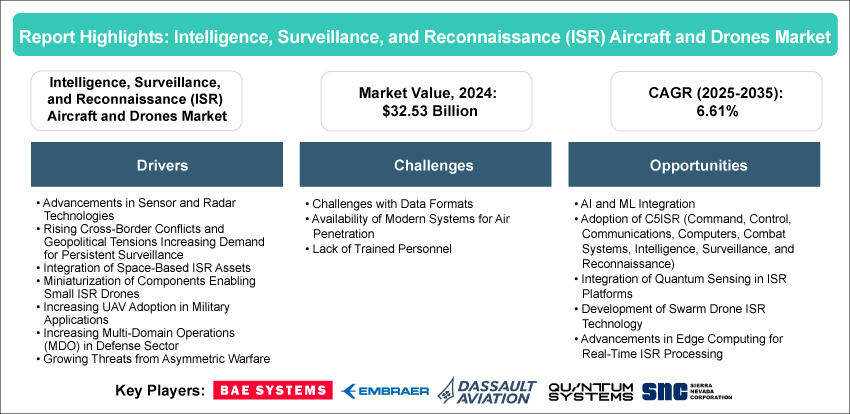
The global intelligence, surveillance, and reconnaissance (ISR) aircraft and drones market was valued at $32.53 billion in 2024 and is projected to reach $65.45 billion by 2035, growing at a CAGR of 6.61%. The market is propelled by advancements in sensor and radar technologies, increasing adoption of AI and machine learning, and rising demand for real-time situational awareness across defense, homeland security, and border monitoring applications. Collaborations between OEMs, technology integrators, and defense agencies are further accelerating innovation in compact, multi-mission ISR platforms, thereby supporting the intelligence, surveillance, and reconnaissance (ISR) aircraft and drones market growth.
Introduction of ISR Aircraft and Drones
ISR aircraft and drones are specialized platforms designed to gather intelligence, perform surveillance, and conduct reconnaissance missions across air, maritime, and land domains. These systems integrate electro-optical/infrared (EO/IR) sensors, radar, signals intelligence (SIGINT), and communications equipment to detect, track, and analyze targets. They are increasingly critical for military operations, border security, disaster management, and maritime patrol, offering persistent situational awareness while minimizing risk to human operators.
Market Introduction
The global intelligence, surveillance, and reconnaissance (ISR) aircraft and drones market has been evolving rapidly due to the convergence of advanced sensors, AI-enabled analytics, and unmanned aerial technologies. Developments in AESA radar, deep sensing, swarm drones, and edge computing are enhancing detection, target identification, and autonomous operations. Rising geopolitical tensions, modernization of armed forces, and strategic defense investments are fueling demand for next-generation ISR solutions capable of operating in contested or denied airspace. These technological advancements are redefining the ISR landscape, enabling more precise, rapid, and cost-effective intelligence collection.
Industrial Impact
The global intelligence, surveillance, and reconnaissance (ISR) aircraft and drones market has a wide-ranging industrial impact across defense manufacturing, technology development, and security operations. Advancements in ISR platforms, including AI-enabled analytics, multi-sensor integration, and autonomous capabilities, drive innovation and enhance operational efficiency for military, homeland security, and border surveillance applications. This growth encourages collaborations between defense OEMs, technology integrators, and research institutions, elevating production standards and fostering R&D in advanced sensors, radar systems, and unmanned aerial technologies. Moreover, increasing investments in ISR solutions contribute to workforce expansion in aerospace engineering, software development, and electronics integration.
Key players operating in the global intelligence, surveillance, and reconnaissance (ISR) aircraft and drones market include Northrop Grumman Corporation, Lockheed Martin Corporation, General Atomics Aeronautical Systems, BAE Systems, L3Harris Technologies, Leonardo S.p.A., Elbit Systems Ltd., Thales Group, Raytheon Technologies Corporation, AeroVironment, Inc., Boeing, Dassault Aviation, Bombardier, and Sierra Nevada Corporation. These companies focus on strategic partnerships, technology collaborations, and acquisitions to expand their ISR capabilities, enhance multi-mission platforms, and strengthen their global market presence.
Market Segmentation:
Segmentation 1: by End-Use Industry
• Reconnaissance and Surveillance
• Electronic Warfare
• Search and Rescue Operations
• Airborne Early Warning Capabilities
• Maritime Support/Patrol
• Tactical Operations
• Target Acquisition
Reconnaissance and Surveillance Segment to Dominate the Global Intelligence, Surveillance, and Reconnaissance (ISR) Aircraft and Drones Market (by End-Use Industry)
The reconnaissance and surveillance segment dominates the global intelligence, surveillance, and reconnaissance (ISR) aircraft and drones market, as they are critical for situational awareness, threat detection, and strategic decision-making. Defense forces and government agencies prioritize aerial ISR for battlefield intelligence, maritime domain awareness, and border monitoring. High-altitude long-endurance (HALE) UAVs and manned ISR aircraft are increasingly equipped with AI-driven analytics, electro-optical/infrared (EO/IR) sensors, and synthetic aperture radar (SAR) to improve target detection and accuracy. For example, in 2024, Northrop Grumman continued Global Hawk contracts to support extended reconnaissance missions.
From a commercial perspective, investments in ISR technologies have surged, with collaborations between defense contractors and technology firms focusing on sensor fusion, AI-based processing, and autonomous operations. For instance, in May 2024, Anduril Industries received U.S. Department of Defense funding to expand its autonomous ISR drone programs with edge computing capabilities, while Elbit Systems partnered with Adani Defense to produce ISR drones for border security. Geopolitical tensions and rising defense budgets in NATO, Indo-Pacific, and Middle Eastern regions are further driving demand for persistent, all-weather ISR solutions. Consequently, the reconnaissance and surveillance segment maintains the largest market share due to its indispensable value in both peacetime operations and conflict scenarios.
Segmentation 2: by Platform
• Military Aircraft
o Fighter Jets
o Special Mission Aircraft
o Missionized Business Jets
o Military Transport Aircraft
• Military Drones
o Medium-Altitude Long Endurance (MALE) Drones
o High-Altitude Long Endurance (HALE) Drones
o Small Drones
o Military Helicopter
Military Aircraft to Dominate the Global Intelligence, Surveillance, and Reconnaissance (ISR) Aircraft and Drones Market (by Platform)
Military aircraft continue to lead the global intelligence, surveillance, and reconnaissance (ISR) aircraft and drones market due to their unmatched endurance, payload capacity, and operational versatility. Platforms such as the Boeing P-8A Poseidon, Lockheed Martin U-2S, and Bombardier Global 6500-based ISR variants provide high-altitude, long-range surveillance with integrated SIGINT, COMINT, and ELINT suites. These aircraft support maritime patrol, battlefield reconnaissance, and strategic intelligence missions. Their ability to host extensive sensor arrays, onboard analysts, and real-time data links makes them critical for multi-domain awareness, particularly in complex regions like the Indo-Pacific and Eastern Europe.
Recent investments underscore this dominance. For instance, in April 2024, the U.S. Navy approved a $1.3 billion extension for additional P-8A Poseidon aircraft. The U.K. RAF upgraded its Rivet Joint fleet with next-generation electronic warfare systems, and India expanded its ISR capabilities by inducting Dassault Falcon 2000 platforms with indigenous sensor payloads. While unmanned ISR drones are growing in popularity due to flexible deployment and lower operational costs, manned platforms remain indispensable for missions requiring secure data handling, crew adaptability, and extended flight durations, especially in contested airspace. All this further drives the demand for intelligence, surveillance, and reconnaissance (ISR) aircraft and drones market over the forecast timeframe from 2025 to 2035.
Segmentation 3: by Component Type
• Surveillance System
o Light Detection and Ranging (LiDAR)
o Electro-Optical/Infrared Sensor (EO/IR Sensors)
o Radar
o Others
• Communication System
o SATCOM
o Antenna
o Datalinks
• Signal Intelligence (SIGINT) System
o Electronic Intelligence (ELINT)
o Communication Intelligence (COMINT)
• Software
o Mission Management
o Threat Detection
• Others
Surveillance System to Lead the Global Intelligence, Surveillance, and Reconnaissance (ISR) Aircraft and Drones Market (by Component Type)
Surveillance systems, encompassing radar, EO/IR sensors, and LiDAR, continue to dominate the global intelligence, surveillance, and reconnaissance (ISR) aircraft and drones market. In 2024, these systems accounted for the largest component share, driven by their critical role in real-time target acquisition, high-resolution imaging, and wide-area situational awareness. Unlike SIGINT modules, communication systems, or software, which often require integration with other platforms, surveillance payloads deliver immediate, mission-critical intelligence from deployment. High-altitude manned aircraft further amplify these capabilities with extended endurance and larger payload capacities, supporting operations such as border security, maritime patrol, and strategic reconnaissance.
Industry players in the intelligence, surveillance, and reconnaissance (ISR) aircraft and drones market are enhancing surveillance systems with next-generation technologies. Boeing, Bombardier, and Embraer are integrating advanced radar, multi-spectral imaging, LiDAR, and synthetic aperture radar to meet evolving defense and homeland security requirements. Concurrently, traditional manned ISR platforms are upgrading EO/IR and radar suites for improved detection and precision. This persistent focus on advanced surveillance capabilities underscores their status as the primary growth driver in the ISR aircraft and drones market, while communication systems, SIGINT platforms, and software remain supportive components.
Segmentation 4: by Support Service
• Simulation
• Active Maintenance
• Data Analytics and Post-Processing
Segmentation 5: by Region
• North America: U.S., Canada, and Mexico
• Europe: Germany, France, U.K., Russia, and Rest-of-Europe
• Asia-Pacific: China, Japan, South Korea, India, Australia, and Rest-of-Asia-Pacific
• Rest-of-the-World: Latin America and the Middle East and Africa
North America is expected to maintain a leading position in the global intelligence, surveillance, and reconnaissance (ISR) aircraft and drones market, holding the largest market share throughout the forecast period. This dominance is supported by the presence of established defense aerospace companies, advanced technological infrastructure, and increasing defense budgets in the U.S. and Canada. Strong government initiatives for modernizing ISR fleets, coupled with ongoing investments in AI-driven sensors, electronic warfare suites, and autonomous drones, are driving demand. Additionally, North America’s leadership in defense R&D and its strategic focus on multi-domain intelligence operations reinforce its market position, while collaborations between defense contractors and technology firms accelerate the deployment of advanced ISR platforms across military and homeland security applications.
Asia-Pacific intelligence, surveillance, and reconnaissance (ISR) aircraft and drones market, emerging as a significant growth region, lags North America in terms of technological maturity and defense spending, though rapid industrialization, rising defense investments, and increasing adoption of UAVs and ISR aircraft in countries like China, India, Japan, and Australia are expected to drive growth in the coming decade.
Demand - Drivers, Limitations, and Opportunities
Market Demand Driver: Advancements in Sensor and Radar Technologies
One of the most significant drivers in the intelligence, surveillance, and reconnaissance (ISR) aircraft and drones market is the rapid progress in sensor and radar systems. Modern radars, including active electronically scanned array (AESA) designs, now offer higher resolution, extended range, and multi-band capabilities, enabling precise target detection and tracking. Electro-optical/infrared (EO/IR) sensors have become lighter and more efficient, delivering sharper imagery from smaller platforms. Companies such as BAE Systems and Elbit Systems have introduced compact AESA radars for unmanned aerial vehicles (UAVs), while L3Harris Technologies launched an ISR suite integrating radar feeds, EO/IR imagery, and signals intelligence into a unified platform. Sensor fusion, software-defined architectures, and modular upgrades are enhancing long-term platform viability and operational efficiency. Military and homeland security stakeholders increasingly recognize the value of real-time situational awareness, driving investment in next-generation ISR sensors and radar technologies.
Market Challenge: Availability of Modern Systems for Air Penetration
A major restraint in the intelligence, surveillance, and reconnaissance (ISR) aircraft and drones market is the limited availability of platforms capable of operating in contested or denied airspace. While many drones and reconnaissance aircraft perform effectively in permissive environments, they often lack stealth features, high-speed capabilities, or advanced electronic countermeasures needed to evade sophisticated air defenses. Legacy ISR platforms may be vulnerable against near-peer adversaries such as China or Russia, and next-generation stealth drones or penetrating ISR jets remain restricted due to classification, export controls, or early-stage development. Programs such as the Northrop Grumman stealth drone projects and the European Future Combat Air System (FCAS) are still in developmental phases, delaying widespread availability. As a result, militaries may rely on retrofitted electronic self-protection suites, which can mitigate but not fully overcome high-threat vulnerabilities, thereby constraining high-end ISR platform adoption and market expansion.
Market Opportunity: AI and ML Integration
Integrating artificial intelligence (AI) and machine learning (ML) into ISR platforms presents a transformative opportunity for the intelligence, surveillance, and reconnaissance (ISR) aircraft and drones market. Advanced algorithms automate image recognition, signal analysis, and target identification, reducing analyst workload and accelerating decision cycles. Leonardo DRS incorporates AI-driven threat detection in full-motion video to flag anomalies, while L3Harris Technologies’ real-time ML processing classifies objects and alerts command centres to unusual activity. AI also enables autonomy, with General Atomics testing “AI co-pilot” functionality for the MQ-9 Reaper and Elbit Systems improving swarm drone reliability. Implementation challenges, including onboard processing requirements and secure data links, are being addressed by companies such as AeroVironment and Raytheon Technologies. AI and ML integration enhances mission effectiveness across tactical drones, maritime patrol aircraft, and large ISR platforms, creating a high-growth segment in the coming decade.
Analyst View
According to Dhrubajyoti Narayan, Principal Analyst at BIS Research, “The global intelligence, surveillance, and reconnaissance (ISR) aircraft and drones market is set for strong growth, driven by advancements in sensors, radar, AI/ML, and edge computing. Rising defense budgets, demand for real-time situational awareness, and adoption of C5ISR and quantum sensing are fuelling investments across manned and unmanned ISR platforms. Key players, including L3Harris Technologies, General Atomics, Elbit Systems, and Raytheon Technologies, focus on sensor fusion, software-defined architectures, and AI-enabled processing to enhance mission effectiveness and platform longevity. While stealth ISR aircraft remain limited, retrofitted and upgraded systems continue to expand market opportunities worldwide.”
Intelligence, Surveillance, and Reconnaissance (ISR) Aircraft and Drones Market - A Global and Regional Analysis
Focus on End-Use Industry, Platform, Component, and Country-Level Analysis - Analysis and Forecast, 2025-2035
Frequently Asked Questions
Intelligence, surveillance, and reconnaissance (ISR) aircraft and drones are specialized platforms designed to collect real-time intelligence through aerial monitoring, data acquisition, and persistent situational awareness. These systems leverage advanced sensors, high-resolution imaging, signal intelligence (SIGINT), radar, and communications payloads to support military, homeland security, border surveillance, disaster response, and critical infrastructure monitoring. With rising defence modernization, increased geopolitical tensions, and rapid advancements in autonomous systems and AI-driven analytics, ISR aircraft and drones have become essential for mission planning, threat detection, and strategic decision-making across air, land, and maritime domains.
Significant opportunities include the integration of artificial intelligence (AI) and machine learning (ML) for autonomous decision-making, widespread adoption of C5ISR frameworks, the emergence of quantum-enabled sensing technologies, the development of swarm-drone ISR capabilities, and advancements in edge computing for real-time on-platform processing. These innovations are driving next-generation ISR modernization across defense, homeland security, and commercial sectors.
Leading companies are adopting collaborative strategies, including joint ventures, technology partnerships, and multi-domain integration programs to enhance payload performance, expand operational ranges, and accelerate AI-enabled mission capabilities. Strategic alliances with defense ministries, aerospace OEMs, and sensor technology providers help companies access new markets, enhance platform interoperability, and secure long-term modernization contracts.
New entrants in the intelligence, surveillance, and reconnaissance (ISR) aircraft and drones market should prioritize partnerships with established ISR platform manufacturers, focus on developing advanced sensor payloads, AI-enabled analytics, secure communication systems, and niche ISR capabilities such as swarm autonomy or edge-processing modules. Additionally, securing funding for R&D, building strong integration capabilities, and establishing robust distribution and after-sales networks will help maintain competitiveness.
The following are some of the USPs of the intelligence, surveillance, and reconnaissance (ISR) aircraft and drones market report:
• A dedicated section analyzing trends adopted by leading ISR aircraft and drone manufacturers
• Comprehensive competitive landscape mapping of the global ISR ecosystem
• Detailed qualitative and quantitative insights at regional and country levels, with segmentation by platform, application, and payload type
• In-depth supply chain and value chain analysis
• Exclusive defense budget analysis for each country covered in the scope, supporting procurement forecasting and capability-development assessments
The intelligence, surveillance, and reconnaissance (ISR) aircraft and drones market report is highly valuable for ISR aircraft and drone manufacturers, defense contractors, payload and sensor suppliers, aerospace OEMs, national defense agencies, border-security authorities, system integrators, and investors evaluating opportunities in next-generation ISR technologies.
