
A quick peek into the report
Virtual Power Plant Market Overview
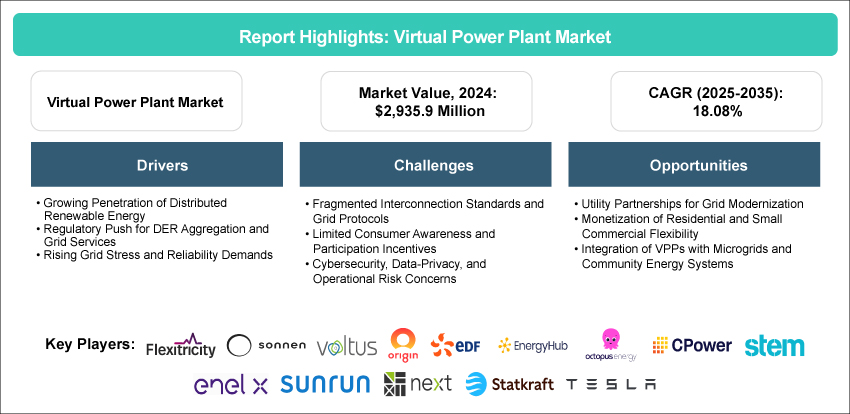
The global virtual power plant (VPP) market is projected to grow from $3,407.7 million in 2025 to $17,950.2 million by 2035, reflecting a strong CAGR of 18.08%. Growth is being driven by the rapid expansion of distributed energy resources (DERs), increasing reliance on software-enabled grid flexibility, and rising grid reliability challenges linked to renewable variability and electrification. As utilities face mounting pressure to defer costly infrastructure upgrades, VPPs offer a scalable, fast-deployable alternative that aggregates rooftop solar, battery storage, EV chargers, smart appliances, and industrial loads into dispatchable capacity.
Distributed generation is expected to dominate the technology segment, followed by demand response and mixed-asset VPPs, as behind-the-meter solar and storage installations accelerate worldwide. Key challenges include fragmented regulatory frameworks, cybersecurity concerns, limited smart-meter penetration, and low customer awareness in emerging markets. With rising grid stress, supportive policies, and major deployments led by utilities, aggregators, and technology providers, the VPP market is positioned for robust expansion, becoming an essential component of modern, flexible, and decarbonized power systems.
Market Introduction
The study conducted by BIS Research identifies the virtual power plant (VPP) market as a pivotal enabler of modern, decentralized, and digitally orchestrated power systems. VPPs are rapidly evolving into multifunctional grid assets capable of delivering real-time flexibility, demand-side optimization, and aggregated capacity across residential, commercial, and industrial customer segments. These systems are increasingly essential in supporting grid stability and reliability, particularly amid rising renewable penetration, growing electrification of transport and buildings, and the heightened frequency of grid stress events.
With advancements in DER orchestration software, AI-driven forecasting, IoT-enabled device connectivity, and automated demand response, VPPs are becoming more autonomous, scalable, and responsive. Their modular and software-defined architecture allows for rapid configuration around diverse asset portfolios, whether battery storage fleets, rooftop solar networks, EV chargers, smart appliances, or industrial loads, unlocking new value streams for grid operators and prosumers alike. As power systems shift toward flexibility-led, distributed, and data-driven operations, VPPs offer a competitive advantage through faster dispatch, improved visibility of behind-the-meter assets, and actionable grid intelligence.
The market is expected to witness robust expansion in the coming years, fueled by increasing renewable deployment, regulatory reforms enabling DER aggregation, rising grid modernization investments, and accelerating adoption of distributed energy resources worldwide.
Industrial Impact
The virtual power plant (VPP) market is having a profound industrial impact, reshaping the power, energy, and utility sectors through rapid advancements in digital orchestration, distributed energy resource (DER) integration, and real-time grid intelligence. VPP platforms, aggregating assets such as rooftop solar, battery storage, EV chargers, smart appliances, and flexible industrial loads, enable dynamic grid balancing, peak-shaving, and dispatchable capacity, significantly enhancing system reliability and operational efficiency across residential, commercial, and industrial domains.
The integration of next-generation IoT controls, AI-driven forecasting, and automated demand response is driving increased demand for modular, scalable, and software-enabled VPP architectures. These advancements are improving grid flexibility, reducing reliance on costly infrastructure upgrades, and enabling coordinated multi-asset operations in increasingly complex, renewable-heavy grid environments. Additionally, the deployment of VPP capabilities across microgrids, utility programs, and community energy systems is fostering collaboration between utilities, technology vendors, DER manufacturers, and energy retailers.
As nations prioritize grid modernization, decarbonization, and digital transformation, the VPP market is expected to play a pivotal role in enabling more resilient, efficient, and data-driven power systems. The industrial ecosystem surrounding VPPs is also evolving rapidly, with strong policy support, rising DER adoption, and growing investment in AI-enabled energy management pushing innovation forward, cementing VPPs as a cornerstone of next-generation electricity networks.
Market Segmentation:
Segmentation 1: by End User
• Industrial
• Commercial
• Residential
Industrial Segment to Dominate the Virtual Power Plant Market (by End User)
In the virtual power plant (VPP) market, the industrial segment is projected to dominate by end user, driven by the substantial flexibility and controllable capacity that industrial facilities can provide to grid operators. Industrial sites, such as manufacturing plants, data centers, refineries, chemical facilities, and large processing units, offer the most impactful load-shifting potential, making them the cornerstone of VPP aggregation strategies. This segment benefits from extensive access to distributed generation assets, including combined heat and power (CHP) units, onsite solar, backup generators, and high-load processes that can be strategically modulated to support grid stability and peak demand management.
Meanwhile, the commercial segment is anticipated to be one of the fastest-growing end-user groups, reflecting the rising adoption of building energy management systems, automated demand response, and behind-the-meter batteries across retail chains, office complexes, logistics centers, and institutional buildings. As commercial facilities become increasingly digitized and interconnected, they represent a scalable and rapidly deployable source of grid flexibility, particularly during peak-load events.
Following closely, the residential segment is expected to witness significant expansion, fueled by the accelerating deployment of rooftop solar, smart thermostats, home batteries, smart water heaters, and EV charging infrastructure. Residential assets, once aggregated in large numbers, create sizable and highly responsive VPP capacity, with software-enabled automation playing a central role in coordination.
Together, these end-user segments are shaping the future of virtual power plants, driving a shift toward more distributed, intelligent, and customer-centric grid resources that enhance resilience, reduce operational costs, and support high renewable penetration.
Segmentation 2: by Technology
• Distribution Generation
• Demand Response
• Mixed Asset
Distribution Generation to Maintain Dominance in the Virtual Power Plant Market (by Technology)
According to recent market data, distribution generation is projected to remain the dominant technology segment in the global virtual power plant (VPP) market, maintaining the largest share through 2035. Valued at $1,455.3 million in 2025, the segment is expected to reach $8,238.2 million by 2035, growing at a CAGR of 17.24%. This sustained leadership has been driven by the rapid deployment of decentralized energy assets, such as rooftop solar, small-scale wind, micro-turbines, and combined heat and power (CHP) units, that form the core generation layer for VPP aggregation. Their ability to deliver flexible, localized capacity makes distribution generation critical for peak shaving, frequency support, and overall grid stability.
Distribution generation remains the preferred VPP technology across North America, Europe, and Asia-Pacific, where renewable energy mandates and decarbonization policies continue to accelerate DER adoption. These assets offer predictable output, strong compatibility with VPP management systems, and diversified service capabilities, cementing their leading role in market expansion.
In contrast, the demand response (DR) segment, currently smaller at $1,029 million in 2025, is projected to grow rapidly at a CAGR of 18.58%, reaching $6,603 million by 2035. Growth is fueled by expanding smart-meter penetration, dynamic tariff programs, automated load-control technologies, and increasing utility reliance on flexible consumption resources to balance variable renewable energy.
The mixed-asset VPP segment, valued at $451.4 million in 2025, is also expected to rise significantly to $3,109 million by 2035, at a CAGR of 19.41%. This segment integrates distribution generation, demand response, and energy storage into a single controllable portfolio, enabling enhanced flexibility, broader service offerings, and stronger revenue stacking potential for aggregators and utilities.
While DR and mixed-asset solutions will drive future innovation and grid modernization, distribution generation is expected to remain the highest-value segment, supported by accelerated renewable deployment, falling rooftop solar costs, and policies incentivizing grid-edge generation. Its foundational role in shaping virtual power plant architectures ensures continued dominance through the forecast period.
Segmentation 3: by Source
• Renewable Energy
• Energy Storage Systems
• Cogeneration
Segmentation 4: by Region
• North America: U.S. and Canada
• Europe: Germany, France, U.K., Italy, and Rest-of-Europe
• Asia-Pacific: China, Japan, South Korea, India, Australia, and Rest-of-Asia-Pacific
• Rest-of-the-World: Latin America and the Middle East and Africa
North America is expected to maintain its dominant position in the global virtual power plant (VPP) market, holding the highest market value throughout the forecast period. The regional market is projected to grow from $1,578.3 million in 2025 to $5,685.7 million by 2035, registering a robust CAGR of 13.67%. This leadership is driven by deep DER penetration, strong federal and state decarbonization mandates, and widespread deployment of distributed generation, behind-the-meter battery storage, EV chargers, and advanced demand response platforms.
Mature wholesale markets (PJM, CAISO, ERCOT), combined with enabling regulatory frameworks such as FERC Order 2222, allow aggregated DERs to participate in capacity, energy, and ancillary service markets, directly accelerating VPP adoption. Utility investments in grid modernization, AMI rollouts, and flexible load programs further reinforce North America’s role as the most advanced VPP ecosystem globally.
The Asia-Pacific region is projected to be the fastest-growing market for VPPs, expanding from $392.1 million in 2025 to $6,409.5 million by 2035, at an exceptional CAGR of 32.23%. Growth is fueled by large-scale renewable energy additions in China, Japan, South Korea, India, and Australia, coupled with strong government initiatives promoting decentralized energy and grid digitalization.
Rapid increases in electricity demand, nationwide AMI deployments, and the scaling of pilot VPPs into commercial operations, particularly in Japan and Australia, are further accelerating adoption. APAC’s aggressive push toward flexible markets, consumer-side energy participation, and battery storage deployment positions it as the fastest-advancing and most transformative VPP region globally.
The Rest-of-the-World (RoW), including Latin America and the Middle East and Africa, is expected to grow from $49.2 million in 2025 to $486.2 million by 2035, at a high CAGR of 25.74%. Although starting from a smaller base, market expansion is supported by rising solar PV adoption in the Gulf states, emerging microgrid programs in Africa, and increasing interest in VPP frameworks to support remote communities and improve grid resiliency.
Countries exploring digitalized grid solutions and behind-the-meter storage for peak reduction are accelerating VPP adoption, especially in regions facing reliability challenges, weak distribution networks, and high dependence on diesel-based backup systems.
Europe remains one of the most mature and stable VPP markets globally, with the market expected to grow from $1,388.0 million in 2025 to $5,368.8 million by 2035, at a steady CAGR of 14.48%. Growth is driven by advanced EU energy policies promoting flexibility services, strong renewable energy penetration, and rapid adoption of residential and commercial DERs.
Countries such as Germany, the U.K., the Netherlands, and Spain are expanding VPP operations through new balancing markets, grid flexibility programs, and large-scale aggregation of heat pumps, EV chargers, and stationary storage. Europe’s supportive regulatory environment, widespread AMI deployment, and ongoing digital grid modernization reinforce its position as a highly developed and innovation-driven VPP region.
Demand: Drivers, Limitations, and Opportunities
Market Demand Drivers: Rising Need for Flexible, Distributed Grid Capabilities
The virtual power plant (VPP) market has been experiencing strong demand growth, driven by rapid energy decentralization, rising renewable penetration, and increasing pressure on grids to manage variability and peak demand. One of the primary demand drivers is the large-scale deployment of behind-the-meter resources, such as rooftop solar, battery storage, EV chargers, smart appliances, HVAC systems, and flexible industrial loads, which provide a scalable pool of dispatchable capacity when aggregated through VPP platforms.
Growing grid instability, exacerbated by extreme weather events, rising electrification, and aging distribution networks, has intensified the need for flexible demand-side resources. Utilities and grid operators are increasingly adopting VPPs to avoid costly peaker plants and defer transmission and distribution upgrades, while still ensuring reliability during peak-load events and supply shortages.
Regulatory support is also strengthening demand. In several markets, reforms that enable DER aggregation, dynamic pricing, and participation of distributed resources in ancillary services are accelerating VPP adoption. As more regions deploy advanced metering infrastructure (AMI) and digital control systems, the ability to orchestrate multi-asset, multi-sector distributed resources is expanding rapidly. The rising adoption of battery storage, demand response programs, EV smart charging, and smart home devices further contributes to the growing pool of flexible assets, positioning VPPs as a critical solution for improving grid resilience, optimizing renewable integration, and enabling a more decentralized energy ecosystem.
Market Challenges: Interoperability Gaps, Regulatory Constraints, and Infrastructure Limitations
The virtual power plant market faces several structural and operational challenges that could limit its scale and commercial viability. A major barrier is the lack of standardized communication protocols and data interoperability across heterogeneous DER devices, which complicates real-time coordination, forecasting accuracy, and reliable dispatch. This fragmentation is further intensified by the wide variety of OEM ecosystems, limiting seamless aggregation across different brands of batteries, EV chargers, and home energy devices.
Regulatory constraints remain another significant hurdle. In many markets, outdated grid codes, unclear rules for DER participation, and limited compensation mechanisms for flexibility services restrict VPP participation in wholesale markets or ancillary service programs. Capacity market rules, interconnection queues, and restrictions on behind-the-meter bidirectional flows further slow deployment.
Infrastructure challenges compound these issues. Limited smart-meter rollout, weak distribution-grid visibility, and insufficient grid digitalization reduce the ability of utilities to validate DER performance or provide accurate pricing signals. High upfront costs of behind-the-meter battery systems, low consumer awareness, and cultural reluctance toward utility control of household devices also dampen participation in residential aggregation programs.
In emerging economies, weak distribution infrastructure, limited financing options, and reliance on subsidized electricity tariffs reduce the economic incentives for VPP adoption. Supply chain constraints for inverters, batteries, and grid-management hardware further delay deployments. Collectively, these challenges highlight the need for stronger regulatory alignment, improved digital infrastructure, and standardized interoperability frameworks to scale VPP operations globally.
Market Opportunities: Remote and Off-Grid Energy Solutions
The growing need for grid resilience and clean energy integration is creating strong opportunities for VPP expansion worldwide. As renewable generation scales, VPPs offer a cost-effective pathway to integrate solar and wind without curtailment by dynamically shifting or storing excess generation. The ability to aggregate distributed batteries, EVs, and controllable loads enables VPPs to provide capacity services, frequency regulation, and peak-shaving functions traditionally provided by centralized power plants.
Rising electrification of transport and heating is unlocking new flexible demand sources. EV smart charging, vehicle-to-grid (V2G) services, electric heat pumps, and commercial building automation provide large, dispatchable load pools that can be orchestrated to reduce grid stress. In industrial facilities, flexible motors, cold storage systems, and process loads create substantial potential for high-value VPP participation in ancillary services markets. Emerging markets present additional opportunities. Regions with weak or remote grids, such as rural Africa, island nations, and remote industrial clusters, may use VPPs to enhance reliability while avoiding costly grid extensions. Donor-supported programs and pilot VPPs in these regions also demonstrate strong potential for hybrid microgrids powered by distributed renewable assets.
Advancements in AI-driven forecasting, real-time optimization platforms, IoT-enabled device control, and blockchain-based settlement are further enhancing the commercial viability of VPPs. As more regions activate flexibility markets and implement dynamic pricing, VPP operators can unlock new revenue streams for both utilities and end users, making VPPs a cornerstone of future distributed, decarbonized energy systems.
Analyst View
According to Dhrubajyoti Narayan, Principal Analyst at BIS Research, “The virtual power plant (VPP) market is positioned for sustained and accelerated growth, driven by the rising need for grid flexibility, rapid expansion of distributed energy resources (DERs), and increasing policy momentum toward decarbonization. Key players in the sector are expanding their operational footprint through large-scale aggregation partnerships, new technology deployments, and deeper utility collaboration across major markets. Notable developments include the multi-thousand-home VPP expansions in the U.S. and Australia, Japan’s commercial-scale aggregation programs, and Europe’s accelerated flexibility market rollouts, each strengthening the global VPP ecosystem.
Strategic alliances are becoming central to competitive differentiation, as aggregators, utilities, EV charging companies, and battery manufacturers increasingly collaborate to unlock scalable consumer and industrial participation. Examples include utility-aggregator partnerships for residential battery orchestration, EV smart-charging integration with grid operators, and large industrial demand-response portfolios designed to support frequency regulation and peak-load management.
While mergers, acquisitions, and new platform innovations are selective, they remain highly targeted and impactful. Advances in AI-driven forecasting, device-level orchestration, and grid-aware optimization are enabling more resilient, autonomous, and commercially viable VPP architectures. Meanwhile, regulatory shifts, such as market reforms enabling DER access to capacity and ancillary service markets, are accelerating monetization pathways globally. As these trends converge, the VPP market is evolving into a highly integrated, software-driven grid resource, offering compelling opportunities for both established energy providers and new technology entrants.”
Virtual Power Plant Market - A Global and Regional Analysis
Focus on Application, Product, and Regional Analysis - Analysis and Forecast, 2025-2035
Frequently Asked Questions
The virtual power plant market focuses on digitally aggregating distributed energy resources (DERs) such as rooftop solar, battery storage, EV chargers, smart appliances, and flexible industrial loads to operate as a unified power plant.
Core VPP technologies include:
• Distributed energy resource management systems (DERMS)
• AI-based forecasting and optimization engines
• IoT-connected smart meters and sensors
• Blockchain for peer-to-peer energy transactions
• Demand response automation
• Grid orchestration platforms
These technologies enable real-time coordination of DERs to deliver flexibility, enhance grid stability, reduce peak demand, and optimize energy market participation.
A diverse mix of energy technology providers, utilities, and digital platform companies leads the VPP ecosystem:
• Energy technology firms such as Tesla, Siemens, Schneider Electric, General Electric, ABB, and Wärtsilä.
• VPP platform providers, including AutoGrid, Next Kraftwerke, Enbala, and EnergyHub.
• Utilities like Enel X, EDF, AES, and Duke Energy are deploying large-scale VPP programs.
• Software and AI innovators (e.g., Octopus Energy, Stem Inc., and Fluence) are enabling flexible load control and advanced DER aggregation.
These organizations are accelerating global VPP deployment through grid modernization, market innovation, and large-scale DER integration.
The VPP market is expanding rapidly due to:
1. Rising penetration of distributed renewables, such as solar PV and wind, requires flexible balancing resources.
2. Grid modernization goals and the shift toward decentralized energy systems.
3. Regulatory support, including FERC Order 2222 in the U.S. and flexibility market reforms in Europe.
4. Surging adoption of electric vehicles and batteries is creating controllable load and storage assets for VPP aggregation.
5. Economic benefits, as VPPs reduce grid congestion, defer infrastructure upgrades, and create new revenue streams for consumers and aggregators.
These drivers position VPPs at the center of the global clean energy transition.
Several obstacles remain:
• Regulatory inconsistencies across regions limit DER participation in wholesale markets.
• Complexity of DER integration, especially with legacy grid infrastructure.
• Cybersecurity risks are a concern as VPPs rely heavily on digital connectivity.
• Data interoperability challenges among heterogeneous DER devices.
• Consumer adoption barriers include limited awareness of VPP benefits and varying incentive structures.
Addressing these challenges requires harmonized policies, secure communication systems, and robust standardization.
Key advances include:
• AI-based load forecasting and real-time optimization
• IoT-enabled DER connectivity
• Smart inverters and advanced metering infrastructure (AMI)
• Blockchain for decentralized energy trading
• Bidirectional EV charging and vehicle-to-grid (V2G) systems
• Battery storage digital twins
These innovations improve VPP responsiveness, scalability, and economic performance.
VPPs play a central role in clean energy strategies by:
• Enabling higher renewable energy penetration
• Reducing dependence on fossil-based peaker plants
• Providing frequency regulation, voltage support, and spinning reserve
• Managing peak loads through automated demand response
• Supporting grid reliability during outages or extreme weather
By orchestrating thousands of DERs, VPPs offer clean, flexible, and cost-effective grid services.
The virtual power plant market is projected to grow strongly, reaching $17.95 billion by 2035, driven by global decarbonization efforts, DER proliferation, and supportive energy market reforms.
This report is valuable for:
• Utilities and grid operators
• DER hardware manufacturers
• Battery and EV charging companies
• VPP platform and software developers
• ESCOs and demand response aggregators
• Policymakers, regulators, and energy planners
• Venture investors and clean-tech strategists
It provides insights into market opportunities, use cases, technology landscapes, and competitive dynamics shaping the future of decentralized energy systems.