A quick peek into the report
Table of Contents
1.1 Market Overview
1.1.1 Market Overview
1.1.2 Global biobanking Market, $Million, 2024-2035
1.2 Market Trends
1.2.1 Impact Analysis
1.2.2 Advent of Multi-omic Biobanks
1.2.3 Integration of AI in Biobanking
1.3 Regulatory Landscape
1.3.1 U.S.
1.3.1.1 Regulatory Requirements for Equipment Products Intended as Medical Devices
1.3.2 Europe
1.3.2.1 Regulatory Requirements for Equipment Products Intended as Medical Devices
1.3.3 Asia-Pacific
1.3.3.1 Japan
1.3.3.1.1 Regulatory Requirements for Equipment Products Intended as Medical Devices
1.3.3.2 China
1.3.3.2.1 Regulatory Requirements for Equipment Products Intended as Medical Devices
1.4 Market Dynamics
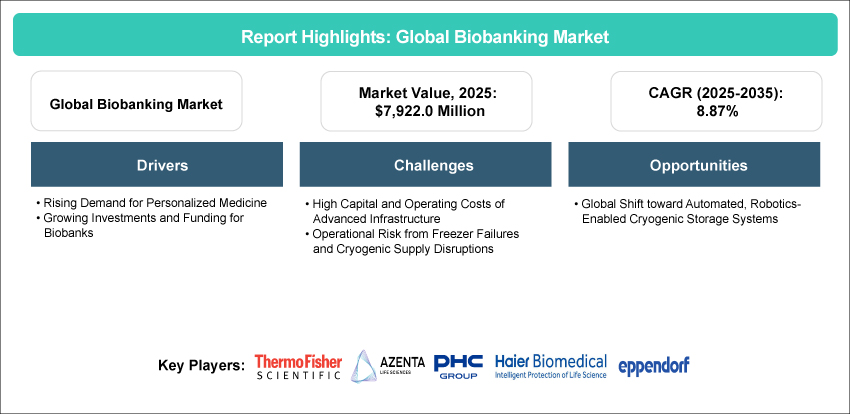
1.4.1 Drivers, Challenges, and Opportunities: Current and Future Impact Assessment
1.4.2 Market Drivers
1.4.2.1 Rising Demand for Personalized Medicine
1.4.2.2 Growing Investments and Funding for Biobanks
1.4.3 Market Challenges
1.4.3.1 High Capital and Operating Costs of Advanced Infrastructure
1.4.3.2 Operational Risk from Freezer Failures and Cryogenic Supply Disruptions
1.4.4 Market Opportunities
1.4.4.1 Global Shift toward Automated, Robotics-Enabled Cryogenic Storage Systems
2.1 Overview
2.1.1 Physical Biobanks
2.1.2 Virtual Biobanks
3.1 Overview
3.1.1 Equipment
3.1.1.1 Storage Equipment
3.1.1.2 Sample Analysis Equipment
3.1.1.3 Sample Processing Equipment
3.1.1.4 Sample Transport Equipment
3.1.2 Consumables
3.1.2.1 Storage Consumables
3.1.2.2 Analysis Consumables
3.1.2.3 Processing Consumables
3.1.2.4 Collection Consumables
3.1.3 Services
3.1.3.1 Storage Services
3.1.3.2 Processing Services
3.1.3.3 Transport Services
3.1.3.4 Supply Services
3.1.4 Software
4.1 Overview
4.1.1 Manual Storage
4.1.2 Automated Storage
5.1 Overview
5.1.1 Blood Products
5.1.2 Solid Tissues & Organs
5.1.3 Cell Lines
5.1.4 Nucleic Acids
5.1.5 Biological Fluids
5.1.6 Human Waste Products
6.1 Overview
6.1.1 Academic and Research Institutions
6.1.2 National/ Regional Agencies
6.1.3 Hybrid / Public–Private Partnership (PPP) Biobanks
6.1.4 Private/Commercial Biobanks
6.1.5 Other Ownership Models
7.1 Overview
7.1.1 Tissue Biobanks
7.1.2 Population-Based Biobanks
7.1.3 Genetic (DNA/RNA)
7.1.4 Disease-Based Biobanks
8.1 Overview
8.1.1 Regenerative Medicine
8.1.2 Life Science Research
8.1.3 Clinical Research
8.1.4 Others
9.1 Overview
9.1.1 Pharmaceutical and Biotechnology Companies and CROs
9.1.2 Academic and Research Institutes
9.1.3 Hospitals
9.1.4 Personal Biobanking Customers (B2C)
10.1 Regional Summary
10.2 North America
10.2.1 Regional Overview
10.2.2 Driving Factors for Market Growth
10.2.3 Factors Challenging the Market
10.2.4 Market Sizing and Forecast
10.2.5 U.S.
10.2.5.1 Country Overview
10.2.5.2 Market Sizing and Forecast
10.2.6 Canada
10.2.6.1 Country Overview
10.2.6.2 Market Sizing and Forecast
10.3 Europe
10.3.1 Regional Overview
10.3.2 Driving Factors for Market Growth
10.3.3 Factors Challenging the Market
10.3.4 Market Sizing and Forecast
10.3.5 U.K.
10.3.5.1 Country Overview
10.3.5.2 Market Sizing and Forecast
10.3.6 Germany
10.3.6.1 Country Overview
10.3.6.2 Market Sizing and Forecast
10.3.7 France
10.3.7.1 Country Overview
10.3.7.2 Market Sizing and Forecast
10.3.8 Italy
10.3.8.1 Country Overview
10.3.8.2 Market Sizing and Forecast
10.3.9 Spain
10.3.9.1 Country Overview
10.3.9.2 Market Sizing and Forecast
10.3.10 Rest-of-the- Europe
10.3.10.1 Country Overview
10.3.10.2 Market Sizing and Forecast
10.4 Asia Pacific
10.4.1 Regional Overview
10.4.2 Driving Factors for Market Growth
10.4.3 Factors Challenging the Market
10.4.4 Market Sizing and Forecast
10.4.5 China
10.4.5.1 Country Overview
10.4.5.2 Market Sizing and Forecast
10.4.6 Japan
10.4.6.1 Country Overview
10.4.6.2 Market Sizing and Forecast
10.4.7 India
10.4.7.1 Country Overview
10.4.7.2 Market Sizing and Forecast
10.4.8 Australia
10.4.8.1 Country Overview
10.4.8.2 Market Sizing and Forecast
10.4.9 Rest-of-the-Asia Pacific
10.4.9.1 Country Overview
10.4.9.2 Market Sizing and Forecast
10.5 Rest-of-the-World
10.5.1 Regional Overview
10.5.2 Driving Factors for Market Growth
10.5.3 Factors Challenging the Market
10.5.4 Market Sizing and Forecast
11.1 Key Strategies and Developments, 2023-2025
11.2 Key Developments Analysis (by Company), 2025
11.3 Company Profiles
11.3.1 BECTON, DICKINSON AND COMPANY
11.3.1.1 Overview
11.3.1.2 Top Products/Product Portfolio
11.3.1.3 Top Competitors
11.3.1.4 Target Customers
11.3.1.5 Key Personal
11.3.1.6 Analyst View
11.3.2 Thermo fisher Scientific Inc.
11.3.2.1 Overview
11.3.2.2 Top Products/Product Portfolio
11.3.2.3 Top Competitors
11.3.2.4 Target Customers
11.3.2.5 Key Personal
11.3.2.6 Analyst View
11.3.3 QIAGEN N.V.
11.3.3.1 Overview
11.3.3.2 Top Products/Product Portfolio
11.3.3.3 Top Competitors
11.3.3.4 Target Customers
11.3.3.5 Key Personal
11.3.3.6 Analyst View
11.3.4 Azenta,Inc.
11.3.4.1 Overview
11.3.4.2 Top Products/Product Portfolio
11.3.4.3 Top Competitors
11.3.4.4 Target Customers
11.3.4.5 Key Personal
11.3.4.6 Analyst View
11.3.5 Merck KGaA
11.3.5.1 Overview
11.3.5.2 Top Products/Product Portfolio
11.3.5.3 Top Competitors
11.3.5.4 Target Customers
11.3.5.5 Key Personal
11.3.5.6 Analyst View
11.3.6 Cryoport Systems, LLC
11.3.6.1 Overview
11.3.6.2 Top Products/Product Portfolio
11.3.6.3 Top Competitors
11.3.6.4 Target Customers
11.3.6.5 Key Personal
11.3.6.6 Analyst View
11.3.7 Danaher Corporation (Cytiva)
11.3.7.1 Overview
11.3.7.2 Top Products/Product Portfolio
11.3.7.3 Top Competitors
11.3.7.4 Target Customers
11.3.7.5 Key Personal
11.3.7.6 Analyst View
11.3.8 PHC Corporation
11.3.8.1 Overview
11.3.8.2 Top Products/Product Portfolio
11.3.8.3 Top Competitors
11.3.8.4 Target Customers
11.3.8.5 Key Personal
11.3.8.6 Analyst View
11.3.9 Avantor,Inc.
11.3.9.1 Overview
11.3.9.2 Top Products/Product Portfolio
11.3.9.3 Top Competitors
11.3.9.4 Target Customers
11.3.9.5 Key Personal
11.3.9.6 Analyst View
11.3.10 Eppendorf SE
11.3.10.1 Overview
11.3.10.2 Top Products/Product Portfolio
11.3.10.3 Top Competitors
11.3.10.4 Target Customers
11.3.10.5 Key Personal
11.3.10.6 Analyst View
11.3.11 Tecan Trading AG
11.3.11.1 Overview
11.3.11.2 Top Products/Product Portfolio
11.3.11.3 Top Competitors
11.3.11.4 Target Customers
11.3.11.5 Key Personal
11.3.11.6 Analyst View
11.3.12 Grenier AG
11.3.12.1 Overview
11.3.12.2 Top Products/Product Portfolio
11.3.12.3 Top Competitors
11.3.12.4 Target Customers
11.3.12.5 Key Personal
11.3.12.6 Analyst View
11.3.13 Esco Micro Pte.Ltd
11.3.13.1 Overview
11.3.13.2 Top Products/Product Portfolio
11.3.13.3 Top Competitors
11.3.13.4 Target Customers
11.3.13.5 Key Personal
11.3.13.6 Analyst View
11.3.14 Hamilton Company
11.3.14.1 Overview
11.3.14.2 Top Products/Product Portfolio
11.3.14.3 Top Competitors
11.3.14.4 Target Customers
11.3.14.5 Key Personal
11.3.14.6 Analyst View
11.3.15 IC Biomedical, LLC
11.3.15.1 Overview
11.3.15.2 Top Products/Product Portfolio
11.3.15.3 Top Competitors
11.3.15.4 Target Customers
11.3.15.5 Key Personal
11.3.15.6 Analyst View
12.1 Data Sources
12.1.1 Primary Data Sources
12.1.2 Secondary Data Sources
12.1.3 Inclusion and Exclusion
12.1.4 Data Triangulation
12.2 Market Estimation and Forecast
Table 1: Market Snapshot
Table 2: Global Biobanking Market (by Region), $Million, 2024-2035
Table 3: Key Strategies and Developments, 2025
Figure 1: Global Biobanking Market (by Scenario), $Million, 2024, 2025, and 2035
Figure 2: Global Biobanking Market, 2024 and 2035
Figure 3: Global Biobanking Market (by Country), $Million, 2024
Figure 4: Global Biobanking Market Snapshot
Figure 5: Global Biobanking Market, $Million, 2024 and 2035
Figure 6: Biobanking Market (by Product and Services), $Million, 2024, 2028, and 2035
Figure 7: Biobank Market (by Operating Model), $Million, 2024, 2028, and 2035
Figure 8: Biobanking Market (by Storage Type), $Million, 2024, 2028, and 2035
Figure 9: Biobanking Market (by Sample Type), $Million, 2024, 2028, and 2035
Figure 10: Biobanking Market (by Ownership), $Million, 2024, 2028, and 2035
Figure 11: Biobanking Market (by Biobank Type), $Million, 2024, 2028, and 2035
Figure 12: Biobanking Market (by Application), $Million, 2024, 2028, and 2035
Figure 13: Biobanking Market (by End User), $Million, 2024, 2028, and 2035
Figure 14: Biobanking Market Segmentation
Figure 15: Global biobanking Market, $Million, 2024-2035
Figure 16: Application of AI in Biobanking
Figure 17: Global Biobanking Market (by Operating Model), $Million, 2024, 2028, and 2035
Figure 18: Global Biobanking Market (Physical Biobanks), $ Million, 2024-2035
Figure 19: Global Biobanking Market (Virtual Biobanks), $Million, 2024-2035
Figure 20: Global Biobanking Market (by Product and Service), $Million, 2024, 2028, and 2035
Figure 21: Global Biobanking Market (by Equipment), $Million, 2024-2035
Figure 22: Global Biobanking Market (Storage Equipment), $Million, 2024-2035
Figure 23: Global Biobanking Market (Sample Analysis Equipment), $Million, 2024-2035
Figure 24: Global Biobanking Market (Sample Processing Equipment), $Million, 2024-2035
Figure 25: Global Biobanking Market (Sample Transport Equipment), $Million, 2024-2035
Figure 26: Global Biobanking Market (by Consumables), $Million, 2024-2035
Figure 27: Global Biobanking Market (Storage Consumables),$Million, 2024-2035
Figure 28: Global Biobanking Market (Analysis Consumables), $Million, 2024-2035
Figure 29: Global Biobanking Market (Processing Consumables), $Million, 2024-2035
Figure 30: Global Biobanking Market (Collection Consumables), $Million, 2024-2035
Figure 31: Global Biobanking Market (by Services), $Million, 2024-2035
Figure 32: Global Biobanking Market (Storage Services),$Million, 2024-2035
Figure 33: Global Biobanking Market (Processing Services), $Million, 2024-2035
Figure 34: Global Biobanking Market (Transport Services), $Million, 2024-2035
Figure 35: Global Biobanking Market (Supply Services), $Million, 2024-2035
Figure 36: Global Biobanking Market (by Software), $Million, 2024-2035
Figure 37: Global Biobanking Market (by Storage Type), $Million, 2024, 2028, and 2035
Figure 38: Global Biobanking Market (Manual Storage), $Million, 2024-2035
Figure 39: Global Biobanking Market (Automated Storage), $Million, 2024-2035
Figure 40: Global Biobanking Market (by Sample Type), $Million, 2024, 2028, and 2035
Figure 41: Global Biobanking Market (Blood Products), $ Million, 2024-2035
Figure 42: Global Biobanking Market (Solid Tissues & Organs), $Million, 2024-2035
Figure 43: Global Biobanking Market (Cell Lines), $Million, 2024-2035
Figure 44: Global Biobanking Market (Nucleic Acids), $Million, 2024-2035
Figure 45: Global Biobanking Market (Biological Fluids), $Million, 2024-2035
Figure 46: Global Biobanking Market (Human Waste Products), $Million, 2024-2035
Figure 47: Global Biobanking Market (by Ownership), $Million, 2024, 2028, and 2035
Figure 48: Global Biobanking Market (Academic and Research Institutions), $ Million, 2024-2035
Figure 49: Global Biobanking Market (National/Regional Agencies), $Million, 2024-2035
Figure 50: Global Biobanking Market (Hybrid / Public–Private Partnership (PPP) Biobanks), $Million, 2024-2035
Figure 51: Global Biobanking Market (Private/Commerical biobanks), $Million, 2024-2035
Figure 52: Global Biobanking Market (Other Ownership Models), $Million, 2024-2035
Figure 53: Global Biobanking Market (by biobank Type), $Million, 2024, 2028, and 2035
Figure 54: Global Biobanking Market (Tissue Biobanks), $Million, 2024-2035
Figure 55: Global Biobanking Market (Population-Baseed Biobanks), $Million, 2024-2035
Figure 56: Global Biobanking Market (Genetic (DNA/RNA)), $Million, 2024-2035
Figure 57: Global Biobanking Market (Disease-Based Biobanks), $Million, 2024-2035
Figure 58: Global Biobanking Market (by Application), $Million, 2024, 2028, and 2035
Figure 59: Global Biobanking Market (Regenerative Medicine), $ Million, 2024-2035
Figure 60: Global Biobanking Market (Life Science Research), $Million, 2024-2035
Figure 61: Global Biobanking Market (Clinical Research), $Million, 2024-2035
Figure 62: Global Biobanking Market (Others), $Million, 2024-2035
Figure 63: Global Biobanking Market (by End User), $Million, 2024, 2028, and 2035
Figure 64: Global Biobanking Market (Pharmaceutical and Biotechnology Companies and CROs), $Million, 2024-2035
Figure 65: Global Biobanking Market (Academic and Research Institutes), $Million, 2024-2035
Figure 66: Global Biobanking Market (Hospitals), $Million, 2024-2035
Figure 67: Global Biobanking Market (Personal Biobanking Customers (B2C)), $Million, 2024-2035
Figure 68: North America Biobanking Market, $Million, 2024-2035
Figure 69: U.S. Biobanking Market, $Million, 2024-2035
Figure 70: Canada Biobanking Market, $Million, 2024-2035
Figure 71: Europe Biobanking Market, $Million, 2024-2035
Figure 72: U.K. Biobanking Market, $Million, 2024-2035
Figure 73: Germany Biobanking Market, $Million, 2024-2035
Figure 74: France Biobanking Market, $Million, 2024-2035
Figure 75: Italy Biobanking Market, $Million, 2024-2035
Figure 76: Spain Biobanking Market, $Million, 2024-2035
Figure 77: Rest-of-Europe Biobanking Market, $Million, 2024-2035
Figure 78: Asia-Pacific Biobanking Market, $Million, 2024-2035
Figure 79: China Biobanking Market, $Million, 2024-2035
Figure 80: Japan Biobanking Market, $Million, 2024-2035
Figure 81: India Biobanking Market, $Million, 2024-2035
Figure 82: Australia Biobanking Market, $Million, 2024-2035
Figure 83: Rest-of-Asia-Pacific Biobanking Market, $Million, 2024-2035
Figure 84: Rest-of-the-World Biobanking Market, $Million, 2024-2035
Figure 85: Key Strategies and Developments, 2023-2025
Figure 86: Inclusion and Exclusion Criteria for the Global Biobanking Market
Figure 87: Data Triangulation
Figure 88: Top-Down and Bottom-Up Approach
Figure 89: Assumptions and Limitations
Biobanking Market Report Coverage
|
Biobanking Market |
|||
|
Base Year |
2024 |
Market Size in 2025 |
$7,922.0 Million |
|
Forecast Period |
2025-2035 |
Value Projection and Estimation by 2035 |
$18,535.1 Million |
|
CAGR During Forecast Period |
8.87% |
Number of Pages |
171 |
|
Number of Tables |
03 | Number of Figures | 89 |
Key Market Players and Competition Synopsis
The competitive landscape of the global biobanking market is shaped by diversified life-science suppliers, specialist biorepository operators, and cold-chain logistics providers that enable end-to-end biospecimen workflows for research and clinical programs. Leading companies such as Thermo Fisher Scientific, BD, QIAGEN, and Danaher provide instruments, consumables, and standardized protocols supporting collection, processing, and long-term preservation. Platform players including Azenta, PHC, and Eppendorf strengthen automation, inventory management, and sample integrity across high-throughput facilities. Service-focused providers such as Cryoport and BioLife Solutions enhance controlled-temperature transport, risk mitigation, and chain-of-custody for temperature-sensitive materials. Software and data layers increasingly differentiate offerings through traceability, compliance, interoperability, and analytics, improving usability of samples for multi-omic discovery and precision medicine. Competition is intense, with vendors expanding portfolios via partnerships, capacity buildouts, and geographic expansion to meet rising demand from pharma, CROs, academia, hospitals, and population-scale initiatives worldwide. Smaller innovators also compete by offering niche kits, consent tools, and virtual biobank networks that broaden access to specimens.
Some prominent names established in the global biobanking market are:
• Thermo Fisher Scientific, Inc.
• Becton, Dickinson and Company (BD)
• QIAGEN N.V.
• Danaher Corporation (Cytiva)
• Azenta, Inc.
• PHC Corporation
• Eppendorf SE
• Cryoport, Inc.
• BioLife Solutions, Inc.
• Avantor, Inc.
• Greiner AG
• Hamilton Company
• Tecan Trading AG
How can this report add value to an organization?
Product/Innovation Strategy: This report offers valuable insights into emerging biobanking technologies, enabling organizations to align product development with industry shifts toward automation, AI integration, and multi-omic capabilities. It highlights key trends in sample management and digital workflows, helping organizations innovate and invest in solutions that meet growing demands for precision medicine, data traceability, and high-throughput storage.
Growth/Marketing Strategy: The report’s regional and segment-specific insights guide organizations in prioritizing growth markets, identifying regions with the fastest adoption, and aligning marketing strategies accordingly. By understanding regional trends and customer preferences, companies can fine-tune their go-to-market approaches, allocate resources efficiently, and capitalize on high-growth opportunities in regions like Asia-Pacific, North America, and Europe.
Competitive Strategy: The report provides a comprehensive competitive landscape, highlighting the strategies of leading players and emerging disruptors. By identifying key strengths, weaknesses, and market entry points of competitors, organizations can refine their differentiation strategies, develop partnerships, and leverage innovation to capture market share. This helps in creating effective positioning and identifying whitespace opportunities across biobank products, services, and platforms.
Methodology
Key Considerations and Assumptions in Market Engineering and Validation
• The base year considered for the calculation of the market size is 2024. A historical year analysis has been done for the period FY2022-FY2023. The market size has been estimated for FY2023 and projected for the period FY2025-FY2035.
• The scope of this report has been carefully derived based on interactions with experts in different companies worldwide.
• The global biobanking market contribution of biobanking anticipated to be launched in the future has been calculated based on the historical analysis of the drugs.
• Revenues of the companies have been referenced from their annual reports for FY2023 and FY2024. For private companies, revenues have been estimated based on factors such as inputs obtained from primary research, funding history, market collaborations, and operational history.
• The global biobanking market has been mapped based on the available products, services, and operating models. This report has considered and profiled all the key companies with significant offerings in this field.
• The report excludes clinical consumables intended for non-biobank use, such as items used in routine diagnostic testing or treatments unrelated to biobanking workflows.
• The report also excludes reagents designed for non-biological testing, including those used in chemical or industrial applications, which are not relevant to biobank operations.
Primary Research:
The primary sources involve industry experts in biobanking, including the market players offering biobanking. Resources such as CEOs, vice presidents, marketing directors, and salespersons have been interviewed to obtain and verify both qualitative and quantitative aspects of this research study.
The key data points taken from the primary sources include:
• Validation and triangulation of all the numbers and graphs
• Validation of the report’s segmentation and key qualitative findings
• Understanding the competitive landscape and business model
• Current and proposed production values of a product by market players
• Percentage split of individual markets for regional analysis
Secondary Research
Open Sources
• Certified publications, articles from recognized authors, white papers, directories, and major databases, among others
• Annual reports, SEC filings, and investor presentations of the leading market players
• Company websites and detailed study of their product portfolio
• Gold standard magazines, journals, white papers, press releases, and news articles
• Paid databases
The key data points taken from the secondary sources include:
• Segmentations and percentage shares
• Data for market value
• Key industry trends of the top players of the market
• Qualitative insights into various aspects of the market, key trends, and emerging areas of innovation
• Quantitative data for mathematical and statistical calculations
Global Biobanking Market Industry Overview

Introduction of Biobanking Market
The global biobanking market, valued at $7,366.2 million in 2024, is on a strong growth trajectory and is anticipated to reach $18,535.1 million by 2035. The market is expected to expand at a compound annual growth rate (CAGR) of 8.87% during the forecast period 2025-2035. Biobanks preserve and manage biological samples, including blood, tissues, cell lines, nucleic acids, and other biospecimens, together with linked clinical and omic data that power drug development and precision medicine. Growth is propelled by rising investments in personalized therapeutics, expanding genomic and population-health programs, and increasing clinical trial complexity that requires reliable sample traceability. The market spans equipment, consumables, software, and services, and it is increasingly shifting from manual storage toward automated, high-density systems and digitized workflows. Virtual biobanking models and interoperable data platforms are improving discovery by connecting distributed collections and enabling researchers to query samples like searchable datasets. At the same time, stringent quality standards and cost pressures are driving demand for robust governance, auditability, and resilient operations across academic, hospital, and commercial biobanks. Advances in multi-omics and AI are further increasing the value of well-annotated specimens, raising expectations for standardized metadata and consent governance frameworks.
Regional Segmentation:
• North America
o U.S.
o Canada
• Europe
o U.K.
o Germany
o France
o Italy
o Spain
o Rest-of-Europe
• Asia-Pacific
o China
o Japan
o Australia
o India
o Rest-of-Asia-Pacific
• Rest-of-the-World
Europe
Europe holds the leading position in the global biobanking market, supported by well-established national biobank networks, coordinated research programs, and strong emphasis on biospecimen quality and standardization. The U.K., Germany, France, Italy, and Spain drive demand through robust academic and clinical research ecosystems, while Rest-of-Europe benefits from cross-border collaborations that expand access to samples and harmonize protocols. Europe’s focus on governance, ethics, and data protection strengthens adoption of traceable workflows, consent management, and interoperable platforms. Growth is further supported by precision medicine initiatives, multi-omic research expansion, and modernization of storage and digital infrastructure.
North America
North America remains a major biobanking market after Europe, driven by strong biopharma activity, extensive clinical trial operations, and high demand for quality-controlled biospecimens. The U.S. anchors regional growth through large-scale genomics initiatives, advanced hospital and academic biorepositories, and continued investments in automation, sample tracking, and data integration. Canada contributes through population-health research networks and expanding translational programs. Despite Europe’s lead, North America continues to scale capacity and resilience, with increasing focus on standardized workflows, chain-of-custody traceability, compliance readiness, and robust cold-chain operations to safeguard sample integrity across long-term storage and transport.
Asia-Pacific
Asia-Pacific is among the fastest-growing regions in biobanking, driven by expanding healthcare infrastructure, rising genomic research investments, and increasing clinical trial activity. China and Japan lead with large research programs and scaling biobank capacity, while India and Australia strengthen biorepository networks supporting translational research and population studies; Rest-of-Asia-Pacific is advancing through new biobank setups and partnerships. Growth is accelerated by adoption of automated storage, improved sample quality standards, and digital data platforms. Increasing focus on personalized medicine and multi-omics is also boosting demand for well-annotated, accessible biospecimens.
Rest-of-the-World
The Rest-of-the-World region is developing steadily, supported by growing research collaborations, improving healthcare capabilities, and increasing participation in global clinical studies. Market expansion is driven by efforts to build national repositories, strengthen disease surveillance, and enable access to high-quality samples for academic and biopharma research. While infrastructure gaps and budget constraints can slow adoption of advanced automation, demand is rising for cost-effective storage, standardized handling protocols, and reliable cold-chain logistics. Partnerships with global providers and donor-funded programs help accelerate capacity building, governance improvements, and long-term biobank sustainability.
Recent Developments in the Global Biobanking Market
• In March 2025: Galatea Bio raised $25 million in Series A funding, led by F-Prime Capital, to advance a global, multi-ancestry biobank. The investment will support efforts to expand genomic data from underrepresented populations and reduce disparities in biomedical research.
• In October 2025: Cryoport, Inc. opened its new 55,000-square-foot Global Supply Chain Center in Louvres, France, strategically located near Charles de Gaulle Airport to enhance global delivery of advanced therapies. The state-of-the-art facility provides end-to-end, temperature-controlled supply chain solutions, offering unparalleled access and reliability for biologics and other temperature-sensitive materials.
• In February 2025: Cryoport, Inc. introduced its new Cryoport Express Cryogenic HV3 Shipping System, offering advanced protection and accessibility for biologics and other temperature-sensitive materials. The HV3 enhances Cryoport’s end-to-end temperature-controlled portfolio, streamlining compliance and risk mitigation to support better patient outcomes.
• In January 2025: Azenta, Inc. has been chosen by UK Biocentre to provide technology for expanding its large-scale sample storage, supporting major international research collections. The new BioArc Ultra system will complement seven existing BioArc Flex units and aid major projects, including the UK’s largest health research initiative, Our Future Health.
Analyst’s Thoughts
According to Akash Mhaskar, Principal Analyst – BIS Research, the global biobanking market is transitioning from repository-centric storage to a data-enabled infrastructure that fuels precision medicine and multi-omic research. Europe leads due to coordinated biobank networks, strong governance, and standardized quality frameworks, while North America continues to scale automation and digital traceability to support biopharma and clinical trials. The strongest upside is in automated high-density storage, virtual biobanking models, and interoperable software that improves sample discoverability and audit readiness. However, high capital costs, energy intensity, and operational risks (equipment downtime, cryogenic disruptions) remain key constraints. Vendors that combine integrity assurance, compliance, and analytics will capture disproportionate share.
Biobanking Market - A Global and Regional Analysis
Product and Services, Operating Model, Storage Type, Sample Type, Ownership, Biobank Type, Application, End User and Regional Analysis - Analysis and Forecast, 2025-2035
Frequently Asked Questions
The global biobanking market encompasses products, services, and platforms used to collect, process, store, manage, and retrieve biological samples and associated data for research and clinical use. It supports genomics, drug development, biomarker discovery, and precision medicine, driven by rising sample volumes, multi-omic programs, and expanding biobank networks worldwide. across academic and commercial settings with compliance.
Market players are adopting strategies such as automation, inventory and traceability, and interoperable data platforms. Companies are also pursuing partnerships, acquisitions, and capacity expansions to support collections, strengthen compliance, and meet growing demand, especially in high-growth regions like Asia-Pacific.
The following are the USPs of this report:
• In-depth market analysis with segmentation across products, services, workflows, end users, and key regions.
• Comprehensive competitive landscape, providing insights into both established and emerging players in the global biobanking market globally today.
• Expert perspectives on current trends, technological advancements, and future growth opportunities in biobanking and biospecimen management.
• Strategic insights into market developments, including regulatory changes, innovations in automation and data governance, and the impact of precision medicine rising demand.
This report is ideal for biobank operators, pharmaceutical and biotechnology companies, CROs, academic and research institutes, hospitals, investors, and policy stakeholders seeking to understand market dynamics and opportunities in biobanking. It is also valuable for R&D leaders, product developers, and marketing teams evaluating automation, software, services, and regional expansion priorities.