
A quick peek into the report
Agri-Fintech Market: The Rise of Digital Lending and Insurance for Farmers Overview
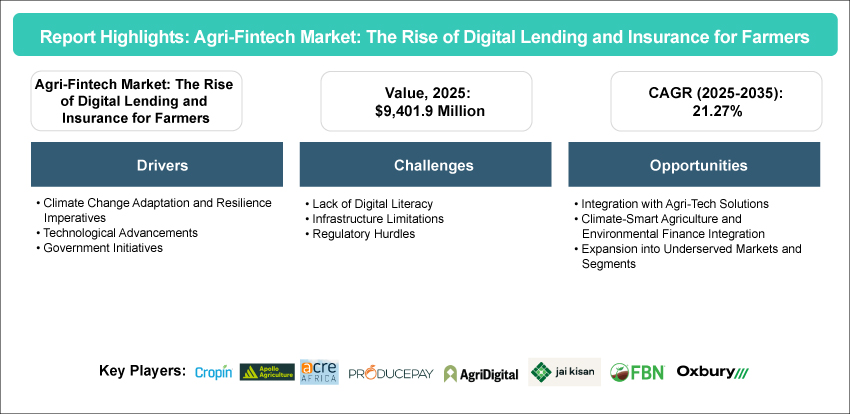
Introduction of Agri-Fintech Market: The Rise of Digital Lending and Insurance for Farmers
The agri-fintech market is witnessing rapid growth, driven primarily by the urgent need to address financial exclusion among farmers and improve access to credit, insurance, and digital payment solutions. The rising risks from climate change, unpredictable weather patterns, and market volatility have made traditional financing inadequate, positioning digital lending and insurance as essential tools for agricultural resilience. Innovations in AI, mobile platforms, and blockchain are enabling real-time credit scoring, yield-based loans, and weather-indexed insurance, making financial services more accessible and efficient. For example, platforms like Jai Kisan in India provide microloans, crop insurance, and integrated payment solutions, supporting both smallholders and large-scale farms. While adoption is expanding, challenges such as low digital literacy, fragmented regulatory frameworks, and infrastructure gaps persist; however, government support and technological innovation continue to fuel market growth.
Market Overview
The agri-fintech market revenue was $7,299.6 million in 2024, and it is expected to reach $64,696.8 million by 2035, advancing at a CAGR of 21.27% during the forecast period (2025-2035). Agri-FinTech has emerged as a critical enabler of financial inclusion and modernization in the global agricultural sector, addressing long-standing gaps in access to credit, insurance, payments, and risk management for farmers and agribusinesses. By integrating digital finance with agricultural data ecosystems, the sector leverages technologies such as mobile banking, AI-driven credit scoring, satellite imagery, and blockchain-based traceability to assess farmer risk profiles, streamline lending, and enable faster financial transactions. These innovations allow financial institutions and agri-platforms to deliver tailored financial services to smallholder farmers and rural enterprises that have traditionally been underserved by conventional banking systems.
Industrial Impact
The agri-fintech market is transforming the agricultural finance landscape by shifting farmers’ and agribusinesses’ decision-making from intuition-based to data-driven financial management. By combining farm-level data, transaction histories, credit scoring models, and real-time market insights, Agri-fintech platforms are enabling precise lending, crop insurance, and payment solutions, improving capital access and reducing financial risks across the value chain. This has led to enhanced investment planning, better cash flow management, and increased adoption of modern farming practices, ultimately driving productivity and operational efficiency.
A major industrial impact is on financial inclusion and risk mitigation. AI-enabled credit assessments, digital wallets, and blockchain-secured transactions allow smallholders and rural enterprises to access loans, insurance, and payment services previously unavailable. Large agribusinesses use integrated agri-fintech solutions to streamline supplier financing and optimize input procurement, while small-scale farmers benefit from mobile-first platforms that facilitate timely credit, insurance claims, and market payments. Collectively, these innovations are strengthening the resilience, scalability, and sustainability of the agricultural sector.
Market Segmentation:
Segmentation 1: By Application
• Small-Hold Farmers
• Agri-Businesses and Cooperatives
• Fisheries and Aquaculture Farmers
• Agri-Traders and Input Dealers
• Others
Small Hold Farmers Lead the Market (by Application)
Small-hold farmers constitute the largest and most influential segment in the global agri-fintech market due to their vast numbers and limited access to formal financial services. Their demand for micro-credit, insurance, and digital payments drives most market transactions, which agri-fintech platforms address through collateral-free, data-driven lending solutions. The seasonal nature of their credit needs ensures consistent, repeat usage of these platforms.
Increasingly, smallholders are organized into Farmer Producer Organizations (FPOs) and cooperatives, enabling fintechs to offer bundled financial services efficiently. Group onboarding reduces customer acquisition costs, improves risk management, and strengthens the adoption of digital finance solutions. For example, Jai Kisan, India’s leading rural fintech, has supported 800,000 farmers and 100,000 rural enterprises via its Bharat Khata platform. After raising USD 3 million (INR 26.5 crore) in an extended Series B round in April 2025, the company, despite a FY2024 loss of USD 5.5 million (INR 51 crore), is expanding its reach and product offerings. Partnering with over 350 corporates, Jai Kisan has facilitated roughly USD 655 million (INR 6,000 crore) in agricultural credit and, with its new NBFC license via Kushal Innovation Capital, can now co-lend with government banks directly.
Segmentation 2: By Product
• Digital Agri-Lending Platforms
• Agri-Insurance (Digital/Parametric Models) Platforms
• Digital Payment and Settlement Platforms
• Credit Scoring and Risk Analytic Platforms
• Farmer Financial Management and Advisory Platforms
• Others
Digital Agri-Lending Platforms Dominate the Market (by Product)
Digital agri-lending platforms dominate the agri-fintech market as they directly address the persistent financial exclusion faced by smallholder farmers, who form the largest customer base. These platforms offer instant, collateral-free, and data-driven loans by leveraging alternative data such as crop cycles, input usage, and transaction histories, enabling farmers to access timely credit for seeds, fertilizers, and equipment. The cyclical nature of agricultural financing, recurring every cropping season, ensures steady and repeat demand, while partnerships with Farmer Producer Organizations (FPOs) and cooperatives amplify reach, reduce customer acquisition costs, and mitigate credit risk through pooled volumes and standardized data. Moreover, the scalability and operational efficiency of digital platforms allow rapid penetration into rural and remote markets, providing real-time disbursal, repayment tracking, and integration with other fintech services like insurance and digital payments. Collectively, these factors make digital agri-lending the most dominant and transformative segment within the global agri-fintech ecosystem.
Segmentation 3: By Region
• North America
• Europe
• Asia-Pacific
• Rest-of-the-World
Asia Pacific Leads the Market (by Region)
Asia-Pacific dominates the global agri-fintech market, fueled by its vast farming population and rapid digital adoption. The region’s digital lending platforms address critical credit gaps for smallholders in countries like India, Indonesia, and Vietnam, offering micro loans, input financing, and harvest-linked credit primarily through mobile apps. Digital insurance is gaining traction via scalable public-private schemes, such as India’s crop insurance and Indonesia’s rice insurance programs. Mobile-first solutions, exemplified by India’s UPI and China’s Alipay, enable widespread rural access, while government policies and subsidies provide strong regulatory support. Combined with large-scale farming needs, this creates an ideal environment for agri-fintech growth. Platforms increasingly bundle credit, insurance, and payments on a single interface, empowering even smallholder farmers to transact digitally. Asia-Pacific is projected to remain the largest agri-fintech market globally through 2035.
Recent Developments in the Agri-Fintech Market
• In July 2025, Growers Edge, a financial technology firm offering modern financial products and data?driven tools for agricultural retailers, manufacturers, and lenders, announced the acquisition of FarmTest, an automated performance testing platform for commercial farms.
• In April 2025, Growers Edge, an agriculture-focused fintech firm, secured $25 million in a recent funding round to expand its innovative financial solutions designed for ag retailers, manufacturers, and lenders.
Analyst’s Thoughts
According to Dhrubajyoti, Principal Analyst at BIS Research, “Agri?fintech market is a transformative force reshaping agricultural finance by bridging longstanding gaps in credit, risk management, and payments for farmers, especially smallholders who have historically been underserved by traditional financial institutions. Digital lending platforms are increasingly leveraging AI, big data, satellite imagery, and alternative credit scoring models to enhance credit assessment, speed up loan approvals, and broaden access to customized financial products, effectively lowering barriers to finance in rural economies. This data?driven approach not only improves lender confidence and risk management but also accelerates financial inclusion by enabling farmers to secure seasonal financing without traditional collateral, supporting productivity and resilience in volatile agricultural cycles.”
Agri-Fintech Market The Rise of Digital Lending and Insurance for Farmers - A Global and Regional Analysis
Focus on Application, Product, and Regional Analysis - Analysis and Forecast, 2025-2035
Frequently Asked Questions
Agri-fintech solutions are digital financial services tailored for the agricultural sector, enabling farmers, cooperatives, and agribusinesses to access credit, insurance, payments, and investment opportunities efficiently. These solutions use advanced technologies like AI, machine learning, mobile platforms, and blockchain to improve financial access, manage risk, and optimize farm operations. Key types include digital lending platforms offering microloans and harvest-linked credit, agricultural insurance solutions such as crop and weather-indexed policies, and digital payment platforms facilitating cashless transactions. Other solutions include supply chain finance for financing value chain operations, investment and crowdfunding platforms for raising capital, and integrated agri-advisory platforms that combine financial services with AI-driven crop guidance and risk assessment. Together, these solutions reduce financial exclusion, enhance farm productivity, and increase resilience to market and climate challenges.
Existing agri-fintech players are adopting several strategies to strengthen their market position. They are increasingly integrating AI, IoT, and satellite data with financial services to offer end-to-end solutions for farmers, enhancing credit scoring, yield prediction, and risk management. Companies are expanding through strategic partnerships with cooperatives, FPOs, agritech platforms, and government schemes to broaden reach and lower acquisition costs. Bundled services combining credit, insurance, and payments on a single platform are being introduced to improve customer retention. Additionally, investments in mobile-first, NLP-enabled interfaces are addressing digital literacy barriers, while climate-smart financing, carbon credit platforms, and green financial products are positioning them as sustainability-focused leaders.
A new agri-fintech company should focus on digital lending and microfinance tailored to seasonal credit cycles, using alternative data for fast, accurate scoring. Integrating financial services with agri-tech tools like IoT, drones, and supply chain platforms can provide end-to-end solutions. Climate-smart financing, insurance, and carbon credit programs offer risk mitigation and additional revenue for farmers. AI-driven predictive analytics and mobile-first, user-friendly interfaces enhance decision-making and accessibility. Partnerships with cooperatives, FPOs, and government schemes, along with bundled services, can drive adoption and scale.
The agri-fintech market was valued at $7,299.6 million in 2024 and is expected to grow at a CAGR of 21.27%, reaching $64,696.8 million by 2035.
Major trends in the agri-fintech market include the embedded finance revolution and super-app emergence, platform marketplace models and ecosystem integration, parametric insurance and climate risk management evolution. Drivers include the climate change adaptation and resilience imperatives, technology advancement, and government initiatives.
Despite its promise, the agri-fintech market faces several challenges. These include a lack of digital literacy, infrastructure limitations, and regulatory hurdles.
The market for agri-fintech presents strong growth opportunities in the integration of agri-fintech with agri-tech tools like AI, drones, and IoT, enabling holistic solutions for financing, crop management, and market access, improving efficiency and risk assessment. Additionally, linking financial services with climate-smart agriculture and carbon credit markets creates new revenue streams and supports sustainable, resilient farming practices.
The report’s unique selling propositions (USPs) lie in its comprehensive segmentation of the agri-fintech market by application and product. It offers a thorough analysis of key trends, market drivers, and challenges across major countries, including the U.S., China, India, Germany, France, and the U.K., along with country-level forecasts and policy insights. The study also features detailed profiles of leading agri-fintech companies and emerging startups, supported by expert analysis highlighting innovation hubs and untapped revenue opportunities. Additionally, it provides strategic guidance to help organizations enhance their competitive positioning and navigate the evolving market landscape.
The agri-fintech report is essential for investors, banks, NBFCs, and fintech startups seeking insights into digital lending, insurance, and payments for smallholder farmers. It is also valuable for government agencies and policymakers planning financial inclusion initiatives, as well as consulting and research firms advising on market trends and strategic partnerships. The report helps stakeholders identify growth opportunities, assess competitive positioning, understand customer demand, and optimize product and market strategies in the rapidly evolving agri-fintech sector.